


The German Institute Taipei and the Israel Economic and Cultural Office in Taipei yesterday jointly condemned the use of German National Socialist Party (Nazi) symbols by an association demanding the redemption of old German mark bonds during a recent demonstration in Taipei.
“Using Nazi symbols and wielding the Nazi flag in public is a despicable act of offense against the victims of the Holocaust and the Holocaust survivors,” the offices said in a joint statement issued yesterday.
They said mocking the memory of the victims of Nazi rule in any way is utterly unacceptable and a gross abuse of the freedom of expression.
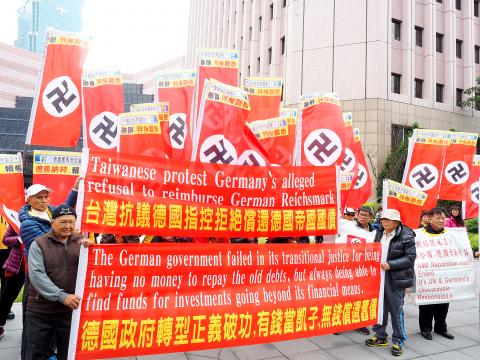
Photo: David Chang, EPA-EFE
The offices were referring to a demonstration in front of Taipei 101 on Thursday by about 50 members of the German Old Mark Association.
The protesters held up banners with swastikas, which in English read: “The German government failed in its transitional justice for being having no money to repay the old debts, but always being able to find funds for investments going beyond its financial means. [sic]”
They also blasted the German government for declaring in 2010 that it had paid off its World War I reparations, while leaving out Taiwan.
Association members have said that after World War I, Germany compensated Japan by paying 2,200 trillion old mark bonds, which the Japanese colonial authorities, who ruled Taiwan between 1895 and 1945, allegedly forcibly sold to Taiwanese people.
The association has demanded that Germany reimburse mark bonds sold in Taiwan by Japan in the 1920s.
In August last year, it staged a protest in Taipei, which was hosting the Summer Universiade.
It is not the first time that the use of Nazi symbols has stirred up controversy in Taiwan.
In December 2016, students at Kuang Fu High School in Hsinchu paraded in Nazi-style uniforms and displayed Nazi symbols during a campus event.
It was followed by another incident in October last year, when an auto parts retailer was found to have put Nazi flag stickers on its shelves.
Additional reporting by Yao Yueh-hung

Considering that most countries issue more than five denominations of banknotes, the central bank has decided to redesign all five denominations, the bank said as it prepares for the first major overhaul of the banknotes in more than 24 years. Central bank Governor Yang Chin-lung (楊金龍) is expected to report to the Legislative Yuan today on the bank’s operations and the redesign’s progress. The bank in a report sent to the legislature ahead of today’s meeting said it had commissioned a survey on the public’s preferences. Survey results showed that NT$100 and NT$1,000 banknotes are the most commonly used, while NT$200 and NT$2,000

The Centers for Disease Control (CDC) yesterday reported the first case of a new COVID-19 subvariant — BA.3.2 — in a 10-year-old Singaporean girl who had a fever upon arrival in Taiwan and tested positive for the disease. The girl left Taiwan on March 20 and the case did not have a direct impact on the local community, it said. The WHO added the BA.3.2 strain to its list of Variants Under Monitoring in December last year, but this was the first imported case of the COVID-19 variant in Taiwan, CDC Deputy Director-General Lin Ming-cheng (林明誠) said. The girl arrived in Taiwan on

South Korea is planning to revise its controversial electronic arrival card, a step Taiwanese officials said prompted them to hold off on planned retaliatory measures, a South Korean media report said yesterday. A Yonhap News Agency report said that the South Korean Ministry of Foreign Affairs is planning to remove the “previous departure place” and “next destination” fields from its e-arrival card system. The plan, reached after interagency consultations, is under review and aims to simplify entry procedures and align the electronic form with the paper version, a South Korean ministry official said. The fields — which appeared only on the electronic form

The Ministry of Foreign Affairs (MOFA) is suspending retaliation measures against South Korea that were set to take effect tomorrow, after Seoul said it is updating its e-arrival system, MOFA said today. The measures were to be a new round of retaliation after Taiwan on March 1 changed South Korea's designation on government-issued alien resident certificates held by South Korean nationals to "South Korea” from the "Republic of Korea," the country’s official name. The move came after months of protests to Seoul over its listing of Taiwan as "China (Taiwan)" in dropdown menus on its new online immigration entry system. MOFA last week


 RSS
RSS