


The Taipei District Court yesterday acquitted a police officer in the shooting death of a suspect who led police on a car chase because the judges believed the officer in question had conformed to “reasonable use” when firing his handgun in an urgent situation in which pedestrians were in danger.
The case concerned police officer Chang Ching-yi (張景義), 46, a member of the public security brigade at Wanhua Precinct, who fatally shot Lee Yu-wei (黎育維), 30, five years ago.
“I felt the heavy burden in my heart had been lifted... This ruling gave justice to members of the law enforcement community,” Chang, a 25-year police veteran, said yesterday after the ruling.
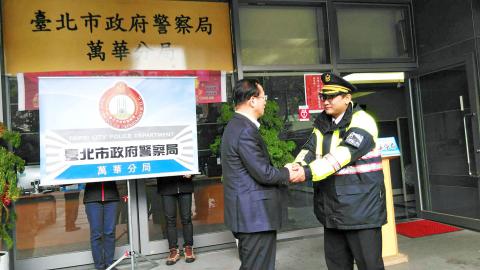
Photo: CNA, courtesy of the Taipei Police Department
Lee was attempting to flee the police when he drove his car through the streets of Taipei’s Ximending (西門町) area, including on the sidewalk, on Aug. 13, 2013.
The judge said Chang shooting Lee conformed with the Act Governing the Use of Police Weapons (警械使用條例).
Chang had acted out of urgency and had tried to disable the suspect without killing him, a court statement said.
Chang had fired only two shots, with the first aimed at Lee’s front tire to stop the car.
Chang said the second had deviated accidentally and the bullet penetrated the front windshield and hit Lee in the abdomen.
Lee was rushed to hospital where he died from hematogenic shock due to severe bleeding.
Lee’s family sued Chang for what they claimed was negligent manslaughter.
The incident began when Lee, under suspicion of stealing gasoline, refused a police request to stop for questioning and fled in his car from New Taipei City’s Jhonghe District (中和).
While attempting to get away, he allegedly tried to mow down a police officer, but did not succeed.
According to eyewitness accounts, Lee drove the car onto the sidewalk and stopped when it hit a concrete barrier.
Chang stood about 2m in front of the car to block it from advancing, and ordered Lee to stop and get out of the car.
Lee then put the car into reverse and drove away from Chang, eyewitnesses said.
The case sparked a huge debate, with Lee’s family and some human rights activists accusing Chang of using excessive force by killing an unarmed man, while others defended the police officer’s actions, saying Chang had acted in self-defense and to protect the lives of the many pedestrians in the area.
“If I had to face the same situation, I would still choose to fire my handgun to stop him. I had to prevent the pedestrians from getting hurt, because it is my job as a police officer,” Chang told reporters yesterday.
“We respect and thank the court for this decision,” National Police Agency Director-General Chen Chia-chin (陳家欽) said.
Lee’s family filed three lawsuits against Chang.
In the first two cases, prosecutors dropped the charges and did not prosecute Chang, but in the third instance prosecutors charged Chang with negligent manslaughter.
According to media reports, Chang had been prepared to pay NT$800,000 (US$27,086) in compensation to Lee’s family for reaching a settlement, but the family refused, as they were seeking NT$20 million in compensation.
The family was persuaded to lower the figure to NT$2 million, but it was still more money than Chang said he could afford to pay.

Considering that most countries issue more than five denominations of banknotes, the central bank has decided to redesign all five denominations, the bank said as it prepares for the first major overhaul of the banknotes in more than 24 years. Central bank Governor Yang Chin-lung (楊金龍) is expected to report to the Legislative Yuan today on the bank’s operations and the redesign’s progress. The bank in a report sent to the legislature ahead of today’s meeting said it had commissioned a survey on the public’s preferences. Survey results showed that NT$100 and NT$1,000 banknotes are the most commonly used, while NT$200 and NT$2,000

The Centers for Disease Control (CDC) yesterday reported the first case of a new COVID-19 subvariant — BA.3.2 — in a 10-year-old Singaporean girl who had a fever upon arrival in Taiwan and tested positive for the disease. The girl left Taiwan on March 20 and the case did not have a direct impact on the local community, it said. The WHO added the BA.3.2 strain to its list of Variants Under Monitoring in December last year, but this was the first imported case of the COVID-19 variant in Taiwan, CDC Deputy Director-General Lin Ming-cheng (林明誠) said. The girl arrived in Taiwan on

South Korea is planning to revise its controversial electronic arrival card, a step Taiwanese officials said prompted them to hold off on planned retaliatory measures, a South Korean media report said yesterday. A Yonhap News Agency report said that the South Korean Ministry of Foreign Affairs is planning to remove the “previous departure place” and “next destination” fields from its e-arrival card system. The plan, reached after interagency consultations, is under review and aims to simplify entry procedures and align the electronic form with the paper version, a South Korean ministry official said. The fields — which appeared only on the electronic form

The Ministry of Foreign Affairs (MOFA) is suspending retaliation measures against South Korea that were set to take effect tomorrow, after Seoul said it is updating its e-arrival system, MOFA said today. The measures were to be a new round of retaliation after Taiwan on March 1 changed South Korea's designation on government-issued alien resident certificates held by South Korean nationals to "South Korea” from the "Republic of Korea," the country’s official name. The move came after months of protests to Seoul over its listing of Taiwan as "China (Taiwan)" in dropdown menus on its new online immigration entry system. MOFA last week


 RSS
RSS