


From classical to pop, Taitung County’s musicians, many of whom are of Aboriginal descent, are transforming the county’s image from idyllic backcountry to the buzzing epicenter of Taiwanese music.
The county’s increasing stature in the musical scene can be gleaned from the winter plum blossom music festival, held in Beinan Township’s (卑南) Likavung Village (利嘉), which has grown to become one of the nation’s top three outdoor concerts.
Chang Chung-yuan (張中元) — principal of Lijia Elementary School, which hosts the event — said that he conceived the festival after a spark of inspiration 19 years ago as an event for fellow classical music lovers.
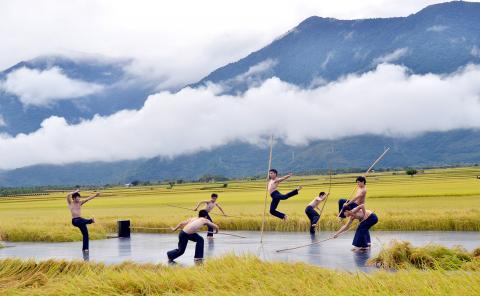
Photo: CNA
“I had an epiphany that the falling white petals formed a beautiful backdrop that was perfect for a music festival,” he said.
In 1999, Chang organized the first edition of the festival for local music aficionados that featured recitals by famed classical pianist Eric Chen (陳冠宇), a great event for the remote Aboriginal community.
The festival caught on and many nationally or internationally renowned classical musicians were featured in the following years, including husband-and-wife cellist and pianist duo Chang Cheng-chieh (張正傑) and Hsieh Wan-ling (謝婉玲); US pianist Ruth Slenczynska; French pianist Jean-Efflam Bavouzet; and the Taiwanese-American Formosa Quartet.
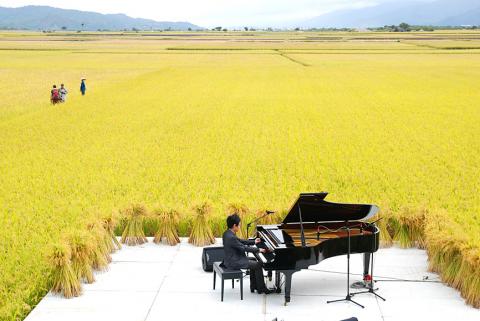
Photo: CNA
Full orchestras have also performed at the event, including the National Symphony Orchestra, the Georg Solti Award-winning Philharmonia Moments Musicaux (樂興之時) and the Taiwan Connection Chamber Orchestra (TC室內樂團).
In 2009, Chang Chung-yuan again teamed up with Chen to stage an outdoor piano recital in a golden field of ripened rice, an event that grew into Chihshang Township’s (池上) annual autumn arts and culture festival.
Since then, the Chihshang festival has seen performances by the Yue Shu-han Brass Quintet (葉樹涵銅管五重奏團), the Cloud Gate Dance Theatre (雲門舞集), the U Theater (優人神鼓) and Philharmonia Moments Musicaux, as well as Aboriginal pop divas A-mei (張惠妹) and A-Lin (黃麗玲), and Taiwan’s “emperor of rock” Wu Bai (伍佰).
The festivals are part of the larger story of Taitung’s increasing prominence in the nation’s musical and performing arts scene. From classical music and modern dance to pop and rock ’n’ roll, Taitung’s performers — sometimes with a strong emphasis on Aboriginal culture — have put the county on the nation’s cultural map.
For example, choreographer Bulareyaung “Bula” Pagarlava in 2015 returned from the US to his hometown, Taitung’s Jialan Village (嘉蘭), to found the Bulareyaung Dance Company (布拉瑞揚舞團), which showcases Taitung-inspired compositions and local dancers.
The same year saw the founding of the Taitung Echo Orchestra, whose concertmaster, Taitung native Tsai Yu-lin (蔡侑霖), has been studying the violin under master violinist Erik Schumann at the Frankfurt University of Music and Performing Arts.
Those groups are but the latest additions to older Taitung-based dance companies and musical groups, such as the traditional Amis Kakeng group (旮亙樂團), Pestle Tone Cultural Troupe (杵音文化藝術團) and Composed Artistes in Taiwan Aborigines (高山舞集), all of which draw inspiration from traditional Aboriginal music and dances.
In September, Taitung City’s publicly funded performance venue, Tiehua Village (鐵花村), began a “full-spectrum musical education program.”
The program aims to educate aspiring musicians on the entirety of the creative process, from writing music and lyrics to sound mixing, advertising, marketing and organizing tours, Tiehua Village executive director Wong Chih-po (汪智博) said.
After completing the program, anyone with the courage and desire to make music would have their chance in the spotlight at Tiehua Village, he said.
“There are many aspiring musicians in eastern Taiwan with the talent and energy to become exceptional. This course is designed for them,” Wong said.
Program head Hao En (昊恩) said many renowned Taiwanese musicians have given classes in the program, including several that hail from Taitung, such as Paiwan Fingerstyle guitarist Baobu Badulu (保卜); Wang Chi-san (王繼三), a recording artist for Rene Liu (劉若英) and David Wong (黃大煒); jazz saxophonist Cheng Hao-wen (鄭皓文), who performed on Waa Wei’s (魏如萱) album Le Herisson (優雅的刺蝟); and Chung Hsing-min (鍾興民), a veteran keyboardist and producer.
Riverside Music general manager Huang Chung-yueh (黃中岳), Wind Music executive director Judy Wu (吳金黛), Wind Music project director Yu Su-ying (于蘇英) and Golden Melody Award-winning composer and producer Lee Cin-cin (李欣芸) also teach in the program, Wong said.

Considering that most countries issue more than five denominations of banknotes, the central bank has decided to redesign all five denominations, the bank said as it prepares for the first major overhaul of the banknotes in more than 24 years. Central bank Governor Yang Chin-lung (楊金龍) is expected to report to the Legislative Yuan today on the bank’s operations and the redesign’s progress. The bank in a report sent to the legislature ahead of today’s meeting said it had commissioned a survey on the public’s preferences. Survey results showed that NT$100 and NT$1,000 banknotes are the most commonly used, while NT$200 and NT$2,000

The Centers for Disease Control (CDC) yesterday reported the first case of a new COVID-19 subvariant — BA.3.2 — in a 10-year-old Singaporean girl who had a fever upon arrival in Taiwan and tested positive for the disease. The girl left Taiwan on March 20 and the case did not have a direct impact on the local community, it said. The WHO added the BA.3.2 strain to its list of Variants Under Monitoring in December last year, but this was the first imported case of the COVID-19 variant in Taiwan, CDC Deputy Director-General Lin Ming-cheng (林明誠) said. The girl arrived in Taiwan on

South Korea is planning to revise its controversial electronic arrival card, a step Taiwanese officials said prompted them to hold off on planned retaliatory measures, a South Korean media report said yesterday. A Yonhap News Agency report said that the South Korean Ministry of Foreign Affairs is planning to remove the “previous departure place” and “next destination” fields from its e-arrival card system. The plan, reached after interagency consultations, is under review and aims to simplify entry procedures and align the electronic form with the paper version, a South Korean ministry official said. The fields — which appeared only on the electronic form

The Ministry of Foreign Affairs (MOFA) is suspending retaliation measures against South Korea that were set to take effect tomorrow, after Seoul said it is updating its e-arrival system, MOFA said today. The measures were to be a new round of retaliation after Taiwan on March 1 changed South Korea's designation on government-issued alien resident certificates held by South Korean nationals to "South Korea” from the "Republic of Korea," the country’s official name. The move came after months of protests to Seoul over its listing of Taiwan as "China (Taiwan)" in dropdown menus on its new online immigration entry system. MOFA last week


 RSS
RSS