


Democratic Progressive Party (DPP) lawmakers yesterday identified major procedural abnormalities in a scandal-ridden navy shipbuilding program that resulted in Ching Fu Shipbuilding Co (慶富造船) securing the contract, with three top military officials, including former minister of national defense Kao Kuang-chi (高廣圻), urged to expound on their involvement in the case.
DPP Legislator Wang Ding-yu (王定宇) pointed to flaws in the tender process and subsequent program management by the Ministry of National Defense, which “revived” Ching Fu from potential disqualification.
Ching Fu, which in 2014 was awarded the NT$35.8 billion (US$1.19 billion at the current exchange rate) contract to build six minesweepers as part of a domestic warship program, secured the contract after the ministry lowered the minimum asset requirement for bidders from one-10th to one-200th of the contract’s value.
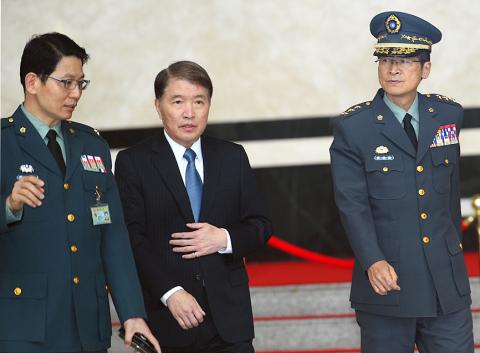
Photo: Chang Chia-ming, Taipei Times
That year, a ministry tender review committee — without its convener and deputy convener present — drew lots to pick a contractor for the minesweeper program, with Ching Fu securing the contract over CSBC Corp, Taiwan.
In 2015, Ching Fu failed to acquire export permits from its subcontractors, Italian shipbuilder Intermarine and US defense firm Lockheed Martin, but the ministry did not dissolve its contract, despite the failure.
State-run banks approved a syndicated loan of NT$20.5 billion to Ching Fu, even though the company was determined to be financially unstable, Wang said.
DPP Legislator Chuang Ruei-hsiung (莊瑞雄) questioned how Ching Fu, which has registered capital of about NT$500 million, was able to secure a tender worth NT$35.8 billion.
Kao, former navy commander-in-chief Tung Hsiang-lung (董翔龍) and former navy deputy commander-in-chief Pu Tze-chun (蒲澤春) should explain decisions that appear to be tailor-made for Ching Fu, Wang said, adding that they might have been pressured into the arrangement.
The ministry might begin the contract dissolution process with Ching Fu by the end of this month, when Intermarine and Lockheed Martin are expected to dissolve their contracts with the firm, Wang said, adding that Ching Fu is on the brink of bankruptcy and its employees have not been paid in months.
“The dissolution of Ching Fu’s contracts with its subcontractors and its bankruptcy constitute a condition for the military to terminate the contract,” Wang said.
Following dissolution of the contract, the ministry would keep Ching Fu’s NT$9 billion performance bond and demand compensation for losses, he added.

Considering that most countries issue more than five denominations of banknotes, the central bank has decided to redesign all five denominations, the bank said as it prepares for the first major overhaul of the banknotes in more than 24 years. Central bank Governor Yang Chin-lung (楊金龍) is expected to report to the Legislative Yuan today on the bank’s operations and the redesign’s progress. The bank in a report sent to the legislature ahead of today’s meeting said it had commissioned a survey on the public’s preferences. Survey results showed that NT$100 and NT$1,000 banknotes are the most commonly used, while NT$200 and NT$2,000

The Centers for Disease Control (CDC) yesterday reported the first case of a new COVID-19 subvariant — BA.3.2 — in a 10-year-old Singaporean girl who had a fever upon arrival in Taiwan and tested positive for the disease. The girl left Taiwan on March 20 and the case did not have a direct impact on the local community, it said. The WHO added the BA.3.2 strain to its list of Variants Under Monitoring in December last year, but this was the first imported case of the COVID-19 variant in Taiwan, CDC Deputy Director-General Lin Ming-cheng (林明誠) said. The girl arrived in Taiwan on

South Korea is planning to revise its controversial electronic arrival card, a step Taiwanese officials said prompted them to hold off on planned retaliatory measures, a South Korean media report said yesterday. A Yonhap News Agency report said that the South Korean Ministry of Foreign Affairs is planning to remove the “previous departure place” and “next destination” fields from its e-arrival card system. The plan, reached after interagency consultations, is under review and aims to simplify entry procedures and align the electronic form with the paper version, a South Korean ministry official said. The fields — which appeared only on the electronic form

The Ministry of Foreign Affairs (MOFA) is suspending retaliation measures against South Korea that were set to take effect tomorrow, after Seoul said it is updating its e-arrival system, MOFA said today. The measures were to be a new round of retaliation after Taiwan on March 1 changed South Korea's designation on government-issued alien resident certificates held by South Korean nationals to "South Korea” from the "Republic of Korea," the country’s official name. The move came after months of protests to Seoul over its listing of Taiwan as "China (Taiwan)" in dropdown menus on its new online immigration entry system. MOFA last week


 RSS
RSS