


After rejecting Chinese investment from Alibaba Group Holding Ltd founder Jack Ma (馬雲) and China’s largest search engine, Baidu Inc, Jose Lin (林思吾), founder of Taiwanese software company Awoo International, earlier this month collected about US$1 million from Silicon Valley entrepreneurs as part of his bid to make the nation’s software businesses known internationally, he said during an interview earlier this month with the Chinese-language Liberty Times (sister newspaper of the Taipei Times).
Awoo, which was founded in 2002, develops search engine optimization software to help companies boost their online visibility.
Lin, 36, said that since the Sunflower movement, he has been thinking about how to maintain distance from Chinese influence.
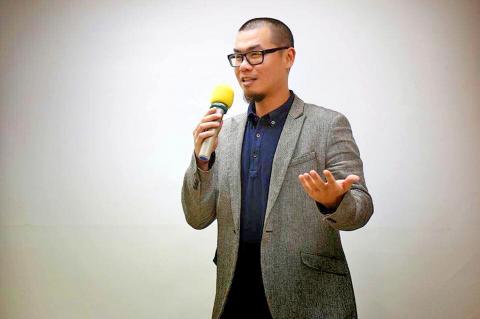
Photo courtesy of Jose Lin
The Sunflower movement refers to student-led protests that began on March 18, 2014, in which students occupied the legislative chamber for nearly 23 days to protest a trade in services agreement with China and how it was handled by the then-Chinese Nationalist Party (KMT) government.
After the movement, Lin said that a question has been coming back to him: “What should young Taiwanese and entrepreneurs do if the nation is to be without China?”
If Taiwan is to be an independent democratic nation, it has to deal with three key issues: industrial structure, land planning and the China factor, he said.
In terms of industrial structure, the software sector is essential for the nation’s development, he said, adding that he decided to start a software business, because of the high gross margin of such products.
While most software companies are based in the US and China, Lin said he hopes that his company can reduce its reliance on China by becoming more globalized.
China is by no means the best partner Taiwan can have in its progress toward independence and normalization, whereas Japan is an important market, he said.
In 2013, Baidu sought collaboration with Lin, but he refused the invitation, because he thought their collaboration would deal a heavy blow to Taiwanese businesses, Lin said.
Baidu’s entries would overwhelm search engines in Taiwan, while small and medium-sized local businesses would be less likely to be seen by general users, he said.
Lin also said “No” to Ma in 2014, when he wanted to invest NT$100 million (US$3.31 million) in his company for a 15 to 20 percent share.
Lin said that Awoo has collected a rookie fund of about US$1 million from PChome chairman Jan Hung-tze (詹宏志), Netscape Communication Corp cofounder James Sha (沙正治), Ellie Mae cofounder Limin Hu (胡立民) and Integrated Device Technology founder Chiu Chun-pang (邱俊邦), with their aggregate share reaching about 10 percent.
As for next steps, Lin said he hopes Awoo can enter the Japanese market and have an initial public offering there.
Japan has a large market base and its capital markets give software businesses friendly evaluations, Lin said, adding that he hopes Taiwanese software companies can become popular and more internalized in Japan.

Considering that most countries issue more than five denominations of banknotes, the central bank has decided to redesign all five denominations, the bank said as it prepares for the first major overhaul of the banknotes in more than 24 years. Central bank Governor Yang Chin-lung (楊金龍) is expected to report to the Legislative Yuan today on the bank’s operations and the redesign’s progress. The bank in a report sent to the legislature ahead of today’s meeting said it had commissioned a survey on the public’s preferences. Survey results showed that NT$100 and NT$1,000 banknotes are the most commonly used, while NT$200 and NT$2,000

The Centers for Disease Control (CDC) yesterday reported the first case of a new COVID-19 subvariant — BA.3.2 — in a 10-year-old Singaporean girl who had a fever upon arrival in Taiwan and tested positive for the disease. The girl left Taiwan on March 20 and the case did not have a direct impact on the local community, it said. The WHO added the BA.3.2 strain to its list of Variants Under Monitoring in December last year, but this was the first imported case of the COVID-19 variant in Taiwan, CDC Deputy Director-General Lin Ming-cheng (林明誠) said. The girl arrived in Taiwan on

South Korea is planning to revise its controversial electronic arrival card, a step Taiwanese officials said prompted them to hold off on planned retaliatory measures, a South Korean media report said yesterday. A Yonhap News Agency report said that the South Korean Ministry of Foreign Affairs is planning to remove the “previous departure place” and “next destination” fields from its e-arrival card system. The plan, reached after interagency consultations, is under review and aims to simplify entry procedures and align the electronic form with the paper version, a South Korean ministry official said. The fields — which appeared only on the electronic form

The Ministry of Foreign Affairs (MOFA) is suspending retaliation measures against South Korea that were set to take effect tomorrow, after Seoul said it is updating its e-arrival system, MOFA said today. The measures were to be a new round of retaliation after Taiwan on March 1 changed South Korea's designation on government-issued alien resident certificates held by South Korean nationals to "South Korea” from the "Republic of Korea," the country’s official name. The move came after months of protests to Seoul over its listing of Taiwan as "China (Taiwan)" in dropdown menus on its new online immigration entry system. MOFA last week


 RSS
RSS