


New Power Party (NPP) Legislator Hsu Yung-ming (徐永明) yesterday panned the nation’s campus military instructors for wearing badges bearing the symbol of the China Youth Corps (CYC) and the Chinese National Party (KMT).
Soldiers were first installed as military instructors in high schools, colleges and universities for the indoctrination, combat training and policing of the students during the Martial Law era. They are currently tasked with providing security and military training at schools nationwide.
The government-issued badges are overtly partisan and inappropriate to wear on campuses, Hsu said.
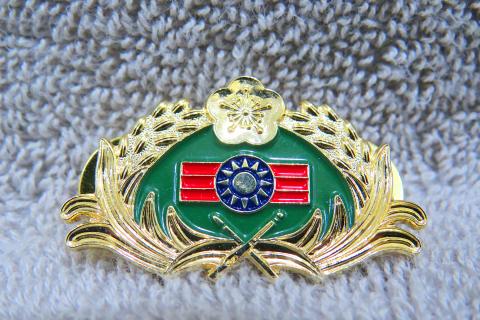
Photo: Chen Yu-fu, Taipei Times
“The CYC badge’s device of white sun on blue sky are symbols of the KMT,” the lawmaker said, citing reports on the corps’ founding on Oct. 4, 1952, by Chinese-language newspapers such as the Popular Daily, the National and the Economic Times.
“The KMT’s six-decade struggle for national revolution means that the Republic of China [ROC] cannot exist without the KMT. The China Youth Corps’ emblem places the KMT emblem at its center as a way of educating Chinese youths of the ROC’s origins and learn how to serve the state,” Hsu quoted the corps as saying at the time.
The corps should stop trying to distance itself from the KMT because the evidence of it being an affiliate organization is incontrovertible, he said.
The military instructor badge is the corps’ white sun on blue sky emblem framed by the a Chinese plum blossom, an ear of wheat and a crossed rifle and an ink brush.
“As the use of the KMT’s badge by military instructors show, the specter of the one-party state continues to haunt our schools and it continues to usurp the government’s authority to brainwash our youths,” he said.
The Ministry of Education should ban such inappropriate political badges as the Legislative Yuan’s mandate to abolish military instruction on campuses is to take effect in 2021, Hsu said.
A year after the CYC’s founding, the Executive Yuan promulgated regulations for the implementation of military training in post-secondary education in Taiwan Province, putting the corps in charge of campus military instruction, an Ill-gotten Party Assets Settlement Committee member said.
According to that regulation, schools must provide three hours of military instruction per week to promote identification with the KMT and anti-communism, resulting in military instructors’ adoption of the CYC symbol, the committee member said.
“In those days, there were three flag poles on campuses, with the middle pole flying the national flag, the CYC flag flying to the left and the school flag flying to the right,” the committee member said.
According to the ministry, an estimated 3,500 soldiers serve as military instructors on campuses.
They are required to wear the badge when wearing their Class A dress uniforms on duty.

Considering that most countries issue more than five denominations of banknotes, the central bank has decided to redesign all five denominations, the bank said as it prepares for the first major overhaul of the banknotes in more than 24 years. Central bank Governor Yang Chin-lung (楊金龍) is expected to report to the Legislative Yuan today on the bank’s operations and the redesign’s progress. The bank in a report sent to the legislature ahead of today’s meeting said it had commissioned a survey on the public’s preferences. Survey results showed that NT$100 and NT$1,000 banknotes are the most commonly used, while NT$200 and NT$2,000

The Centers for Disease Control (CDC) yesterday reported the first case of a new COVID-19 subvariant — BA.3.2 — in a 10-year-old Singaporean girl who had a fever upon arrival in Taiwan and tested positive for the disease. The girl left Taiwan on March 20 and the case did not have a direct impact on the local community, it said. The WHO added the BA.3.2 strain to its list of Variants Under Monitoring in December last year, but this was the first imported case of the COVID-19 variant in Taiwan, CDC Deputy Director-General Lin Ming-cheng (林明誠) said. The girl arrived in Taiwan on

South Korea is planning to revise its controversial electronic arrival card, a step Taiwanese officials said prompted them to hold off on planned retaliatory measures, a South Korean media report said yesterday. A Yonhap News Agency report said that the South Korean Ministry of Foreign Affairs is planning to remove the “previous departure place” and “next destination” fields from its e-arrival card system. The plan, reached after interagency consultations, is under review and aims to simplify entry procedures and align the electronic form with the paper version, a South Korean ministry official said. The fields — which appeared only on the electronic form

The Ministry of Foreign Affairs (MOFA) is suspending retaliation measures against South Korea that were set to take effect tomorrow, after Seoul said it is updating its e-arrival system, MOFA said today. The measures were to be a new round of retaliation after Taiwan on March 1 changed South Korea's designation on government-issued alien resident certificates held by South Korean nationals to "South Korea” from the "Republic of Korea," the country’s official name. The move came after months of protests to Seoul over its listing of Taiwan as "China (Taiwan)" in dropdown menus on its new online immigration entry system. MOFA last week


 RSS
RSS