


An auto-parts retailer’s sale of Nazi flag stickers has drawn condemnation from the Israeli Economic and Cultural Office in Taipei and the Ministry of Foreign Affairs after a Facebook post lambasting the store went viral on Friday.
They have since been pulled from the shelves at the retailer’s branch in Hsinchu County’s Jhubei Township (竹北).
A netizen posted a photograph taken inside the store, showing Nazi flag stickers under the label “German national flags,” on a Facebook group created for “explosive revelations.”
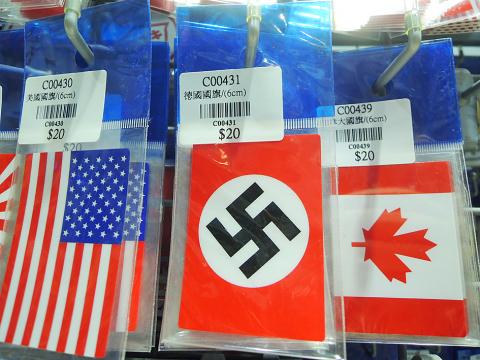
Photo: Liao Hsueh-ju, Taipei Times
The Nazi flag stickers were hung between those of the US and Canadian flags, with stickers of the Japanese Empire’s war flag to the left of the US flag stickers, with each pack priced at NT$20.
“This is utterly ignorant of the values of the international community. Items like these should not be sold,” the person who posted the photograph wrote.
Israeli Representative Asher Yarden on Saturday issued a statement condemning the store.
“These flags represent the Nazi regime during the Jewish Holocaust — the darkest period in modern times — and have historically been used by evil forces to spread hate and terror, intimidate and incite,” Yarden said.
The re-emergence of such hateful flags is unacceptable anywhere, Yarden said, “but this incident is even more disturbing since it is the second time in less than a year that the Nazi flag is being presented in an abusive way in Hsinchu County.”
In December last year, students at Hsinchu Kuang Fu High School paraded in Nazi-style uniforms and displayed Nazi symbols during a campus event.
The principal of the private school Cheng Hsiao-ming (程曉銘) resigned days after the incident.
Israel calls on the appropriate authorities in Taiwan to “take immediate action” to remove the stickers from sale and initiate a program of public education that would raise Holocaust awareness in Taiwan, Yarden said.
Such a program would bring about better understanding and prevent the reoccurrence of such deplorable happenings, he added.
Ministry spokesman Andrew Lee (李憲章) said the ministry urges the public to confront the atrocities committed by Adolf Hitler and the Nazis during World War II, including wars of aggression and the massacre of 6 million Jews.
“We should not mislead any of Taiwan’s international partners into thinking that Nazism is supported or condoned by the nation in any way,” Lee said.
The ministry acknowledges the strong condemnation from the Israeli representative office and has conveyed the government’s “grave concern” over the issue, he said.
Ho Tung-tsan (何東燦), who owns the auto-parts retailer, on Saturday told the Central News Agency that his company sells more than 10,000 kinds of merchandise and that any one outlet might have more than 1,000.
Stickers are very popular, both to cover up scratches or just for decoration, he said, adding that sometimes, if the stores are very busy, staff might allow sticker company representatives to restock the racks themselves.
The outlet staff should have monitored the situation, he said.

Considering that most countries issue more than five denominations of banknotes, the central bank has decided to redesign all five denominations, the bank said as it prepares for the first major overhaul of the banknotes in more than 24 years. Central bank Governor Yang Chin-lung (楊金龍) is expected to report to the Legislative Yuan today on the bank’s operations and the redesign’s progress. The bank in a report sent to the legislature ahead of today’s meeting said it had commissioned a survey on the public’s preferences. Survey results showed that NT$100 and NT$1,000 banknotes are the most commonly used, while NT$200 and NT$2,000

The Centers for Disease Control (CDC) yesterday reported the first case of a new COVID-19 subvariant — BA.3.2 — in a 10-year-old Singaporean girl who had a fever upon arrival in Taiwan and tested positive for the disease. The girl left Taiwan on March 20 and the case did not have a direct impact on the local community, it said. The WHO added the BA.3.2 strain to its list of Variants Under Monitoring in December last year, but this was the first imported case of the COVID-19 variant in Taiwan, CDC Deputy Director-General Lin Ming-cheng (林明誠) said. The girl arrived in Taiwan on

South Korea is planning to revise its controversial electronic arrival card, a step Taiwanese officials said prompted them to hold off on planned retaliatory measures, a South Korean media report said yesterday. A Yonhap News Agency report said that the South Korean Ministry of Foreign Affairs is planning to remove the “previous departure place” and “next destination” fields from its e-arrival card system. The plan, reached after interagency consultations, is under review and aims to simplify entry procedures and align the electronic form with the paper version, a South Korean ministry official said. The fields — which appeared only on the electronic form

The Ministry of Foreign Affairs (MOFA) is suspending retaliation measures against South Korea that were set to take effect tomorrow, after Seoul said it is updating its e-arrival system, MOFA said today. The measures were to be a new round of retaliation after Taiwan on March 1 changed South Korea's designation on government-issued alien resident certificates held by South Korean nationals to "South Korea” from the "Republic of Korea," the country’s official name. The move came after months of protests to Seoul over its listing of Taiwan as "China (Taiwan)" in dropdown menus on its new online immigration entry system. MOFA last week


 RSS
RSS