


Prosecutors yesterday indicted Aloha Bus Co driver Wu Hsieh-sung on a charge of negligent manslaughter following a deadly bus accident on Sept. 11.
Six people were killed and 11 injured when Wu crashed into the median on the Sun Yat-sen Freeway (Freeway No. 1) in Kaohsiung’s Gangshan District (岡山).
Wu said he was attempting to evade a vehicle in front of him at the time of the accident.
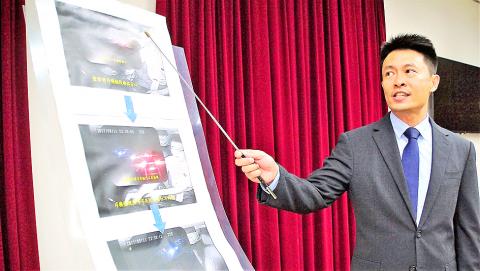
Photo: CNA
Chaotou District Chief Prosecutor Hsu Hung-ju (徐弘儒) said footage from the bus showed that Wu took his eyes off the road twice to look for something to the right of his seat before the crash.
Wu told investigators that he was stifled by the heat and was trying to find wet wipes to wipe his face, Hsu said, adding that reports that Wu was looking for his cellphone were incorrect.
The bus’ internal recorder showed that Wu was not driving over the speed limit, Hsu said, adding that the bus was traveling at 73kph at the moment of impact.
The bus’ speed did not exceed 105kph in the 13 minutes prior to the accident, he added.
The speed limit for that section of the freeway is 110kph, Hsu said.
Wu was not wearing a seat belt and the swerve he made to avoid hitting the vehicle in front threw him off his seat, saving his life, Hsu added.
The work schedule at Aloha Bus showed that Wu was not overworked and the bus company had followed labor laws, he said.
Wu did not work overtime in the seven-day period prior to the accident and he had the mandated 10 hours of rest before driving as required by law, Hsu said.
Smartphone location data showed that Wu’s phone was near his residence in Kaohsiung’s Fongshan District (鳳山) during his rest period, confirming company records, Hsu said.
There is no evidence that the vehicle in front of the bus was responsible for the crash in any way, Hsu said, adding that investigators reviewed surveillance footage from a freeway camera and interviewed the driver of the vehicle.
Ten of the 11 people injured in the accident have yet to press charges against Wu for negligence causing bodily harm, Hsu said.
Wu is recuperating from his injuries and his commercial license has been revoked, Aloha Bus said, adding that it would take full responsibility for civil lawsuits, but not for the criminal charges.
Aloha Bus spokesman Juan Fu-sheng (阮福生) said the company’s vehicles have anti-sleep alarms, but they were undergoing calibration and were inactive at the time of the accident.
The device tracks the driver’s eye movements and sounds an alarm if the driver’s attention wavers, and keeps a log of the alarms for the company’s reference, Juan said.
The devices are now operational and the company will take disciplinary action against offending drivers, including firing them, Juan said, adding that all drivers would be retrained.
The government cannot supervise individual commercial drivers and to a large extent depends on bus operators to regulate their drivers, Ministry of Transportation and Communications Department of Railways and Highways official Hu Ti-chi (胡迪琦) said.
The government is providing subsidies to bus companies for the installation of anti-sleep alarms, Hu added.

Considering that most countries issue more than five denominations of banknotes, the central bank has decided to redesign all five denominations, the bank said as it prepares for the first major overhaul of the banknotes in more than 24 years. Central bank Governor Yang Chin-lung (楊金龍) is expected to report to the Legislative Yuan today on the bank’s operations and the redesign’s progress. The bank in a report sent to the legislature ahead of today’s meeting said it had commissioned a survey on the public’s preferences. Survey results showed that NT$100 and NT$1,000 banknotes are the most commonly used, while NT$200 and NT$2,000

The Centers for Disease Control (CDC) yesterday reported the first case of a new COVID-19 subvariant — BA.3.2 — in a 10-year-old Singaporean girl who had a fever upon arrival in Taiwan and tested positive for the disease. The girl left Taiwan on March 20 and the case did not have a direct impact on the local community, it said. The WHO added the BA.3.2 strain to its list of Variants Under Monitoring in December last year, but this was the first imported case of the COVID-19 variant in Taiwan, CDC Deputy Director-General Lin Ming-cheng (林明誠) said. The girl arrived in Taiwan on

South Korea is planning to revise its controversial electronic arrival card, a step Taiwanese officials said prompted them to hold off on planned retaliatory measures, a South Korean media report said yesterday. A Yonhap News Agency report said that the South Korean Ministry of Foreign Affairs is planning to remove the “previous departure place” and “next destination” fields from its e-arrival card system. The plan, reached after interagency consultations, is under review and aims to simplify entry procedures and align the electronic form with the paper version, a South Korean ministry official said. The fields — which appeared only on the electronic form

The Ministry of Foreign Affairs (MOFA) is suspending retaliation measures against South Korea that were set to take effect tomorrow, after Seoul said it is updating its e-arrival system, MOFA said today. The measures were to be a new round of retaliation after Taiwan on March 1 changed South Korea's designation on government-issued alien resident certificates held by South Korean nationals to "South Korea” from the "Republic of Korea," the country’s official name. The move came after months of protests to Seoul over its listing of Taiwan as "China (Taiwan)" in dropdown menus on its new online immigration entry system. MOFA last week


 RSS
RSS