


Welhunt Materials Enterprise on Tuesday last week signed an academic-industrial pact with National Pingtung University of Science and Technology for its cashew nut business in Cambodia.
University president Tai Chang-hsien (戴昌賢) said the university is to collaborate with Welhunt Materials on technical research, including tropical fruit tree cultivation, agricultural drones, artificial intelligence-assisted agricultural machinery and assembly lines with machine vision.
Welhunt Materials is a diverse and international business that trades in steel, coal and cashews, company general manager Huang Ching-hua (黃清華) said.
The growth of Welhunt Materials’ plantations in Cambodia over the past decade has created a demand for skilled workers and supervisors, he said, adding that the firm bought 350 hectares of farmland near Cambodia’s capital, Phnom Penh, and planted 100,000 cashew trees last year.
The company this year plans to establish a consolidated supply chain by cultivating another 1,200 hectares and installing a processing facility with a monthly output of 150 tonnes, he said.
The global market for cashews is estimated to be worth US$3 billion per year, and Vietnam, the world’s leading exporter of finished cashew products, grows only one-third of the nuts it sells annually, Huang said.
Vietnam’s 1.2 million tonnes of processed cashew exports were grown in three areas that have roughly equal output: Vietnam, Cambodia and Africa, he said.
Unlike Vietnam, people are not worried that Cambodia’s cashew fields are affected by Agent Orange — a herbicide and defoliant used by the US Military during the Vietnam War — but the nation does not have any cashew processing facilities, which limits it to growing, he said.
Having toured Vietnam’s cashew factories, Huang said he is convinced they need modern production techniques and sanitation standards, and Taiwanese technical expertise is competitive.
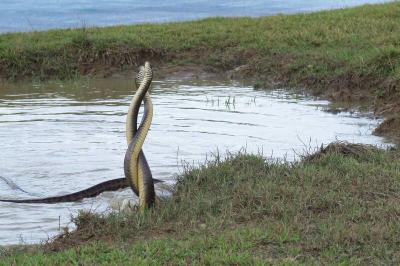
Kenting National Park service technician Yang Jien-fon (楊政峰) won a silver award in World Grand Prix Photography Awards Spring Season for his photograph of two male rat snakes intertwined in combat. Yang’s colleagues at Kenting National Park said he is a master of nature photography who has been held back by his job in civil service. The awards accept entries in all four seasons across six categories: architectural and urban photography, black-and-white and fine art photography, commercial and fashion photography, documentary and people photography, nature and experimental photography, and mobile photography. Awards are ranked according to scores and divided into platinum, gold and
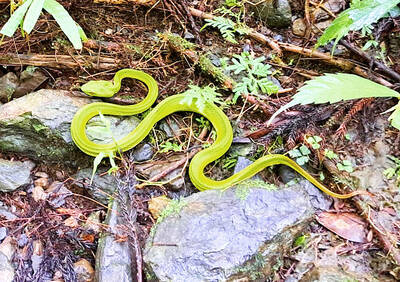
More than half of the bamboo vipers captured in Tainan in the past few years were found in the city’s Sinhua District (新化), while other districts had smaller catches or none at all. Every year, Tainan captures about 6,000 snakes which have made their way into people’s homes. Of the six major venomous snakes in Taiwan, the cobra, the many-banded krait, the brown-spotted pit viper and the bamboo viper are the most frequently captured. The high concentration of bamboo vipers captured in Sinhua District is puzzling. Tainan Agriculture Bureau Forestry and Nature Conservation Division head Chu Chien-ming (朱健明) earlier this week said that the
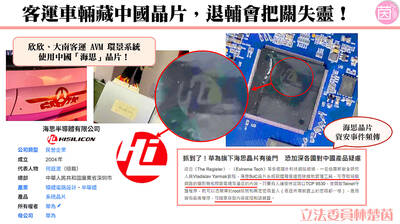
BREACH OF CONTRACT: The bus operators would seek compensation and have demanded that the manufacturer replace the chips with ones that meet regulations Two bus operators found to be using buses with China-made chips are to demand that the original manufacturers replace the systems and provide compensation for breach of contract, the Veterans Affairs Council said yesterday. Democratic Progressive Party Legislator Michelle Lin (林楚茵) yesterday said that Da Nan Bus Co and Shin-Shin Bus Co Ltd have fielded a total of 82 buses that are using Chinese chips. The bus models were made by Tron-E, while the systems provider was CYE Electronics, Lin said. Lin alleged that the buses were using chips manufactured by Huawei subsidiary HiSilicon Co, which presents a national security risk if the

The National Immigration Agency has banned two Chinese from returning to Taiwan, after they published social media content it described as disrespectful to national sovereignty. The agency imposed a two-month ban on a Chinese man surnamed Liang (梁) and a permanent ban on a woman surnamed Yang (楊), an influencer with 23 million followers, in October last year and last week respectively. Minister of the Interior Liu Shyh-fang (劉世芳) yesterday said on the sidelines of a legislative meeting that Chinese visitors to Taiwan are required to comply with the rules and regulations governing their entry permits. The government has handled the ban and


 RSS
RSS