


The Eslite Bookstore chain on Monday officially opened the nation’s longest underground book street in Taipei, creating what the city hopes will become a new tourist attraction.
The 261m book street, named R79 Eslite Underground because it is close to exits R7 and R9, is in an underground walkway between the MRT Zhongshan Station and MRT Shuanglian Station.
The walkway used to be part of the Zhongshan Metro Mall, an underground shopping mall that sells clothes, food, discounted books and other products, but Eslite won a bid in March to transform a section into a book street.
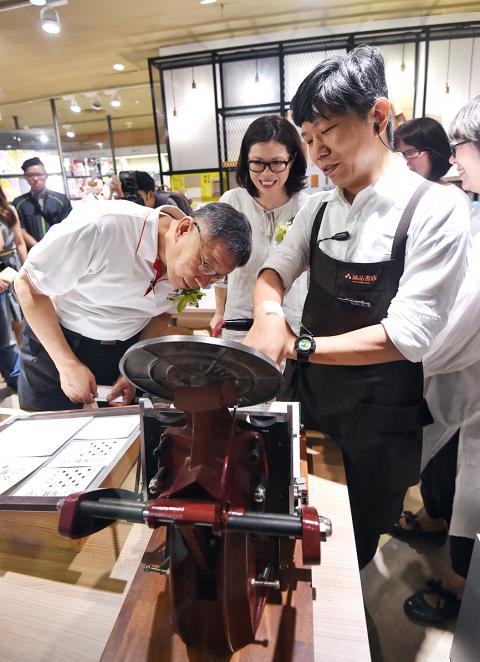
Photo: Liu Hsin-de, Taipei Times
The underground complex features more than 60,000 titles on a wide variety of topics and also includes shops that sell cultural and creative products, vinyl records, stationery, food and coffee.
Taipei Mayor Ko Wen-je (柯文哲), who attended the opening ceremony, said the transformation of the underground walkway was a success, predicting that the book street, which opened ahead of the Taipei Universiade, would become a new scenic spot for travelers visiting the city.
Ko also praised Robert Wu (吳清友), the founder and chairman of Eslite Corp who died of heart disease last month, as a man who “changed the definition of bookstores in Taiwan.”
“He brought humanities, art and creativity into people’s lives,” Ko said, adding that the book street was Wu’s last project.
Wu’s daughter Mercy Wu (吳旻潔), who has taken over as Eslite’s chairwoman, said her father’s wish was that commuters who used to spend five minutes walking the corridor will stay for at least half an hour and that others will pay special visits to the book street.
“The beauty of the Zhongshan underground book street is that it creates a lot of opportunities for people to run into books,” she said. “We hope to create these chance meetings not only in Taipei, but in various public spaces across Taiwan.”
Eslite is to pay rent to Taipei Rapid Transit Corp for the space, which the metro company estimated would increase its earnings by more than NT$10 million (US$331,115) per year compared with the previous operator of the space, which suffered annual losses.
Maru Yuan, who works in the publishing industry and visited the book street on Monday, said that in an age of fewer bookstores, the book street is a way to bring ordinary people closer to books.
“It may be crowded outside, but inside it is a paradise for reading,” she said.

The military has spotted two Chinese warships operating in waters near Penghu County in the Taiwan Strait and sent its own naval and air forces to monitor the vessels, the Ministry of National Defense (MND) said. Beijing sends warships and warplanes into the waters and skies around Taiwan on an almost daily basis, drawing condemnation from Taipei. While the ministry offers daily updates on the locations of Chinese military aircraft, it only rarely gives details of where Chinese warships are operating, generally only when it detects aircraft carriers, as happened last week. A Chinese destroyer and a frigate entered waters to the southwest

A magnitude 6.1 earthquake struck off the coast of Yilan County at 8:39pm tonight, the Central Weather Administration (CWA) said, with no immediate reports of damage or injuries. The epicenter was 38.7km east-northeast of Yilan County Hall at a focal depth of 98.3km, the CWA’s Seismological Center said. The quake’s maximum intensity, which gauges the actual physical effect of a seismic event, was a level 4 on Taiwan’s 7-tier intensity scale, the center said. That intensity level was recorded in Yilan County’s Nanao Township (南澳), Hsinchu County’s Guansi Township (關西), Nantou County’s Hehuanshan (合歡山) and Hualien County’s Yanliao (鹽寮). An intensity of 3 was

Japanese Prime Minister Sanae Takaichi’s comment last year on Tokyo’s potential reaction to a Taiwan-China conflict has forced Beijing to rewrite its invasion plans, a retired Japanese general said. Takaichi told the Diet on Nov. 7 last year that a Chinese naval blockade or military attack on Taiwan could constitute a “survival-threatening situation” for Japan, potentially allowing Tokyo to exercise its right to collective self-defense. Former Japan Ground Self-Defense Force general Kiyofumi Ogawa said in a recent speech that the remark has been interpreted as meaning Japan could intervene in the early stages of a Taiwan Strait conflict, undermining China’s previous assumptions
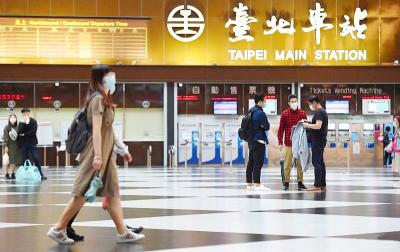
Taiwan Railways Corp (TRC) today announced that Shin Kong Mitsukoshi has been selected as the preferred bidder to operate the Taipei Railway Station shopping mall, replacing the current operator, Breeze Development Co Ltd. Among eight qualified firms that delivered presentations and were evaluated by a review committee, Shin Kong Mitsukoshi was ranked first, while Breeze was named the runner-up, the rail company said in a statement. Contract negotiations are to proceed in accordance with regulations, it said, adding that if negotiations with the top bidder fail, it could invite the second-ranked applicant to enter talks. Breeze in a statement today expressed doubts over


 RSS
RSS