


Describing his work as a photographer documenting the democracy movement before and after the end of the Martial Law era, Chiu Wan-hsing (邱萬興) said of the transition period: “You had to be ready to go to prison any time.”
Taiwan on Saturday marked the 30th anniversary of the lifting of martial law.
Martial law was imposed on May 19, 1949, in Taiwan and lifted by then-president Chiang Ching-kuo (蔣經國) on July 15, 1987. Under martial law, people were not allowed to form political parties and there were no rights to free assembly, speech and publication in Taiwan.
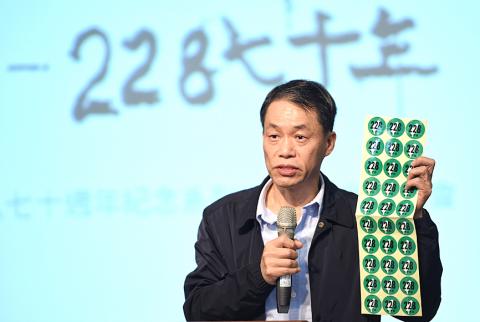
Photo: Liu Hsin-de, Taipei Times
Many of the victims and families of those who lost their lives during the long period of repression remembered the period over the weekend, including Chiu.
Born in Taoyuan, he graduated from Fu-Hsin Trade and Arts School, specializing in drawing and graphic design.
After graduation, he worked for a construction company, where he was responsible for advertising real-estate. In the early 1980s, people from outside the Chinese Nationalist Party (KMT) fought fiercely for the freedom of speech, leading to the proliferation of opposition magazines.
It was at that time that Chiu’s friend asked him to help edit The Eighties, a political journal.
Chiu documented many major events with his camera, including the Wild Lily student movement, a student sit-in demonstration in 1990 for democratic reform, the establishment of the Democratic Progressive Party in 1986, and the 1988 peasant movement.
He was also the first photographer to arrive at the scene of the death of Freedom Era Weekly editor Deng Nan-jung (鄭南榕), who committed suicide by self-immolation in 1989 to fight for freedom of speech.
Chiu said he was taking photographs at a museum in Taipei on April 7, 1989, when he heard that something had happened at the office of the magazine founded by Deng.
After rushing to the office on his scooter, Chiu said he saw a lot of smoke and a SWAT team at the site.
Chiu said that following negiotioans with police, he was allowed into the office, where he saw the charred body of Deng.
“It was painful to take those photographs. I cried while taking them. It was difficult to see a man being burned alive,” he said. “Without Deng Nan-jung’s determination and sacrifice, it would have been impossible for Taiwan’s freedom of speech to come this far today... Democracy did not just fall from the sky. It was earned step-by-step.”
Even during the period after martial law ended when Chiu started working for the Democratic Progressive Party, he said he was often harassed and followed by the police and had to change his residence every two to three months.
“I once got a call and the caller said: ‘I am your high-school classmate and I would like to treat you to coffee.’ The police often harassed you with these kinds of calls, to frighten you,” he said.


UPGRADE: The Kang Ding-class frigate is replacing its Chaparall missiles with Tien Chien II and Hua Yang VLS, which would provide it with long-range, 360° air defense Taiwan plans to produce 1,200 to 1,376 Hai Chien II missiles (海劍二, Sea Sword II) — also known as TC-2N — to serve as the standard air defense system of the navy’s surface combatant fleet, a source said yesterday. Last week, the Hai Chien II, the naval version of the Tien Kung II missile (天劍二, Sky Sword II), completed a live-fire test in waters off the National Chungshan Institute of Science and Technology’s Jiupeng facility (九鵬) in Pingtung County’s Manjhou Township (滿州). The MIM72 Chaparral and other dated air defense missiles that currently arm Taiwanese ships have inadequate range to combat Chinese

REASONS FOR TRAVEL: An assistant professor said that proposed amendments to penalize drivers if they used drugs overseas would not deter people from traveling People who operate a motor vehicle under the influence of marijuana would have their driver’s license revoked, even if they used the substance while overseas, the Ministry of Transportation and Communications said yesterday, citing proposed amendments to the Road Traffic Management and Penalty Act (道路交通管理處罰條例). The amendments would also authorize the government to revoke the licenses of people determined to have used Category 1 or Category 2 narcotics, even if they were not operating a vehicle while under the influence of drugs, as well as ban them from taking the license test for three years, the ministry said. People aged 18 or
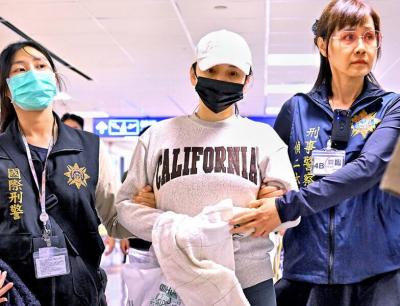
Johanne Liou (劉喬安), a Taiwanese woman who shot to unwanted fame during the Sunflower movement protests in 2014, returned to Taiwan last night after being deported from the US. She is to stand trial in Taiwan for charges involving embezzlement, fraud and drug crimes. The Criminal Investigation Bureau (CIB) said it took her into custody at Taiwan Taoyuan International Airport and would first question her before transferring her to the New Taipei District Prosecutors’ Office. She was arrested upon disembarking a flight from San Francisco that landed shortly before 7pm. Liou absconded to the US in 2019 after jumping bail
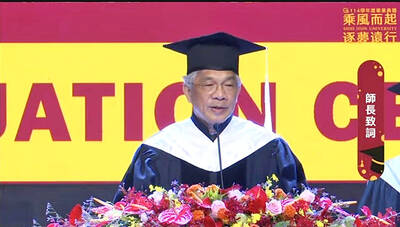
Shih Hsin University President Chen Ching-he (陳清河) yesterday issued a public apology for comments made in his commencement speech last week, stating that he has asked the school to suspend his duties and halt his wages for two months as a show of contrition. At the commencement ceremony on May 30, Chen said, “If you don’t manage your time well, or your own emotions, or your health, then I am telling every one of you — put a quick end to ‘you,’ because the world has no need for ‘you.’” The comments have sparked significant controversy online, and Chen through an open


 RSS
RSS