


Conflicts over narrative within the Democratic Progressive Party (DPP) about de jure and de facto independence and the necessity of the Republic of China (ROC) framework have resurfaced as cross-strait relations have deteriorated to their lowest point since President Tsai Ing-wen (蔡英文) assumed office in May last year and following the loss of one of the nation’s most important diplomatic allies to China.
Panama on June 13 shifted diplomatic recognition from Taipei to Beijing, a diplomatic fiasco that has sparked debate among the party’s pro-independence and “centrist” camps about the government’s China policy and the necessity of the ROC framework.
Former premier Yu Shyi-kun and presidential adviser Koo Kwang-ming (辜寬敏) have “welcomed” Panama’s severance of diplomatic ties with Taipei, which they said would create room for Taiwan as “an independent sovereign state” unassociated with the ROC.
Both have said the ROC framework of competing with Beijing for representation of China is a burden that should be unloaded for the normalization of Taiwan, echoing comments by DPP politicians and pro-independence groups for years.
A “Taiwanese nationalist” proposal to scrap the ROC as a necessary step toward realizing Taiwan’s de jure statehood in a central idea entrenched in the so-called independence clause of the DPP’s charter, which seeks to make a new constitution and build a “Taiwan Republic.”
The pursuit of de jure independence was further solidified in the DPP’s 2007 Normal Country Resolution, which seeks to change the nation’s official title from “Republic of China” to “Taiwan,” draft a new constitution and seek UN membership under the name “Taiwan.”
The DPP has at times struggled with the pursuit of de jure independence, especially when it is at the helm of the government — under the ROC constitutional framework — and Yu and Koo’s pro-independence narrative has been contested within the party by a more centrist narrative that downplays the urgency of independence and highlights the strategic necessity of the ROC framework.
In a statement following the Panama debacle, Tsai reaffirmed the “existence of the ROC,” although in what might have been her sternest language to address Beijing.
“The ROC is a sovereign country, which is a fact that Beijing can never deny,” Tsai said.
Tsai, who helped draft the “two-states theory” in 1999 when she was an adviser to former president Lee Teng-hui (李登輝), has repeatedly reiterated that maintaining the cross-strait “status quo” is her administration’s top priority.
Her acceptance of the ROC framework has also been implied by her refusal to relaunch an initiative of former president Chen Shui-bian (陳水扁) to join the UN under the name “Taiwan.”
Although there have been rumors within the party that Tsai is considering relaunching the initiative in September, it has been speculated that she would accommodate it within the ROC framework.
The acceptance of de facto independence and the hull of the ROC — endorsed by the DPP’s Resolution on Taiwan’s Future, which accepts the ROC constitutional framework and demands a referendum for any change to the “status quo” — is supported by centrist DPP members and even some independence advocates to varying degrees.
Recent comments by Tainan Mayor William Lai (賴清德) might speak for the usually reticent Tsai.
In what has been considered his attempt to reshape the DPP’s cross-strait narrative, Lai — a strong DPP contender for the presidency well-known for his pro-independence bent — said that his stance on China is “building affinity with China while loving Taiwan.”
Lai — arguably the most influential politician of the DPP’s New Tide faction, which drafted the independence clause — has appeared to soften his stance and DPP politicians in elected offices have shown no hesitation to follow his lead.
Kaohsiung Mayor Chen Chu (陳菊), Taichung Mayor Lin Chia-lung (林佳龍) and Taoyuan Mayor Cheng Wen-tsang (鄭文燦) have spoken about establishing a rapport with China, albeit using less explicit terms than Lai, such as “reconciling with China” and “understanding China.”
Building affinity with China is imperative, even if that might cost the independence clause.
“Accepting the ‘1992 consensus’ is not the problem... Abolishing the DPP [pro-independence] charter is not the problem, either,” Lai told an audience of Taiwanese-Americans on Sunday.
The Presidential Office and the DPP were quick to respond to his remarks, saying that Lai was not proposing the acceptance of the so-called “1992 consensus” or the abolition of the independence clause, but rather a rhetorical rejection of those proposals, signaling that support of de jure independence within the party has indeed lost ground.
The “1992 consensus” — a term former Mainland Affairs Council chairman Su Chi (蘇起) in 2006 admitted to making up in 2000 — refers to a tacit understanding between the Chinese Nationalist Party (KMT) and the Chinese government that both sides acknowledge that there is “one China,” which each side having its own interpretation of what “China” means.
DPP Legislator Hsu Chih-chieh (許智傑) has proposed a “conditional 1992 consensus” to build rapport with China, while DPP caucus whip Ker Chien-ming (柯建銘) reportedly told a newspaper that the independence clause is the single greatest obstacle to cross-strait interactions and that revising the DPP charter would be a pragmatic way to reconcile cross-strait differences.
Attempts to freeze the independence clause, or halt the pursuit of de jure independence, has repeatedly been a struggle within the party.
After it approved the clause in 1991, the DPP suffered a landslide defeat in elections for the now-defunct National Assembly, from which the party learned its lesson.
In 1999, just a year prior to a presidential election, the DPP approved the Resolution on Taiwan’s Future to boost Chen Shui-bian’s campaign.
The first two years of his first term were marked by a centrist position, with Chen Shui-bian pledging the “four noes and one without” to maintain the “status quo” and the ROC framework.
However, in the height of a cross-strait deadlock, he evoked Taiwanese nationalist sentiment while seeking re-election and launched a referendum to join the UN under the name “Taiwan” in his second term.
At the end of his administration’s second term, the DPP, with the arrival of the Normal Country Resolution, resolutely turned to support de jure independence, which was followed by another landslide defeat in the 2008 general elections.
In 2013, Ker suggested that the DPP freeze the independence clause, followed the next year by about 40 members launching a proposal to freeze it, which was shelved.
Despite their pro-independence slants, Tsai’s and Lai’s narratives have to be understood in the vein of the struggle between de jure and de facto independence, which has titled in favor of the latter.
Within the milieu of international politics in which Beijing and Washington continue to steer cross-strait relations under their different “one China” frameworks that forestall de jure independence, it is difficult for the discussion of “a maximum realization” of Taiwanese nationalism — a “Taiwan Republic.”
The DPP knows as well as the KMT that a centrist route — acknowledging a “Taiwanized ROC” — is a road that must be taken.
That position is not easily shaken, especially after the DPP learned its lesson from Chen Shui-bian’s radicalization of Taiwanese nationalism, which offended Beijing and Washington and eventually led to the DPP losing power.
Just as there is no need to scrap the ROC if the DPP can take over and convert it into a localized democracy, there is no need to freeze the independence clause, as the DPP can claim that Taiwan is already an independent country and therefore has no need to declare independence — a stance repeatedly voiced by centrists in the DPP, but not its “hardcore” pro-independence members — while easily winning the votes of supporters of de jure independence.
Unless Beijing ramps up its promotion of the “one China” principle to the point of provoking Taiwanese nationalism, the centrist narrative will continue to dominate the DPP’s mainstream attitude toward Taiwan’s statehood.

A magnitude 6.1 earthquake struck off the coast of Yilan County at 8:39pm tonight, the Central Weather Administration (CWA) said, with no immediate reports of damage or injuries. The epicenter was 38.7km east-northeast of Yilan County Hall at a focal depth of 98.3km, the CWA’s Seismological Center said. The quake’s maximum intensity, which gauges the actual physical effect of a seismic event, was a level 4 on Taiwan’s 7-tier intensity scale, the center said. That intensity level was recorded in Yilan County’s Nanao Township (南澳), Hsinchu County’s Guansi Township (關西), Nantou County’s Hehuanshan (合歡山) and Hualien County’s Yanliao (鹽寮). An intensity of 3 was

Instead of focusing solely on the threat of a full-scale military invasion, the US and its allies must prepare for a potential Chinese “quarantine” of Taiwan enforced through customs inspections, Stanford University Hoover fellow Eyck Freymann said in a Foreign Affairs article published on Wednesday. China could use various “gray zone” tactics in “reconfiguring the regional and ultimately the global economic order without a war,” said Freymann, who is also a nonresident research fellow at the US Naval War College. China might seize control of Taiwan’s links to the outside world by requiring all flights and ships entering or leaving Taiwan
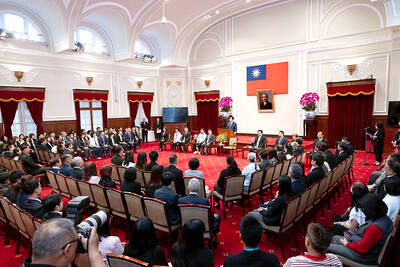
The next minimum wage hike is expected to exceed NT$30,000, President William Lai (賴清德) said yesterday during an award ceremony honoring “model workers,” including migrant workers, at the Presidential Office ahead of Workers’ Day today. Lai said he wished to thank the awardees on behalf of the nation and extend his most sincere respect for their hard work, on which Taiwan’s prosperity has been built. Lai specifically thanked 10 migrant workers selected for the award, saying that although they left their home countries to further their own goals, their efforts have benefited Taiwan as well. The nation’s industrial sector and small businesses lay
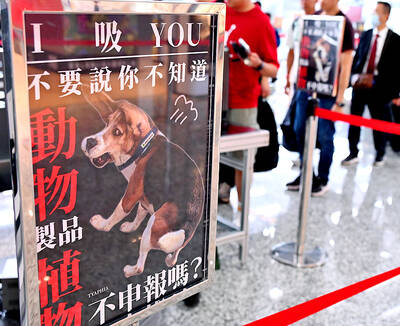
Quarantine awareness posters at Taiwan Taoyuan International Airport have gone viral for their use of wordplay. Issued by the airport branch of the Animal and Plant Health Inspection Agency, the posters feature sniffer dogs making a range of facial expressions, paired with advisory messages built around homophones. “We update the messages for holidays and campaign needs, periodically refreshing materials to attract people’s attention,” quarantine officials said. “The aim is to use the dogs’ appeal to draw focus to quarantine regulations.” A Japanese traveler visiting Taiwan has posted a photo on X of a poster showing a quarantine dog with a


 RSS
RSS