


Publisher and former national policy adviser Rex How (郝明義) has launched an online petition urging the government to conduct a thorough review of and hold a public debate on the Forward-looking Infrastructure Development Program to prevent unnecessary spending.
The eight-year, NT$882.49 billion (US$29.24 billion) project is expected to be approved in the extraordinary legislative session starting tomorrow, but How and a coalition of campaigners yesterday launched a signature drive to call on the government to re-examine the program.
They asked the government to elucidate the necessity of each of the infrastructure projects in the program, their source of funding, and benefit and social impact, as well as possible alternatives to each program and an estimated number of jobs to be created.
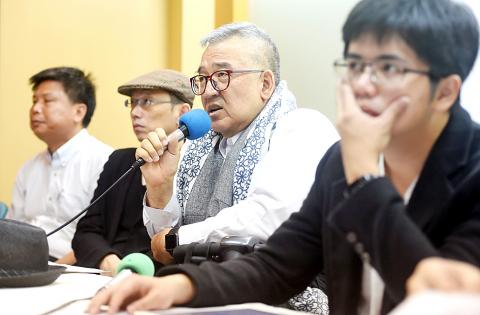
Photo: Liao Chen-huei, Taipei Times
The drive was launched through the National Development Council’s policy discussion forum, as the government is required to reply to any petition launched on the forum which is signed by more than 5,000 people within two months.
Campaigners include former Democratic Progressive Party legislator Lin Choi-shui (林濁水), National Chengchi University land economics professor Hsu Shih-jung (徐世榮), government watchdog site Watchout chief executive Lin Tzu-yi (林祖儀) and democracy activist Dennis Wei (魏揚).
A description running only a few hundred words was provided for a NT$30 billion light rail project in Hsinchu City in the program’s official document, suggesting a hasty budgeting practice that failed to take into to account the necessity of proposed projects, How said.
“A draft act on the program received the approval of a legislative committee, but not a single word of the act was modified,” How said, criticizing the review process.
National Association for the Promotion of Community Universities secretary-general Yang Chih-pin (楊志彬) said most major water and flood management infrastructure were built in the past decade and there should be no urgency to build new water supply facilities as the program emphasizes.
“The government should instead focus on water conservation and pollution remediation to ensure environmental and ecological protection,” Yan said.
The program might result in more spending than expected because extra construction costs often emerge in public infrastructure projects, artist Yao Jui-chung (姚瑞中) said, citing additional spending in more than 90 percent of public construction projects last year.
Yao, who has published five books documenting the so-called “mosquito halls” — a reference to buildings that are underutilized — said the government risks creating more underutilized infrastructure if it does not thoroughly review the program.
Hsu criticized the program for what he said its inferior planning and an authoritarian decisionmaking process.
The program’s official report is shallow in content, Hsu said, adding that it might have been hastily drafted by think tanks and consultancy firms.
The program, like all major construction projects, has to undergo a four-step process that involves submission of plans for construction, environmental protection, land use and expropriation, but the Executive Yuan has approved the construction portion of the program before the other plans were submitted, which would make the reviewing of the remaining three portions of the program merely a rubber-stamp process, he added.
“This is the authoritarianism that the Chinese Nationalist Party [KMT] established. It was anticipated that the Democratic Progressive Party administration would make some changes, but nothing has changed,” Hsu said.

NATIONAL SECURITY: Authorities are working to confirm the identities of the military personnel involved and investigating possible illegal conduct and regulatory violations Authorities are probing possible national security implications after Kinmen police and immigration officers on Sunday found a Chinese woman allegedly posing as a tourist while engaging in prostitution involving more than 10 military personnel. The woman, surnamed Chen (陳), has since been deported, authorities said, adding that investigators are still working to confirm the identities of those implicated, as the records only listed code names and aliases. The case stemmed from a report received by the Kinmen District Prosecutors’ Office on Friday last week from the Jinhu Precinct of the Kinmen County Police Bureau. On Sunday, police, along with the National Immigration

GLOBALGIVING: ‘ Caving to external pressure is not acceptable for an organization that has cultivated justice reform and human rights for 30 years,’ one NGO said A slew of non-government organizations (NGOs) have withdrawn from the GlobalGiving fundraising platform after it announced it would use “Chinese Taipei” instead of “Taiwan” from next month. The Taiwan Good Rice Association wrote on Facebook on Friday that it was informed on April 28 via a teleconference call of the change, which was made because the platform wanted to operate in China. Taiwan Good Rice is to terminate all cooperative relationships with GlobalGiving in response to the platform’s “unilateral and non-negotiable” decision to remove references to Taiwan, the NGO said. “Taiwan is in the official name of Taiwan Good Rice Association and the

HEAVY WEATHER: Typhoon Jangmi is due to crash straight into the Ryukyus as airlines look to shift flights to larger aircraft or cancel flights to Okinawa entirely Taiwan’s international air carriers announced flight adjustments over the weekend as Typhoon Jangmi is forecast to hit the Ryukyu Islands today and tomorrow. The Central Weather Administration (CWA) upgraded Jangmi from a tropical storm to a typhoon at 8am yesterday, with the eye located 580km south of Naha city. It was moving north at 19kph. Today, China Airlines’ CI-120, CI-121, CI-122 and CI-123 flights between Taoyuan and Naha, Okinawa, have been canceled as well as CI-132 and CI-133 between Kaohsiung and Naha. EVA Air’s BR-112, BR-113, BR-186 and BR-185 flights between Taoyuan and Naha are also canceled. Low-cost carrier Tigerair Taiwan canceled IT-230,
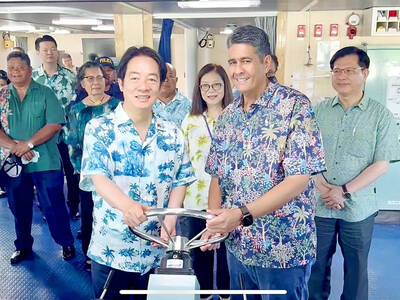
MULTIPRONGED APPROACH: China has sought to pressure Palau across a number of fronts, but the island nation has staunchly resisted overtures to ditch Taiwan Palau has been firm in backing Taiwan despite Chinese pressure that uses tourism economics, cyberattacks and criminal infiltration as tools to threaten the Pacific ally into renouncing its recognition of Taiwan as a sovereign state. The Presidential Office yesterday announced that Vice President Hsiao Bi-khim (蕭美琴) would visit Palau from Saturday to Wednesday next week at the invitation of Palauan President Surangel Whipps Jr. Whipps in April said in an interview that China had outspokenly asked Palau to “denounce Taiwan.” “And we have said: ‘We have no enemies, but nobody tells us who our friends are,’” he said. Whipps has told reporters multiple times


 RSS
RSS