


An ad hoc committee review of CPC Corp, Taiwan’s development project in Taoyuan’s Kuantang Industrial Park yesterday ended with no consensus, as environmentalists expressed concern over the project’s potential effect on algae reefs.
The CPC plans to build its third liquefied natural gas receiving terminal with facilities in the industrial park and nearby port. The company’s first two terminals are in Kaohsiung and Taichung.
Environmental groups gathered outside the meeting, calling on the Environmental Protection Administration (EPA) to preserve the large stretch of algae reefs along the shore where the new facilities are to be built.
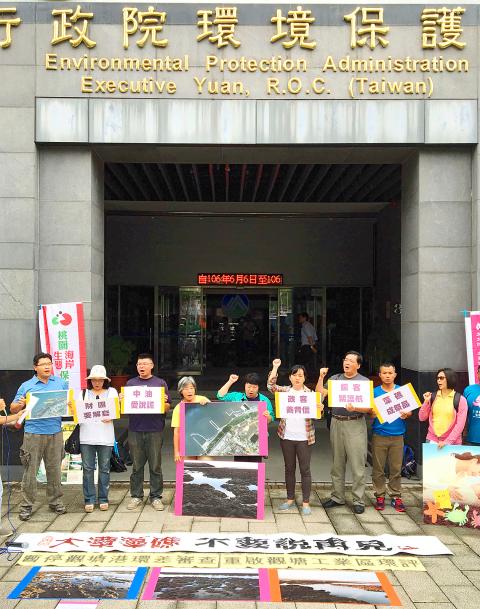
Photo: CNA
The project has been shrouded in controversy since the port property was transferred from Tuntex Group subsidiary Tung Ting Gas Corp to CPC several years ago, Taoyuan Local Union director-
general Pan Chong-cheng (潘忠政) said, adding that the company misreported the size of the facilities in an early report to the agency.
The company claimed that the project would cover 77 hectares, but an environmental assessment report made in 1999 showed plans for a 230-hectare project, Pan said.
In addition to receiving natural gas, CPC plans to build facilities for cement and petrochemicals there, he said.
Environmentalists also questioned the company’s adherence to procedures during the meeting.
Council of Agriculture Deputy Minister Chen Chi-chung (陳吉仲) examined the reef with the company and experts on Wednesday last week, Pan said.
“Chen said no conclusion [about environmental impact] can be reached until National Central University publishes its study on the issue. So why are we wasting time on this meeting?” Pan asked.
Algae reefs have been growing along the coastline of the port for about 7,500 years, Endemic Species Research Institute researcher Liu Ching-yu (劉靜榆) said.
The reefs are considered valuable because the species is indigenous to Taiwan and can only be found in Kuantang, she said.
A study conducted by CPC on May 24 contested that argument, saying that growth covers only 0.27 percent of the coastline.
The company said the port could help the government achieve its aim of creating a “nuclear-free homeland by 2025,” adding that the port is the best location from which to receive natural gas.
The venue will facilitate gas supply to Taiwan Power Co’s Datan (大潭) power plant, as well as to households in northern Taiwan, the company said.
Without the new facility, there could be a shortage of power supply to local businesses, it said.
Liu Shi-ping (劉希平), a member of the EPA’s review committee, said conflict remains between CPC and Taipower.
“How will natural gas and sea water pipes be laid?” Liu asked. “The pipes will cross the entire industrial park — it will look quite messy.”
Liu responded to company claims that pipes could be buried, saying it would be worrying given the company’s “very bad record.”
EPA review committee head Lee Chien-ming (李堅明) ended the meeting with the announcement that a consensus could not be reached because most committee members left the meeting early.
The meeting had originally been scheduled for May 9, but was postponed due to the resignation of committee member Lin Hsing-juh (林幸助).
The EPA issued a statement on May 9 saying that Lin resigned because he had become a CPC consultant.
Lin and the company both rejected the claim on the same day.

Considering that most countries issue more than five denominations of banknotes, the central bank has decided to redesign all five denominations, the bank said as it prepares for the first major overhaul of the banknotes in more than 24 years. Central bank Governor Yang Chin-lung (楊金龍) is expected to report to the Legislative Yuan today on the bank’s operations and the redesign’s progress. The bank in a report sent to the legislature ahead of today’s meeting said it had commissioned a survey on the public’s preferences. Survey results showed that NT$100 and NT$1,000 banknotes are the most commonly used, while NT$200 and NT$2,000

The Centers for Disease Control (CDC) yesterday reported the first case of a new COVID-19 subvariant — BA.3.2 — in a 10-year-old Singaporean girl who had a fever upon arrival in Taiwan and tested positive for the disease. The girl left Taiwan on March 20 and the case did not have a direct impact on the local community, it said. The WHO added the BA.3.2 strain to its list of Variants Under Monitoring in December last year, but this was the first imported case of the COVID-19 variant in Taiwan, CDC Deputy Director-General Lin Ming-cheng (林明誠) said. The girl arrived in Taiwan on

South Korea is planning to revise its controversial electronic arrival card, a step Taiwanese officials said prompted them to hold off on planned retaliatory measures, a South Korean media report said yesterday. A Yonhap News Agency report said that the South Korean Ministry of Foreign Affairs is planning to remove the “previous departure place” and “next destination” fields from its e-arrival card system. The plan, reached after interagency consultations, is under review and aims to simplify entry procedures and align the electronic form with the paper version, a South Korean ministry official said. The fields — which appeared only on the electronic form

The Ministry of Foreign Affairs (MOFA) is suspending retaliation measures against South Korea that were set to take effect tomorrow, after Seoul said it is updating its e-arrival system, MOFA said today. The measures were to be a new round of retaliation after Taiwan on March 1 changed South Korea's designation on government-issued alien resident certificates held by South Korean nationals to "South Korea” from the "Republic of Korea," the country’s official name. The move came after months of protests to Seoul over its listing of Taiwan as "China (Taiwan)" in dropdown menus on its new online immigration entry system. MOFA last week


 RSS
RSS