


Father Gerald George “Jerry” Martinson, a US Jesuit missionary who lived and worked in Taiwan for 50 years, was praised at a memorial yesterday and Pope Francis sent a message describing him as a blessing for all people.
Martinson was also known as Uncle Jerry from his English teaching programs and his Chinese name Ting Sung-yun (丁松筠).
While doctors on Wednesday said he seemed to have died several days ago of a heart attack, the Chinese Regional Bishops’ Conference later issued a statement saying that he had passed away earlier in the day.
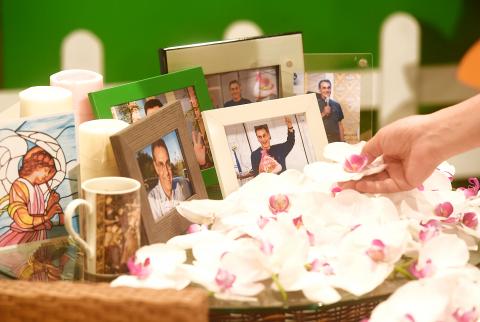
Photo: Chien Jung-fong, Taipei Times
The Ministry of the Interior had originally planned to hold a news conference yesterday to present Martinson with a national identification card for his work in Taiwan, but the news conference instead became a memorial for the beloved priest.
John Jao (饒志成), of the Society of Jesus, Chinese Province, said Martinson was “an optimistic, joyful priest filled with love.”
“He looked at things positively and rarely complained about other people. Everyone who met him loved him,” Jao said.
Although Martinson could not be on hand to accept the Republic of China ID card, he was sure to celebrate with the Lord above at officially becoming a Taiwanese, he said.
Jao added that Pope Francis sent a message after learning of Martinson’s passing, saying that he was grateful “the Lord has given us Uncle Jerry,” and that a lot of people in Taiwan, China and Asia knew him.
Control Yuan Vice President Sun Ta-chuan (孫大川), who once served as a secretary for Martinson, said that his concept of “family” was different from others.
Sun said he once invited the priest for dinner after work, but the priest declined and instead took his guitar to a construction site to eat with local and migrant workers.
Sun said that for the priest, the definition of “family” was extremely broad, including people from every class.
Minister of the Interior Yeh Jiunn-rong (葉俊榮) presented the ID card to Jerry Martinson’s younger brother, Barry, who is also a Jesuit priest.
Barry Martinson, equally recognizable and known by his Chinese name Ting Sung-ching (丁松青), said that his brother had said to him before his heart surgery in April that if he died, he wanted people to know he loved them.
Choking back tears, Barry Martinson said: “I want to tell you now, I love you.”
He said that although he and his brother have long felt they are Taiwanese, he was happy to accept the ID card for his brother.
Jerry Martinson is to be buried in the cemetery of the Catholic Chingshan Spirituality Center in Changhua, a Society of Jesus staff member said yesterday, after earlier reports had said he was to be buried in the cemetery of Fu Jen Catholic University’s Faculty of Theology of St Robert Bellarmine in New Taipei City.
President Tsai Ing-wen (蔡英文) yesterday tweeted a message in memory of Jerry Martinson, saying the priest was a bona fide Taiwanese who dedicated decades of his life to the nation and deserves “our respect and gratitude.”
The Buddhist Compassion Relief Tzu Chi Foundation also issued a statement expressing its condolences.
Jerry Martinson was born in 1942. He came to Taiwan in 1967 as a missionary and went to live in Hsinchu County.
He became a television producer and host, working at Kuangchi Program Service, a television studio that has been producing free educational programs in Taiwan since 1958.
This story has been updated since it was first published to correct the name of the cemetery where Father Jerry Martinson is to be buried.

Considering that most countries issue more than five denominations of banknotes, the central bank has decided to redesign all five denominations, the bank said as it prepares for the first major overhaul of the banknotes in more than 24 years. Central bank Governor Yang Chin-lung (楊金龍) is expected to report to the Legislative Yuan today on the bank’s operations and the redesign’s progress. The bank in a report sent to the legislature ahead of today’s meeting said it had commissioned a survey on the public’s preferences. Survey results showed that NT$100 and NT$1,000 banknotes are the most commonly used, while NT$200 and NT$2,000

The Centers for Disease Control (CDC) yesterday reported the first case of a new COVID-19 subvariant — BA.3.2 — in a 10-year-old Singaporean girl who had a fever upon arrival in Taiwan and tested positive for the disease. The girl left Taiwan on March 20 and the case did not have a direct impact on the local community, it said. The WHO added the BA.3.2 strain to its list of Variants Under Monitoring in December last year, but this was the first imported case of the COVID-19 variant in Taiwan, CDC Deputy Director-General Lin Ming-cheng (林明誠) said. The girl arrived in Taiwan on

South Korea is planning to revise its controversial electronic arrival card, a step Taiwanese officials said prompted them to hold off on planned retaliatory measures, a South Korean media report said yesterday. A Yonhap News Agency report said that the South Korean Ministry of Foreign Affairs is planning to remove the “previous departure place” and “next destination” fields from its e-arrival card system. The plan, reached after interagency consultations, is under review and aims to simplify entry procedures and align the electronic form with the paper version, a South Korean ministry official said. The fields — which appeared only on the electronic form

The Ministry of Foreign Affairs (MOFA) is suspending retaliation measures against South Korea that were set to take effect tomorrow, after Seoul said it is updating its e-arrival system, MOFA said today. The measures were to be a new round of retaliation after Taiwan on March 1 changed South Korea's designation on government-issued alien resident certificates held by South Korean nationals to "South Korea” from the "Republic of Korea," the country’s official name. The move came after months of protests to Seoul over its listing of Taiwan as "China (Taiwan)" in dropdown menus on its new online immigration entry system. MOFA last week


 RSS
RSS