


Democratic Progressive Party (DPP) officials yesterday called on Chinese Nationalist Party (KMT) chairman-elect Wu Den-yih (吳敦義) to reveal all assets obtained by the party through abuse of government power and other illegal means as a probe into a controversial land deal in rural Taipei began.
DPP spokesman Ruan Jhao-syong (阮昭雄) said that the KMT’s National Development and Research Institute on an 8,300 ping (2.74 hectare) plot of land in Taipei’s Muzha (木柵) area was acquired in 1964 from local resident Yeh Chung-chuan (葉中川) during authoritarian one-party rule of Chiang Kai-shek (蔣介石).
Ruan, citing accusations in a lawsuit filed by Yeh’s family members, said that the “KMT took over the land through coercion and threats against private citizens.”
“It happened during the Martial Law era under the party’s autocratic rule,” Ruan said. “Therefore, we urge KMT chairman-elect Wu to put an end to the party’s ownership of ill-gotten assets.”
“Wu was elected KMT chairman recently after he declared that he would lead the party with a new style and mindset,” Ruan said. “So we ask Wu to make a clean break from the past by making a full disclosure of the party’s many ill-gotten assets and return them to their rightful owners.”
Most Taiwanese demand that political parties make full assessments and settle any ill-gotten assets, he said.
“The KMT should stop resisting this process by hiding information and refusing to cooperate on the matter,” he said.
“The KMT in this regard is worse than the mobsters,” Ruan said, adding that at least gangsters abide by their code of honor, compensating the owner of property they take.
“In the case of the Yeh family, the KMT used coercion and threats to force the family off their land without any compensation and later sold the land to a developer, making a large profit,” he said.
The plot of land was bought by the KMT in 1964 from Yeh, whose family in 2007 sued the party over the acquisition.
Yeh’s family bought the land in 1939, but the Japanese colonial army built a prisoner-of-war camp on it.
The land was later taken over by the KMT after it retreated to Taiwan following its loss in the Chinese Civil War.
In 1961, seeing he was unlikely to have the land returned to him by the KMT, Yeh reportedly offered to sell the land for NT$200 per ping, or NT$364,004 in total, but the party declined.
Yeh said he was visited in 1962 by four armed men — who arrived in two military jeeps — led by a KMT official and a local township official who invited him to “have a cup of tea” to discuss the land sale.
However, a handgun was pulled out and pointed at Yeh’s head during the meeting, Yeh’s wife, Yeh Chang Shu-chin (葉張淑津) told a court hearing in 2007.
Facing such threats by the KMT, the Yeh family had no choice but to sign a contract to sell the land to the party for NT$191,100, court testimony showed.
The KMT transferred the land into its name and deposited NT$19,000 — about one-10th of the amount in the contract — with the courts, but Yeh Chung-chuan refused to accept the money and the KMT took over ownership without paying the family, it said.
The family sued the KMT in 2007 and the Ill-gotten Party Assets Settlement Committee in March reopened the investigation into the case, with a hearing scheduled for next month.


UPGRADE: The Kang Ding-class frigate is replacing its Chaparall missiles with Tien Chien II and Hua Yang VLS, which would provide it with long-range, 360° air defense Taiwan plans to produce 1,200 to 1,376 Hai Chien II missiles (海劍二, Sea Sword II) — also known as TC-2N — to serve as the standard air defense system of the navy’s surface combatant fleet, a source said yesterday. Last week, the Hai Chien II, the naval version of the Tien Kung II missile (天劍二, Sky Sword II), completed a live-fire test in waters off the National Chungshan Institute of Science and Technology’s Jiupeng facility (九鵬) in Pingtung County’s Manjhou Township (滿州). The MIM72 Chaparral and other dated air defense missiles that currently arm Taiwanese ships have inadequate range to combat Chinese

REASONS FOR TRAVEL: An assistant professor said that proposed amendments to penalize drivers if they used drugs overseas would not deter people from traveling People who operate a motor vehicle under the influence of marijuana would have their driver’s license revoked, even if they used the substance while overseas, the Ministry of Transportation and Communications said yesterday, citing proposed amendments to the Road Traffic Management and Penalty Act (道路交通管理處罰條例). The amendments would also authorize the government to revoke the licenses of people determined to have used Category 1 or Category 2 narcotics, even if they were not operating a vehicle while under the influence of drugs, as well as ban them from taking the license test for three years, the ministry said. People aged 18 or
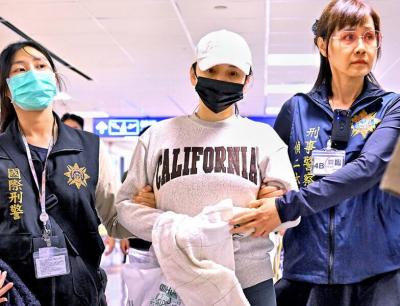
Johanne Liou (劉喬安), a Taiwanese woman who shot to unwanted fame during the Sunflower movement protests in 2014, returned to Taiwan last night after being deported from the US. She is to stand trial in Taiwan for charges involving embezzlement, fraud and drug crimes. The Criminal Investigation Bureau (CIB) said it took her into custody at Taiwan Taoyuan International Airport and would first question her before transferring her to the New Taipei District Prosecutors’ Office. She was arrested upon disembarking a flight from San Francisco that landed shortly before 7pm. Liou absconded to the US in 2019 after jumping bail
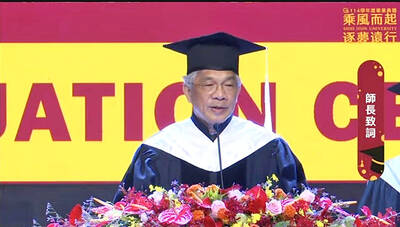
Shih Hsin University President Chen Ching-he (陳清河) yesterday issued a public apology for comments made in his commencement speech last week, stating that he has asked the school to suspend his duties and halt his wages for two months as a show of contrition. At the commencement ceremony on May 30, Chen said, “If you don’t manage your time well, or your own emotions, or your health, then I am telling every one of you — put a quick end to ‘you,’ because the world has no need for ‘you.’” The comments have sparked significant controversy online, and Chen through an open


 RSS
RSS