


Lee Ching-yu’s (李凈瑜) trip to the US last week to seek help in freeing her husband, human rights advocate Lee Ming-che (李明哲), was arranged by US non-governmental organization (NGO) China Aid, a statement released yesterday by a task force involved with the rescue efforts said.
Lee Ming-che was detained after entering Zhuhai, China, from Macau on March 19. He used to work for the Democratic Progressive Party and is a staff member at Wenshan Community College in Taipei, as well as a volunteer at the NGO Covenant Watch.
Lee Ching-yu on Thursday last week testified at a US House of Representatives committee hearing about her husband’s detention.
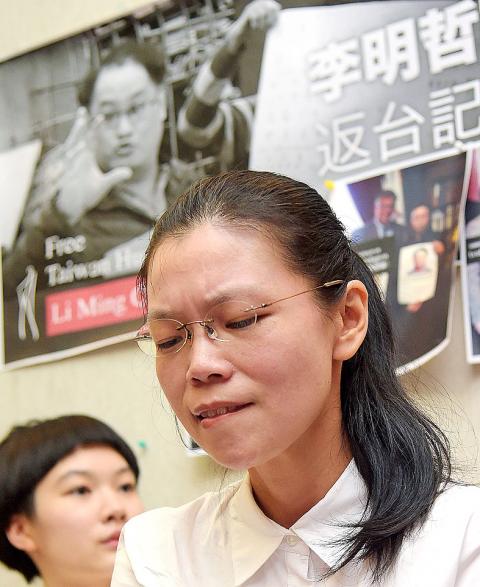
Photo: Huang Yao-cheng, Taipei Times
Chinese-language Next Magazine this week reported that President Tsai Ing-wen (蔡英文) sent aides to help arrange Lee Ching-yu’s US visit.
The report also said Tsai’s aides criticized Lee Ching-yu for “drawing too much attention” during her trip, affecting China’s willingness to release Lee Ming-che ahead of the Dragon Boat Festival on Tuesday.
China Aid president Bob Fu (傅希狄) on Wednesday rebuffed the magazine’s report.
In a separate statement issued yesterday, the task force involved with the rescue efforts said Lee Ching-yu’s US trip had nothing to do the Presidential Office or the government.
The government treated the issue with apathy, and the Mainland Affairs Council had ignored Lee Ching-yu’s letters, it said.
It also said that during the council’s first meeting with civic groups involved with the case on April 20, council Deputy Minister Chiu Chui-cheng (邱垂正) asked Lee Ming-che’s family members to “lay low” if they wanted China to release him.
Taiwan Foundation for Democracy president Hsu Szu-chien (徐斯儉) was assigned by the Presidential Office to work out solutions with the task force, but in effect was making their pursuit of international aid more difficult, the statement said, adding that as a result, Lee Ming-che’s family declined governmental subsidies and took matters into their own hands to defend their freedom of action and expression.
After Lee Ching-yu returned to Taiwan, no governmental agency sent officials to learn about the details, the statement said.
The information the task force heard from the Presidential Office as reported by Next Magazine were “distorted remarks that were a far cry from the truth,” it added.
“Compared with the support and goodwill the White House had shown us, the Tsai administration was cold-hearted and indifferent toward the victim,” it said.
The trip was single-handedly organized by Fu with the help of China Aid, as Lee Ching-yu could not have arranged it by herself, it said.
The statement also called on Beijing to immediately release Lee Ming-che, “whose humanitarian work is noble and respected,” in addition to urging the Tsai administration to stop fabricating lies.
“We understand that, given the circumstances across the Taiwan Strait, there is little the government can do to rescue Lee Ming-che. We can also live with the government’s insincerity when it sent a negotiator to resolve the issue,” it said. “However, the government should avoid turning itself into a laughingstock by making remarks that are far from the truth.”
The Presidential Office yesterday said that “Lee Ming-che is our citizen,” and that its responsibility is prioritizing his safety while upholding the nation’s dignity.
The government has made continuous efforts to rescue Lee Ming-che and hopes that he can return soon, it said, adding that it has remained in contact with his family to provide them with a thorough understanding the rescue efforts.

Considering that most countries issue more than five denominations of banknotes, the central bank has decided to redesign all five denominations, the bank said as it prepares for the first major overhaul of the banknotes in more than 24 years. Central bank Governor Yang Chin-lung (楊金龍) is expected to report to the Legislative Yuan today on the bank’s operations and the redesign’s progress. The bank in a report sent to the legislature ahead of today’s meeting said it had commissioned a survey on the public’s preferences. Survey results showed that NT$100 and NT$1,000 banknotes are the most commonly used, while NT$200 and NT$2,000

The Centers for Disease Control (CDC) yesterday reported the first case of a new COVID-19 subvariant — BA.3.2 — in a 10-year-old Singaporean girl who had a fever upon arrival in Taiwan and tested positive for the disease. The girl left Taiwan on March 20 and the case did not have a direct impact on the local community, it said. The WHO added the BA.3.2 strain to its list of Variants Under Monitoring in December last year, but this was the first imported case of the COVID-19 variant in Taiwan, CDC Deputy Director-General Lin Ming-cheng (林明誠) said. The girl arrived in Taiwan on

South Korea is planning to revise its controversial electronic arrival card, a step Taiwanese officials said prompted them to hold off on planned retaliatory measures, a South Korean media report said yesterday. A Yonhap News Agency report said that the South Korean Ministry of Foreign Affairs is planning to remove the “previous departure place” and “next destination” fields from its e-arrival card system. The plan, reached after interagency consultations, is under review and aims to simplify entry procedures and align the electronic form with the paper version, a South Korean ministry official said. The fields — which appeared only on the electronic form

The Ministry of Foreign Affairs (MOFA) is suspending retaliation measures against South Korea that were set to take effect tomorrow, after Seoul said it is updating its e-arrival system, MOFA said today. The measures were to be a new round of retaliation after Taiwan on March 1 changed South Korea's designation on government-issued alien resident certificates held by South Korean nationals to "South Korea” from the "Republic of Korea," the country’s official name. The move came after months of protests to Seoul over its listing of Taiwan as "China (Taiwan)" in dropdown menus on its new online immigration entry system. MOFA last week


 RSS
RSS