


Having weathered three separate natural disasters that cost Tan Hou Ocean Development Co hundreds of millions of New Taiwan dollars, company owner Liu Tien-ho (劉天和) remains steadfast in his resolve to provide uncontaminated fish.
Liu said he had not always been involved in aquaculture, but made his fortune in 1982 making exhaust piping for semiconductor factories.
Liu said he was diagnosed with bowel cancer in 1998 at the age of 48, and it was the catalyst for his career change.
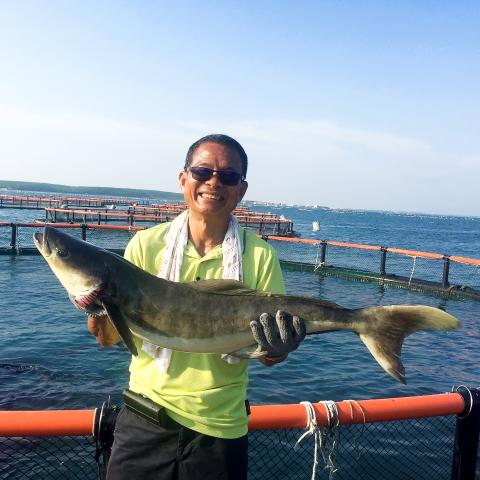
Photo: Yang Ya-ming, Taipei Times
After eight surgeries Liu said the only protein he was able to eat came from easily digestible fish, but he had been unable to find a source he felt comfortable eating, so he decided to farm “clean” fish.
After consulting with the Fisheries Research Institute and National Taiwan Ocean University experts, Liu opened his fish farm near Penghu (澎湖) in 2003, which had the cleanest water.
The fish are not given antibiotics and their tanks are cleaned with fresh water on a weekly basis, he said.
“We raise our fish in the most natural way possible, which drastically lowers success rates,” Liu said, adding that it is common for an entire batch to die and it is rare for the farm to have a survival rate of more than 80 percent.
At first, Liu focused on farming black king fish, amber jack and Queensland grouper, he said, adding that the company sold its first fish in 2005.
However, the farm was hit by a typhoon in April 2007, which saw all the farmed fish dumped into Magong Township (馬公) harbor.
“Anglers had a field day while my heart bled at the loss,” Liu said.
Despite efforts to rebuild the farm, the area was hit by cold fronts in 2008 and 2010, Liu said, adding that the disasters cost him NT$500 million (US$16.63 million).
The losses reflect the hardship of making a living from the sea, Liu said, adding that he has learned his lesson and adjusted his strategy.
The longer the fish are kept out at sea, the greater the risk of not being able to sell them, which also places heavy pressure on finances, Liu said, adding that the company has now implemented a controlled harvest to mitigate the treat from natural disasters.
“We avoid keeping fish out at sea in the winter and bring them in before the Lunar New Year. We sell the entire fish, butchered, in one package,” Liu said.
“Some of our regular customers buy larger fish weighing more than 20kg,” Liu said.
Liu said he farms more than 800,000 fish in about 30 varieties and has plans to raise more.
The company farms fish in a higher price bracket, limiting its output, while maintaining a stable price.
Tan Hou sells NT$300 million worth of fish each year. Last year it faced a NT$85 million loss, Liu said, adding that he has spent more than NT$2 billion raising fish.
There is still “a long way to go” before making a profit, he said.
Despite being told he is “throwing money into the sea,” Liu’s dedication has seen Tan Hou grow into the only known branded fishery in Taiwan that raises, markets and cooks its fish.

Considering that most countries issue more than five denominations of banknotes, the central bank has decided to redesign all five denominations, the bank said as it prepares for the first major overhaul of the banknotes in more than 24 years. Central bank Governor Yang Chin-lung (楊金龍) is expected to report to the Legislative Yuan today on the bank’s operations and the redesign’s progress. The bank in a report sent to the legislature ahead of today’s meeting said it had commissioned a survey on the public’s preferences. Survey results showed that NT$100 and NT$1,000 banknotes are the most commonly used, while NT$200 and NT$2,000

The Centers for Disease Control (CDC) yesterday reported the first case of a new COVID-19 subvariant — BA.3.2 — in a 10-year-old Singaporean girl who had a fever upon arrival in Taiwan and tested positive for the disease. The girl left Taiwan on March 20 and the case did not have a direct impact on the local community, it said. The WHO added the BA.3.2 strain to its list of Variants Under Monitoring in December last year, but this was the first imported case of the COVID-19 variant in Taiwan, CDC Deputy Director-General Lin Ming-cheng (林明誠) said. The girl arrived in Taiwan on

South Korea is planning to revise its controversial electronic arrival card, a step Taiwanese officials said prompted them to hold off on planned retaliatory measures, a South Korean media report said yesterday. A Yonhap News Agency report said that the South Korean Ministry of Foreign Affairs is planning to remove the “previous departure place” and “next destination” fields from its e-arrival card system. The plan, reached after interagency consultations, is under review and aims to simplify entry procedures and align the electronic form with the paper version, a South Korean ministry official said. The fields — which appeared only on the electronic form

The Ministry of Foreign Affairs (MOFA) is suspending retaliation measures against South Korea that were set to take effect tomorrow, after Seoul said it is updating its e-arrival system, MOFA said today. The measures were to be a new round of retaliation after Taiwan on March 1 changed South Korea's designation on government-issued alien resident certificates held by South Korean nationals to "South Korea” from the "Republic of Korea," the country’s official name. The move came after months of protests to Seoul over its listing of Taiwan as "China (Taiwan)" in dropdown menus on its new online immigration entry system. MOFA last week


 RSS
RSS