


The new five-day workweek system’s restrictions on working hours have caused consumer prices to increase, making revisions allowing for atypical work arrangements necessary, Democratic Progressive Party (DPP) Legislator Lin Tai-hua (林岱樺) said yesterday.
Lin said the policy — which requires “a fixed day off and a flexible rest day” every seven days, during which employees could be asked to work, but are entitled to higher overtime pay — has increased operating costs, causing consumer prices to rise.
Since its enactment in December last year, the policy has caused employers to try to reduce costs by limiting overtime hours, forcing many employees to seek part-time jobs to make up for lost income, Lin said.
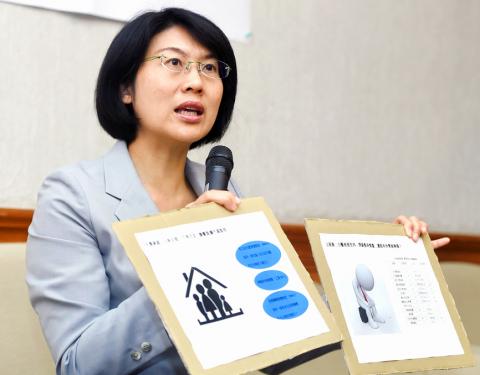
Photo: Liao Chen-huei, Taipei Times
Citing an online job bank survey, Lin said the average monthly cost of living for salaried workers has increased by NT$4,165 since last year, which she said might be due to the policy.
The monthly tuition for private kindergartens is to increase by NT$4,800, and nursing home costs are to go up by NT$1,500, adding another NT$75,600 per year, Lin added.
“If the increased prices for household goods and food are irreversible, policy changes and law amendments could hardly lower the consumer ‘pain index,’” Lin said, calling on the Cabinet to make immediate changes to the policy.
Lin’s call as a member of the pan-green camp was rare, as the law was passed by the DPP-dominated legislature.
“If there is a direct link between the policy and the rise in general prices, the government should make necessary changes, such as formulating a set of special regulations for the service industry” where there are longer working hours and a flexible work schedule, she said.
The government could also consider establishing a “flexible working time account” system that allows workers to “save” and “withdraw” working hours, so employers and workers could increase or decrease work without affecting salaries and welfare.
The Executive Yuan said there is no plan to amend the policy.
Executive Yuan spokesman Hsu Kuo-yung (徐國勇) said the government understands the opposition, but the Ministry of Labor has no plan for revisions.

Considering that most countries issue more than five denominations of banknotes, the central bank has decided to redesign all five denominations, the bank said as it prepares for the first major overhaul of the banknotes in more than 24 years. Central bank Governor Yang Chin-lung (楊金龍) is expected to report to the Legislative Yuan today on the bank’s operations and the redesign’s progress. The bank in a report sent to the legislature ahead of today’s meeting said it had commissioned a survey on the public’s preferences. Survey results showed that NT$100 and NT$1,000 banknotes are the most commonly used, while NT$200 and NT$2,000

The Centers for Disease Control (CDC) yesterday reported the first case of a new COVID-19 subvariant — BA.3.2 — in a 10-year-old Singaporean girl who had a fever upon arrival in Taiwan and tested positive for the disease. The girl left Taiwan on March 20 and the case did not have a direct impact on the local community, it said. The WHO added the BA.3.2 strain to its list of Variants Under Monitoring in December last year, but this was the first imported case of the COVID-19 variant in Taiwan, CDC Deputy Director-General Lin Ming-cheng (林明誠) said. The girl arrived in Taiwan on

South Korea is planning to revise its controversial electronic arrival card, a step Taiwanese officials said prompted them to hold off on planned retaliatory measures, a South Korean media report said yesterday. A Yonhap News Agency report said that the South Korean Ministry of Foreign Affairs is planning to remove the “previous departure place” and “next destination” fields from its e-arrival card system. The plan, reached after interagency consultations, is under review and aims to simplify entry procedures and align the electronic form with the paper version, a South Korean ministry official said. The fields — which appeared only on the electronic form

The Ministry of Foreign Affairs (MOFA) is suspending retaliation measures against South Korea that were set to take effect tomorrow, after Seoul said it is updating its e-arrival system, MOFA said today. The measures were to be a new round of retaliation after Taiwan on March 1 changed South Korea's designation on government-issued alien resident certificates held by South Korean nationals to "South Korea” from the "Republic of Korea," the country’s official name. The move came after months of protests to Seoul over its listing of Taiwan as "China (Taiwan)" in dropdown menus on its new online immigration entry system. MOFA last week


 RSS
RSS