


National Taiwan University (NTU) professor of dentistry Chang Cheng-chi (張正琪) yesterday accused the institution of having fabricated the results of an investigation into problematic scientific papers by professor Kuo Min-liang’s (郭明良) research team in an attempt to make her a “scapegoat.”
Citing results from an ad-hoc investigation committee, the university on Saturday last week said that Chang, a member of Kuo’s team, is to be fired over breaches of academic integrity after copying and inappropriately editing images in three medical papers.
The papers were published by the Journal of the National Cancer Institute in 2006, Cell Death and Differentiation in 2013 and Oral Oncology in 2013.
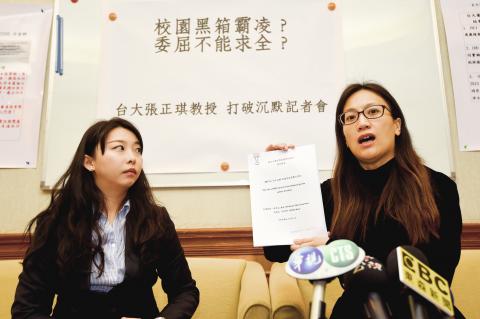
Photo: Chien Jung-fong, Taipei Times
The university said that Chang was the de facto author of a retracted article published by the Journal of Biological Chemistry in 2008, which Kuo supervised, adding that she also oversaw experiments conducted for the research.
The papers showed falsified findings in a number of duplicated images, the university said.
NTU said that Chang is to be disqualified as a professor, dismissed, barred from reapplying for lecturing positions at the university for five years and prohibited from requesting research grants from the institute for five years.
NTU professor and NTU Hospital vice superintendent Lin Ming-tsan (林明燦), who is listed as the paper’s first author, was barred from taking managerial posts at the university for five years and would not be able to apply for research funds for two years.
Speaking at a news conference in Taipei, Chang rejected the accusations, saying that she was a “scapegoat” and a victim of a “political power struggle” on the campus.
Chang said that she is only responsible for the 2008 article, but her contribution was limited to editing portions written in English, for which she was listed as the third author.
The committee’s conclusions are a “far cry from the truth,” as she did not provide any text or images for the paper, and she did not participate in the experiments.
The paper published by Oral Oncology, a master’s thesis she supervised, is entirely legitimate with no falsified or plagiarized information, she said, adding that no corrections to that paper have been sought.
Similarly, the article published by Cell Death and Differentiation contains no problematic data and has never been corrected, she said.
A duplicated image in the Journal of the National Cancer Institute article, which she is the first author of, was a careless mistake rather than a result of academic misconduct, Chang said, adding that she made a correction to the erroneous portions with the permission of the journal’s board of editors.
The committee’s investigation results were distorted, and the “disproportionate” punishments are the most severe in the university’s history, she said.
Chang called on the university to retract the punishments and give her a chance to defend herself, or else she would file a lawsuit to defend her reputation.
Chang said that she has been a conscientious faculty member who owes her achievements to NTU and that she could not conceive how the university could be so cruel as to destroy someone it has nurtured.
Chang said that on the evening of Nov. 11 last year, the same day the scandal erupted, she was called to NTU president Yang Pan-chyr’s (楊泮池) office, where a meeting between her, Kuo and the university’s top management — Yang, Kuo, NTU vice president Kuo Tei-wei (郭大維) and NTU secretary-general Lin Ta-te (林達德) — was held.
During the meeting, Yang and Lin told her to “keep her mouth shut” about the incident, she said.
It was at about the same time that a “cyberbullying campaign” was launched against her, with some netizens on Professional Technology Temple (PTT), the nation’s largest online academic bulletin board, insinuating that she had seduced Yang, her postdoctoral research adviser, and had “traded [sexual] favors for personal gain,” Chang said, adding that she believed the rumormongers had been mobilized.
She said that she had gathered evidence of the accusations and would file lawsuits against the people who wrote them to restore her reputation.
Lin denied that Chang had been told to “keep her mouth shut.”
All investigation results were produced after a stringent review procedure by medical experts, deans and representatives from 11 departments, he said, adding that Chang has the right to appeal the penalties while the school waits for the Ministry of Science and Technology and the Ministry of Education to conclude their investigations into the case.

Considering that most countries issue more than five denominations of banknotes, the central bank has decided to redesign all five denominations, the bank said as it prepares for the first major overhaul of the banknotes in more than 24 years. Central bank Governor Yang Chin-lung (楊金龍) is expected to report to the Legislative Yuan today on the bank’s operations and the redesign’s progress. The bank in a report sent to the legislature ahead of today’s meeting said it had commissioned a survey on the public’s preferences. Survey results showed that NT$100 and NT$1,000 banknotes are the most commonly used, while NT$200 and NT$2,000

The Centers for Disease Control (CDC) yesterday reported the first case of a new COVID-19 subvariant — BA.3.2 — in a 10-year-old Singaporean girl who had a fever upon arrival in Taiwan and tested positive for the disease. The girl left Taiwan on March 20 and the case did not have a direct impact on the local community, it said. The WHO added the BA.3.2 strain to its list of Variants Under Monitoring in December last year, but this was the first imported case of the COVID-19 variant in Taiwan, CDC Deputy Director-General Lin Ming-cheng (林明誠) said. The girl arrived in Taiwan on

South Korea is planning to revise its controversial electronic arrival card, a step Taiwanese officials said prompted them to hold off on planned retaliatory measures, a South Korean media report said yesterday. A Yonhap News Agency report said that the South Korean Ministry of Foreign Affairs is planning to remove the “previous departure place” and “next destination” fields from its e-arrival card system. The plan, reached after interagency consultations, is under review and aims to simplify entry procedures and align the electronic form with the paper version, a South Korean ministry official said. The fields — which appeared only on the electronic form

The Ministry of Foreign Affairs (MOFA) is suspending retaliation measures against South Korea that were set to take effect tomorrow, after Seoul said it is updating its e-arrival system, MOFA said today. The measures were to be a new round of retaliation after Taiwan on March 1 changed South Korea's designation on government-issued alien resident certificates held by South Korean nationals to "South Korea” from the "Republic of Korea," the country’s official name. The move came after months of protests to Seoul over its listing of Taiwan as "China (Taiwan)" in dropdown menus on its new online immigration entry system. MOFA last week


 RSS
RSS