


Police and firefighters should be allowed to form unions, New Power Party (NPP) Legislator Hsu Yung-ming (徐永明) said yesterday, announcing a proposal to include both professions under the Labor Union Act (工會法).
“The Civil Servant Association Act (公務員協會法) has castrated firefighters’ and police’s right to negotiate,” Hsu said, citing provisions in the act that deny the right to demand labor talks to firefighters’ and police officers’ associations.
Both professions are governed by the Civil Servant Association Act, due to provisions in the Labor Union Act forbidding the formation of unions by civil servants, with the sole exception of teachers.
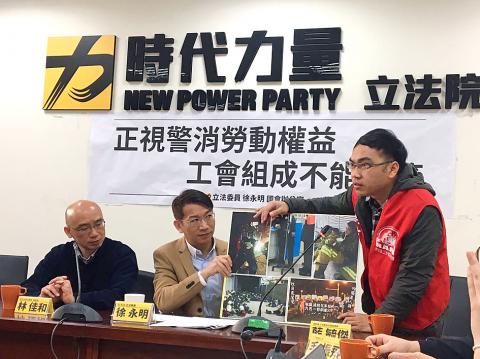
Photo: CNA
“Police and firefighters have just as much right to form unions as teachers, and by revising the Labor Union Act, we want to give that right,” Hsu said, citing similarities between working conditions for firefighters, police officers and ordinary workers.
Representatives of police officers’ and firefighters’ rights associations said formal organization was needed to force the government to negotiate key issues such as understaffing and long working hours.
“For any issue, from demanding normal shifts to reducing workload, we can only protest outside the National Police Administration in the heat, wind and rain, because we do not have the right to demand negotiations,” said Wu Tsung-che (吳宗哲), an executive director of the Taiwan Policemen’s Work Rights Promotion Association.
“We want the right to strike as a final resort, but the content of that right can be negotiated,” said Lan Yu-chieh (藍毓傑), a director at the National Association for Firefighters’ Rights, adding that firefighters are required to be on duty for at least 360 hours per month.
“The right to strike is separate from the right to organize,” National Chengchi University law professor Lin Chia-ho (林佳和) said, adding that a limited right to strike could also be granted without threatening basic social services.
“The right to strike is not all or nothing,” he said, citing provisions within the Act for Settlement of Labor-Management Disputes (勞資爭議處理法) which mandate that minimum or essential services be provided during strikes that affect hospitals, utilities and other basic services.

Considering that most countries issue more than five denominations of banknotes, the central bank has decided to redesign all five denominations, the bank said as it prepares for the first major overhaul of the banknotes in more than 24 years. Central bank Governor Yang Chin-lung (楊金龍) is expected to report to the Legislative Yuan today on the bank’s operations and the redesign’s progress. The bank in a report sent to the legislature ahead of today’s meeting said it had commissioned a survey on the public’s preferences. Survey results showed that NT$100 and NT$1,000 banknotes are the most commonly used, while NT$200 and NT$2,000

The Centers for Disease Control (CDC) yesterday reported the first case of a new COVID-19 subvariant — BA.3.2 — in a 10-year-old Singaporean girl who had a fever upon arrival in Taiwan and tested positive for the disease. The girl left Taiwan on March 20 and the case did not have a direct impact on the local community, it said. The WHO added the BA.3.2 strain to its list of Variants Under Monitoring in December last year, but this was the first imported case of the COVID-19 variant in Taiwan, CDC Deputy Director-General Lin Ming-cheng (林明誠) said. The girl arrived in Taiwan on

South Korea is planning to revise its controversial electronic arrival card, a step Taiwanese officials said prompted them to hold off on planned retaliatory measures, a South Korean media report said yesterday. A Yonhap News Agency report said that the South Korean Ministry of Foreign Affairs is planning to remove the “previous departure place” and “next destination” fields from its e-arrival card system. The plan, reached after interagency consultations, is under review and aims to simplify entry procedures and align the electronic form with the paper version, a South Korean ministry official said. The fields — which appeared only on the electronic form

The Ministry of Foreign Affairs (MOFA) is suspending retaliation measures against South Korea that were set to take effect tomorrow, after Seoul said it is updating its e-arrival system, MOFA said today. The measures were to be a new round of retaliation after Taiwan on March 1 changed South Korea's designation on government-issued alien resident certificates held by South Korean nationals to "South Korea” from the "Republic of Korea," the country’s official name. The move came after months of protests to Seoul over its listing of Taiwan as "China (Taiwan)" in dropdown menus on its new online immigration entry system. MOFA last week


 RSS
RSS