


Environmental groups yesterday protested in front of the Health Promotion Administration’s (HPA) building in Taipei, questioning the objectivity of health examinations conducted on 61 students of Ciaotou Elementary School’s Syucuo (許厝) branch, who were transferred to the main campus last semester to prevent exposure to pollutants.
The Syucuo students were transferred to the main branch last year due to the result of a three-year-study conducted by the National Health Research Institutes (NHRI) that found elevated levels of thiodiglycolic acid (TdGA) in their urine.
As high TdGA levels are an indicator of exposure to the carcinogen vinyl chloride monomer, environmental groups and parents suspect pollutants from Formosa Petrochemical Corp’s naphtha cracker in Yunlin County’s Mailiao Township (麥寮) — located only 900m from the Syucuo campus — to be the cause of the elevated levels.
However, after the Syucuo students had studied for a semester on the main campus — 5.5km from the cracker — examinations commissioned by the HPA and led by National Cheng Kung University professor Lee Ching-chang (李俊璋) found that the students’ urine contained even higher TdGA levels than previously.
After Lee’s research team suggested that the increased urinary TdGA levels might have been caused by increased consumption of eggs, a specialist meeting was held at the HPA yesterday morning to discuss the examination results.
Holding a banner reading “protect children’s health, reject wrongful study,” more than a dozen representatives from the groups protested against Lee’s test, and urged the HPA not to transfer the students back to the Syucuo campus.
Lee has conducted several studies commissioned by Formosa Petrochemical Corp, so the impartiality of the urine examinations is questionable, Taiwan Healthy Air Action Alliance director Yang Joe-ming (楊澤民) said, adding that Lee’s examination methods were over-simple and did not take environmental variables into consideration.
“The findings do not invalidate the results of the NHRI’s long-term study … he could not explain why the students’ urinary TdGA levels were even higher in some students,” Yunlin County Environmental Protection Union chairman Chang Tsu-chien (張子見) said. “The naphtha cracker is still a factor affecting their levels, and the risk to their health still exists.”
After the meeting, HPA Director Wang Ying-wei (王英偉) said that specialists have differing opinions on whether the students’ increased TdGA levels were caused by eggs, but added that he made it clear at the beginning of the meeting that the HPA would not make a reccomendation on whether the students should be transferred.
He said urinary TdGA levels can also be affected by having hepatitis B, vitamin consumption, breathing in secondhand cigarette smoke and other factors.
The decision to transfer the students was taken by the Cabinet last semester, so the local government plans to discuss the central government further, Yunlin County Commissioner Lee Chin-yung (李進勇) told reporters.


An essay competition jointly organized by a local writing society and a publisher affiliated with the Chinese Communist Party (CCP) might have contravened the Act Governing Relations Between the People of the Taiwan Area and the Mainland Area (臺灣地區與大陸地區人民關係條例), the Mainland Affairs Council (MAC) said on Thursday. “In this case, the partner organization is clearly an agency under the CCP’s Fujian Provincial Committee,” MAC Deputy Minister and spokesperson Liang Wen-chieh (梁文傑) said at a news briefing in Taipei. “It also involves bringing Taiwanese students to China with all-expenses-paid arrangements to attend award ceremonies and camps,” Liang said. Those two “characteristics” are typically sufficient
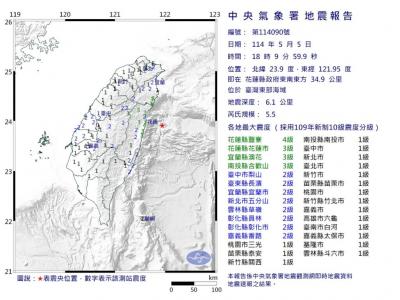
A magnitude 5.9 earthquake that struck about 33km off the coast of Hualien City was the "main shock" in a series of quakes in the area, with aftershocks expected over the next three days, the Central Weather Administration (CWA) said yesterday. Prior to the magnitude 5.9 quake shaking most of Taiwan at 6:53pm yesterday, six other earthquakes stronger than a magnitude of 4, starting with a magnitude 5.5 quake at 6:09pm, occurred in the area. CWA Seismological Center Director Wu Chien-fu (吳健富) confirmed that the quakes were all part of the same series and that the magnitude 5.5 temblor was
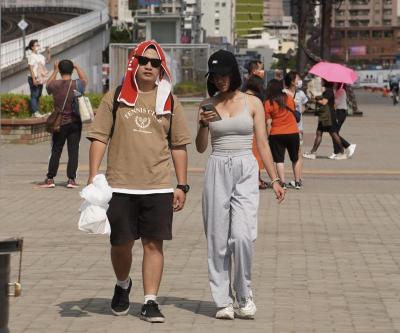
The Central Weather Administration has issued a heat alert for southeastern Taiwan, warning of temperatures as high as 36°C today, while alerting some coastal areas of strong winds later in the day. Kaohsiung’s Neimen District (內門) and Pingtung County’s Neipu Township (內埔) are under an orange heat alert, which warns of temperatures as high as 36°C for three consecutive days, the CWA said, citing southwest winds. The heat would also extend to Tainan’s Nansi (楠西) and Yujing (玉井) districts, as well as Pingtung’s Gaoshu (高樹), Yanpu (鹽埔) and Majia (瑪家) townships, it said, forecasting highs of up to 36°C in those areas

The brilliant blue waters, thick foliage and bucolic atmosphere on this seemingly idyllic archipelago deep in the Pacific Ocean belie the key role it now plays in a titanic geopolitical struggle. Palau is again on the front line as China, and the US and its allies prepare their forces in an intensifying contest for control over the Asia-Pacific region. The democratic nation of just 17,000 people hosts US-controlled airstrips and soon-to-be-completed radar installations that the US military describes as “critical” to monitoring vast swathes of water and airspace. It is also a key piece of the second island chain, a string of


 RSS
RSS