


Democratic Progressive Party (DPP) Legislator Gao Jyh-peng’s (高志鵬) proposal to redesign the nation’s currency to replace the images of Republic of China founding father Sun Yat-sen (孫逸仙) and former president Chiang Kai-shek (蔣介石) has sparked a heated public debate.
Gao on Thursday last week wrote on Facebook that while preparing hongbao (紅包, red envelopes) for the Lunar New Year holiday, some of his friends complained that they were tired of “looking at the faces of Sun and Chiang,” which are featured on the NT$100 bill, as well as the NT$50, NT$10, NT$5 and NT$1 coins.
“Banknotes and coins are not only the nation’s legal currency, they also represent our national identity and culture,” Gao wrote, adding that Sun and Chiang are “heroes only to some people.”
Gao said that after the holiday, he would propose legislation for the establishment of a “national currency design committee,” which would be tasked with creating new designs for the currency that are more in line with the nation’s current state of affairs.
The public should be allowed to participate in the process to ensure that there is a public consensus on the new designs, he said.
Amendments to the Central Bank Act (中央銀行法) are needed to fulfill this goal, Gao said.
Independence activists, academics and pro-localization groups have for many years called on the government to design new currencies, saying the images of Sun and Chiang are reminiscent of the White Terror-era and the Chinese Nationalist Party’s (KMT) dictatorship, during which Taiwanese faced harsh repression.
National Taipei University of Education professor Lee Hsiao-feng (李筱峰) said that KMT officials had painted Sun as the “nation’s founding father” by creating a personality cult and anoiting him like a deity.
“During his lifetime, Sun was never referred to as the ‘founding father’ and there is still an ongoing debate about his political career and place in history,” Lee said.
The issue has also stirred up heated discussion on the Internet, with many voicing support for Kao’s proposal.
Some said that having the image of a dictator who was mainly responsible for White Terror atrocities and the 228 Incident on the nation’s coins is like post-war Germany honoring Adolf Hitler.
Others suggested using the images of prominent Taiwanese artists, musicians, writers and social reformers instead.
However, some netizens said the DPP government should focus on improving the economy, instead of wasting energy on designing a new currency.

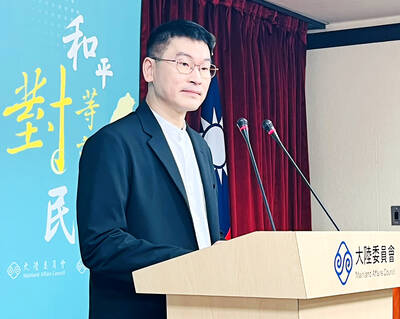
An essay competition jointly organized by a local writing society and a publisher affiliated with the Chinese Communist Party (CCP) might have contravened the Act Governing Relations Between the People of the Taiwan Area and the Mainland Area (臺灣地區與大陸地區人民關係條例), the Mainland Affairs Council (MAC) said on Thursday. “In this case, the partner organization is clearly an agency under the CCP’s Fujian Provincial Committee,” MAC Deputy Minister and spokesperson Liang Wen-chieh (梁文傑) said at a news briefing in Taipei. “It also involves bringing Taiwanese students to China with all-expenses-paid arrangements to attend award ceremonies and camps,” Liang said. Those two “characteristics” are typically sufficient
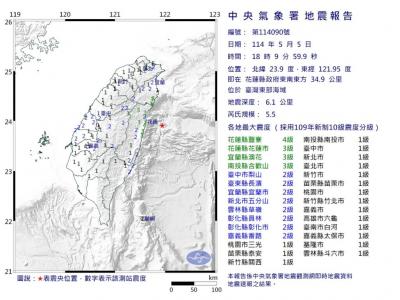
A magnitude 5.9 earthquake that struck about 33km off the coast of Hualien City was the "main shock" in a series of quakes in the area, with aftershocks expected over the next three days, the Central Weather Administration (CWA) said yesterday. Prior to the magnitude 5.9 quake shaking most of Taiwan at 6:53pm yesterday, six other earthquakes stronger than a magnitude of 4, starting with a magnitude 5.5 quake at 6:09pm, occurred in the area. CWA Seismological Center Director Wu Chien-fu (吳健富) confirmed that the quakes were all part of the same series and that the magnitude 5.5 temblor was
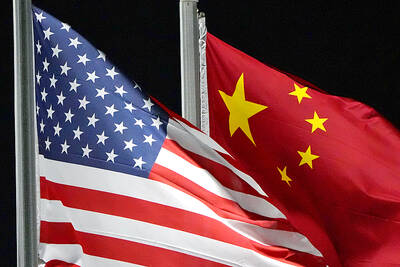
The brilliant blue waters, thick foliage and bucolic atmosphere on this seemingly idyllic archipelago deep in the Pacific Ocean belie the key role it now plays in a titanic geopolitical struggle. Palau is again on the front line as China, and the US and its allies prepare their forces in an intensifying contest for control over the Asia-Pacific region. The democratic nation of just 17,000 people hosts US-controlled airstrips and soon-to-be-completed radar installations that the US military describes as “critical” to monitoring vast swathes of water and airspace. It is also a key piece of the second island chain, a string of
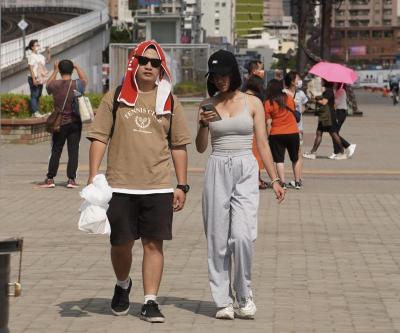
The Central Weather Administration has issued a heat alert for southeastern Taiwan, warning of temperatures as high as 36°C today, while alerting some coastal areas of strong winds later in the day. Kaohsiung’s Neimen District (內門) and Pingtung County’s Neipu Township (內埔) are under an orange heat alert, which warns of temperatures as high as 36°C for three consecutive days, the CWA said, citing southwest winds. The heat would also extend to Tainan’s Nansi (楠西) and Yujing (玉井) districts, as well as Pingtung’s Gaoshu (高樹), Yanpu (鹽埔) and Majia (瑪家) townships, it said, forecasting highs of up to 36°C in those areas


 RSS
RSS