


The Grass Mountain Teen Club, a brick compound on Yangmingshan (陽明山) that served as a club for US soldiers and their families stationed in Taiwan from the 1950s to the 1970s, has reopened as a public space for music, food and nostalgia.
The former club, built in the 1950s and named Grass Mountain Teen Club in 1968, has been renamed the Brick Yard 33 1/3 (BY33). Combining indoor and outdoor spaces, it is a place where people can listen to vinyl records, eat food inspired by southern US cuisine and savor the atmosphere.
The project was undertaken under the Old House renaissance program launched by the Taipei City Government in 2012. Private investors were encouraged to join the project to restore “cultural properties” that had been abandoned and “revive” them by transforming them into cultural and creative spaces.
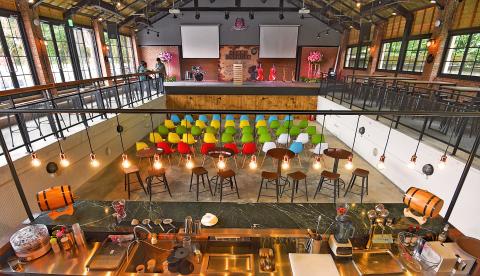
Photo: Chu Pei-hsiung, Taipei Times
In 2014, U-Tech Media Corp won a public tender to renovate the US soldiers’ club, which consisted of red-brick buildings and two swimming pools on a nearly 3,300m2 site on a Yangmingshan hillside.
The compound, which was part of a cluster of dormitories for US military personnel stationed in Taiwan, was a key leisure site of the soldiers and their family members in the 1950s to 1970s.
At the BY33 opening ceremony on Thursday last week, U-Tech Media chairman Steve Chang (張昭焚) said the company budgeted NT$70 million (US$2.22 million) to restore the old compound, but spent NT$95 million because it wanted the renovation to be as close to its original state as possible.
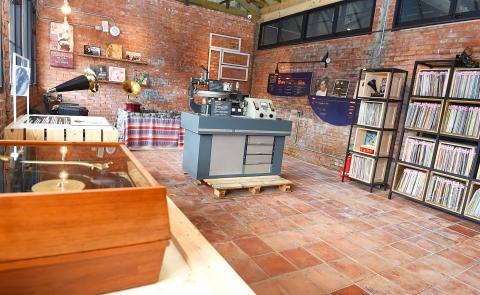
Photo: Chu Pei-hsiung, Taipei Times
Gordon Yeh (葉垂景), chairman of the Ritek Group, which founded U-Tech Media, said the company was determined to restore the buildings using their original construction techniques and it scoured the nation for builders with knowledge of traditional skills to assist in the project.
His team located the factory that produced the roof tiles used when the club was remodeled more than 30 years ago and found more than 10,000 of the same tiles still in the factory’s inventory, Yeh said.
After more than two years of construction, the club was transformed into a multipurpose complex divided into three areas: a dining room, a music room and a public bar.
There are also plenty of indoor and outdoor spaces for exhibitions and performances, according to U-Tech Media.
“We hope to attract locals, schools and other organizations,” U-Tech general manager Lo Yi-fu (羅宜富) said. “We built an exclusive space for people to listen to vinyl records and hold performances, mixing old and new music, Western and Oriental music.”
BY33 is open every day from 11am to 9pm except for Jan. 27 and Jan. 28 during the Lunar New Year holiday.
Access may be restricted when there are exclusive activities, but admission is free.

Considering that most countries issue more than five denominations of banknotes, the central bank has decided to redesign all five denominations, the bank said as it prepares for the first major overhaul of the banknotes in more than 24 years. Central bank Governor Yang Chin-lung (楊金龍) is expected to report to the Legislative Yuan today on the bank’s operations and the redesign’s progress. The bank in a report sent to the legislature ahead of today’s meeting said it had commissioned a survey on the public’s preferences. Survey results showed that NT$100 and NT$1,000 banknotes are the most commonly used, while NT$200 and NT$2,000

The Centers for Disease Control (CDC) yesterday reported the first case of a new COVID-19 subvariant — BA.3.2 — in a 10-year-old Singaporean girl who had a fever upon arrival in Taiwan and tested positive for the disease. The girl left Taiwan on March 20 and the case did not have a direct impact on the local community, it said. The WHO added the BA.3.2 strain to its list of Variants Under Monitoring in December last year, but this was the first imported case of the COVID-19 variant in Taiwan, CDC Deputy Director-General Lin Ming-cheng (林明誠) said. The girl arrived in Taiwan on

South Korea is planning to revise its controversial electronic arrival card, a step Taiwanese officials said prompted them to hold off on planned retaliatory measures, a South Korean media report said yesterday. A Yonhap News Agency report said that the South Korean Ministry of Foreign Affairs is planning to remove the “previous departure place” and “next destination” fields from its e-arrival card system. The plan, reached after interagency consultations, is under review and aims to simplify entry procedures and align the electronic form with the paper version, a South Korean ministry official said. The fields — which appeared only on the electronic form

The Ministry of Foreign Affairs (MOFA) is suspending retaliation measures against South Korea that were set to take effect tomorrow, after Seoul said it is updating its e-arrival system, MOFA said today. The measures were to be a new round of retaliation after Taiwan on March 1 changed South Korea's designation on government-issued alien resident certificates held by South Korean nationals to "South Korea” from the "Republic of Korea," the country’s official name. The move came after months of protests to Seoul over its listing of Taiwan as "China (Taiwan)" in dropdown menus on its new online immigration entry system. MOFA last week


 RSS
RSS