


The majority of people in Taiwan prefer to conduct banking transactions in person rather than online, a survey by global information technology company Unisys said.
The survey, conducted in September last year, found that 74 percent of consumers preferred visiting a bank in person, while 19 percent preferred to bank online, 5 percent would rather use a mobile banking app and 2 percent would opt for telephone transactions.
Among seven Asia-Pacific regions questioned in the survey, Taiwan and Hong Kong had the highest preference for in-person banking (74 percent), followed by the Philippines with 73 percent, Malaysia 67 percent, Australia 53 percent and New Zealand 42 percent, according to the survey.
The majority of people in all seven nations said that they were likely to make payments, research banking products and check their account balances via a bank’s Web site, Unisys said.
“However, Taiwan consistently recorded the lowest use of mobile banking apps of all countries surveyed and a higher preference for using a branch than most other countries,” Unisys said.
The survey also found that long queues in branches were the biggest annoyance to consumers in Taiwan when dealing with a bank.
This finding “suggests there is substantial opportunity for Taiwan’s banks to extend digital banking strategies to improve the customer experience and reduce operational costs,” Unisys said in its report, which was published in November last year.
Eric Crabtree, Unisys vice president and global head of financial services, said that in Taiwan’s crowded retail banking market, it is critical for banks to differentiate themselves to increase their domestic market share, defend against overseas banks entering Taiwan or expand overseas business.
“Branches still play a key role in educating customers on their financial future, but most bank transactions can be done via more convenient digital channels,” Crabtree said.
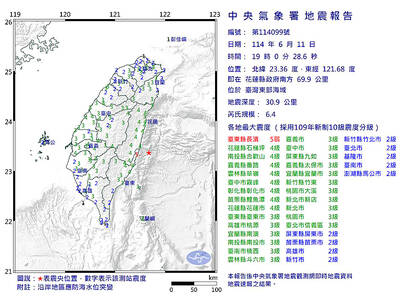
A magnitude 6.4 earthquake struck off the coast of Hualien County in eastern Taiwan at 7pm yesterday, the Central Weather Administration (CWA) said. The epicenter of the temblor was at sea, about 69.9km south of Hualien County Hall, at a depth of 30.9km, it said. There were no immediate reports of damage resulting from the quake. The earthquake’s intensity, which gauges the actual effect of a temblor, was highest in Taitung County’s Changbin Township (長濱), where it measured 5 on Taiwan’s seven-tier intensity scale. The quake also measured an intensity of 4 in Hualien, Nantou, Chiayi, Yunlin, Changhua and Miaoli counties, as well as

Credit departments of farmers’ and fishers’ associations blocked a total of more than NT$180 million (US$6.01 million) from being lost to scams last year, National Police Agency (NPA) data showed. The Agricultural Finance Agency (AFA) said last week that staff of farmers’ and fishers’ associations’ credit departments are required to implement fraud prevention measures when they serve clients at the counter. They would ask clients about personal financial management activities whenever they suspect there might be a fraud situation, and would immediately report the incident to local authorities, which would send police officers to the site to help, it said. NPA data showed

ENERGY RESILIENCE: Although Alaska is open for investments, Taiwan is sourcing its gas from the Middle East, and the sea routes carry risks, Ho Cheng-hui said US government officials’ high-profile reception of a Taiwanese representative at the Alaska Sustainable Energy Conference indicated the emergence of an Indo-Pacific energy resilience alliance, an academic said. Presidential Office Secretary-General Pan Men-an (潘孟安) attended the conference in Alaska on Thursday last week at the invitation of the US government. Pan visited oil and gas facilities with senior US officials, including US Secretary of the Interior Doug Burgum, US Secretary of Energy Chris Wright, Alaska Governor Mike Dunleavy and US Senator Daniel Sullivan. Pan attending the conference on behalf of President William Lai (賴清德) shows a significant elevation in diplomatic representation,
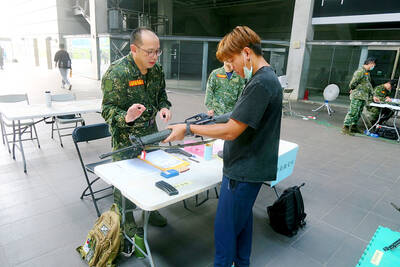
The Taipei City Reserve Command yesterday initiated its first-ever 14-day recall of some of the city’s civilian service reservists, who are to undergo additional training on top of refresher courses. The command said that it rented sites in Neihu District (內湖), including the Taipei Tennis Center, for the duration of the camp to optimize tactical positioning and accommodate the size of the battalion of reservists. A battalion is made up of four companies of more than 200 reservists each, it said. Aside from shooting drills at a range in New Taipei City’s Linkou District (林口), the remainder of the training would be at


 RSS
RSS