


Prosecutors yesterday searched Taoyuan-based Grape King Bio Ltd’s (葡萄王生技) production facilities and offices, and summoned several employees for questioning in connection with allegations of repackaging and selling expired products.
The Taipei District Prosecutors’ Office headed the search at 10 locations in Taipei and Taoyuan, confiscating business records and documents at the company’s facilities, with the investigation focusing on fraud and forgery allegations, along with alleged violations of the Act Governing Food Safety and Sanitation (食品安全衛生管理法).
Grape King Bio is a leading local brand of biological products, medicinal drinks and health supplements, and was founded by Tseng Shui-chao (曾水照).
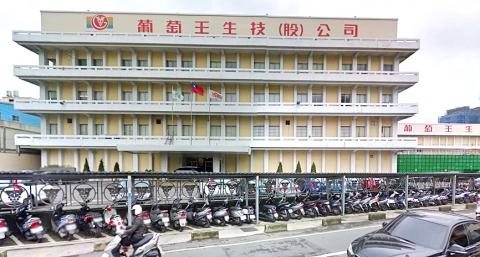
Photo: Lee Jung-ping, Taipei Times
Although the company is publicly listed, its operations are mainly controlled by Tseng’s children.
An investigation was launched earlier this week after media reports quoted employees as saying that they were instructed by supervisors to alter expiration dates and repackage expired goods as new products.
The reports said that the company has in the past few years sold six products past their expiration dates, including Ganoderma extract pills, which are made from Ganoderma mushrooms, touted by traditional Chinese medicine practitioners for their health benefits and pharmaceutical properties against a variety of illnesses.
The company reportedly had more than 110,000 Ganoderma extract pills which had expired in 2012 and were relabeled with a new expiry date in 2015.
Food and Drug Administration inspectors on Wednesday conducted an investigation at the company’s production facilities and warehouses, and prosecutors detained 10 employees for questioning, including production section chief Chang An-cheng (張安掙), and business manager Su Chia-li (蘇家瑮).
Six employees were released after posting bail yesterday morning following questioning.
According to prosecutors, some employees admitted altering the expiration dates and relabeling expired products, but said they were acting under instructions from their supervisors.
Prosecutors were still questioning company chairman Tseng Sheng-lin (曾盛麟), his sister, general manager Tseng Mei-ching (曾美菁), and other company executives by press time last night.
News of the alleged fraud hit the company’s shares, which closed at NT$187 yesterday.
The company’s stock has plummeted 21.7 percent since Dec. 1.
Tseng Sheng-lin on Wednesday summoned company executives for an emergency meeting, followed by a news conference, where he denied the allegations and said all the products made by the company conform to safety standards, and accused a member of the Tseng family of spreading rumors amid a row to gain control of the company.
“The rumors are not true and we regret the situation,” he said.

Considering that most countries issue more than five denominations of banknotes, the central bank has decided to redesign all five denominations, the bank said as it prepares for the first major overhaul of the banknotes in more than 24 years. Central bank Governor Yang Chin-lung (楊金龍) is expected to report to the Legislative Yuan today on the bank’s operations and the redesign’s progress. The bank in a report sent to the legislature ahead of today’s meeting said it had commissioned a survey on the public’s preferences. Survey results showed that NT$100 and NT$1,000 banknotes are the most commonly used, while NT$200 and NT$2,000

The Centers for Disease Control (CDC) yesterday reported the first case of a new COVID-19 subvariant — BA.3.2 — in a 10-year-old Singaporean girl who had a fever upon arrival in Taiwan and tested positive for the disease. The girl left Taiwan on March 20 and the case did not have a direct impact on the local community, it said. The WHO added the BA.3.2 strain to its list of Variants Under Monitoring in December last year, but this was the first imported case of the COVID-19 variant in Taiwan, CDC Deputy Director-General Lin Ming-cheng (林明誠) said. The girl arrived in Taiwan on

South Korea is planning to revise its controversial electronic arrival card, a step Taiwanese officials said prompted them to hold off on planned retaliatory measures, a South Korean media report said yesterday. A Yonhap News Agency report said that the South Korean Ministry of Foreign Affairs is planning to remove the “previous departure place” and “next destination” fields from its e-arrival card system. The plan, reached after interagency consultations, is under review and aims to simplify entry procedures and align the electronic form with the paper version, a South Korean ministry official said. The fields — which appeared only on the electronic form

The Ministry of Foreign Affairs (MOFA) is suspending retaliation measures against South Korea that were set to take effect tomorrow, after Seoul said it is updating its e-arrival system, MOFA said today. The measures were to be a new round of retaliation after Taiwan on March 1 changed South Korea's designation on government-issued alien resident certificates held by South Korean nationals to "South Korea” from the "Republic of Korea," the country’s official name. The move came after months of protests to Seoul over its listing of Taiwan as "China (Taiwan)" in dropdown menus on its new online immigration entry system. MOFA last week


 RSS
RSS