


Two suspects were charged and released after posting bail yesterday after an investigation into a woman’s death found that she had consumed recreational drugs in “narcotic coffee powder” mixed with alcoholic drinks at a days-long party at a luxury hotel in Taipei.
Prosecutors had summoned three men — Chiang Che-wei (江哲瑋), Hung Sheng-yan (洪聖晏) and one surnamed Chu (朱) — for questioning, as they were with the 21-year-old woman, surnamed Kuo (郭), in the hotel room on Wednesday prior to her losing consciousness.
After questioning at the Taipei District Prosecutors’ Office, Hung and Chiang were charged with negligence resulting in death before being released on bail of NT$300,000 and NT$100,000 respectively.
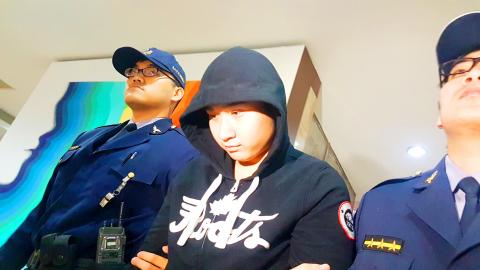
Photo: Chien Lee-chung, Taipei Times
Investigators from the Xinyi District (信義) Police Precinct yesterday questioned a young woman surnamed Liu (劉), who reportedly attended the drug-and-alcohol-fueled sex party and helped carry Kuo to the hotel’s lobby, where she was taken by taxi to Cathay General Hospital.
According to a police report, Chu, a wealthy socialite, rented a VIP suite on the 25th floor of the W Hotel for five days and invited Hung and other friends to the party.
Hung then contacted Chiang, who works at a nightclub, and other male friends who invited five female acquaintances to the party, which lasted four days, with people coming and going throughout that period, the report said.
Kuo, who was reportedly invited by Chiang, arrived on Sunday last week and was carried out unconscious on Wednesday.
During questioning, Chiang said partygoers had sex and indulged in food, alcoholic beverages and “narcotic coffee powder.”
According to police, “narcotic coffee powder” is a new form of recreational drug that has become popular among young people. They said it has become one of the leading causes of drug overdose-related deaths.
The mixture — consisting of cannabis, amphetamines or mephedrone (commonly known as “bath salts”) mixed with other stimulants and narcotics, according to police — is sealed in packets and often disguised as commercial ground coffee, which is not easily detected, they said.
Chiang reportedly told investigators that Kuo had consumed alcoholic drinks and the mixture.
Blood tests confirmed that she had consumed illegal drugs, but her cause of death has not been determined, officials said.
Police conducted drug tests on urine samples from the three men and Liu to check if they also consumed illegal drugs.
Investigators suspect that besides the drugs and alcohol, sexual assault and violence might have contributed to Kuo’s death.
Kuo’s family, who live in Taitung County, said she had worked as a model, rejecting speculation that she was an escort.
Kuo was a nice girl and was not prone to partying, relatives said, demanding that authorities conduct a thorough investigation, as they suspect she was sexually abused after being force-fed drugs.

Considering that most countries issue more than five denominations of banknotes, the central bank has decided to redesign all five denominations, the bank said as it prepares for the first major overhaul of the banknotes in more than 24 years. Central bank Governor Yang Chin-lung (楊金龍) is expected to report to the Legislative Yuan today on the bank’s operations and the redesign’s progress. The bank in a report sent to the legislature ahead of today’s meeting said it had commissioned a survey on the public’s preferences. Survey results showed that NT$100 and NT$1,000 banknotes are the most commonly used, while NT$200 and NT$2,000

The Centers for Disease Control (CDC) yesterday reported the first case of a new COVID-19 subvariant — BA.3.2 — in a 10-year-old Singaporean girl who had a fever upon arrival in Taiwan and tested positive for the disease. The girl left Taiwan on March 20 and the case did not have a direct impact on the local community, it said. The WHO added the BA.3.2 strain to its list of Variants Under Monitoring in December last year, but this was the first imported case of the COVID-19 variant in Taiwan, CDC Deputy Director-General Lin Ming-cheng (林明誠) said. The girl arrived in Taiwan on

South Korea is planning to revise its controversial electronic arrival card, a step Taiwanese officials said prompted them to hold off on planned retaliatory measures, a South Korean media report said yesterday. A Yonhap News Agency report said that the South Korean Ministry of Foreign Affairs is planning to remove the “previous departure place” and “next destination” fields from its e-arrival card system. The plan, reached after interagency consultations, is under review and aims to simplify entry procedures and align the electronic form with the paper version, a South Korean ministry official said. The fields — which appeared only on the electronic form

The Ministry of Foreign Affairs (MOFA) is suspending retaliation measures against South Korea that were set to take effect tomorrow, after Seoul said it is updating its e-arrival system, MOFA said today. The measures were to be a new round of retaliation after Taiwan on March 1 changed South Korea's designation on government-issued alien resident certificates held by South Korean nationals to "South Korea” from the "Republic of Korea," the country’s official name. The move came after months of protests to Seoul over its listing of Taiwan as "China (Taiwan)" in dropdown menus on its new online immigration entry system. MOFA last week


 RSS
RSS