


The Council of Agriculture (COA) yesterday said it would promote agricultural cooperation with four countries under the government’s “new southbound policy.”
The four countries have yet to be finalized, but will probably be Vietnam, Thailand, Myanmar and Indonesia, council officials said, although they did not rule out other countries being included.
In a report on “new southbound agriculture” at a Cabinet meeting, the council said that the nation relies too heavily on the Chinese market for exports of its agricultural products and that it is urgent and necessary to diversify its markets.
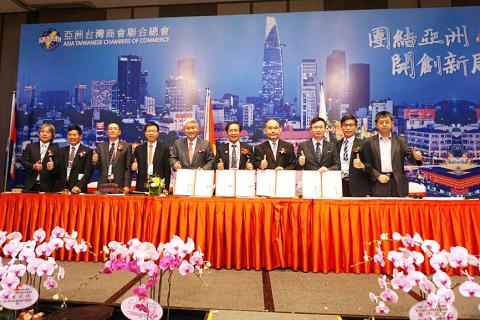
Photo: CNA
The strategy will include maintaining existing export markets and actively tapping into emerging markets, such as ASEAN, South Asia, New Zealand and Australia, the council said.
Under the “new southbound agriculture,” the council will seek to increase business opportunities and contributions by investing in select countries’ agricultural industries and exporting agricultural machinery.
The goals will be to develop full cooperation in agriculture with the four countries and help agriculture enterprises set up at least 10 model farms in those countries, the council said.
In related news, the Agricultural Technology Research Institute (ATRI) on Saturday signed additional accords in agriculture cooperation with ASEAN members.
The government-sponsored ATRI inked memoranda of understanding on agricultural cooperation with the Asia Taiwanese Chambers of Commerce (ATCC) and Taiwanese investor associations from Cambodia, Laos and Brunei, in Ho Chi Minh City, Vietnam.
Since September, the ARTI, which has set its sights on closer ties with ASEAN, has signed similar cooperation agreements with Taiwanese investor associations in eight ASEAN countries designed to accelerate the pace of agricultural development.
In addition to Cambodia, Laos and Brunei, the institute has signed accords with Taiwanese investor associations based in Thailand, Vietnam, Malaysia, Singapore and the Philippines, the institute said.
New Southbound Policy Office Director James Huang (黃志芳), who witnessed the signing ceremony, on Tuesday said that agricultural cooperation and promotion is one of his office’s key policy areas.
ATCC head Lee Tien-chi (李天柒) said that he was glad to see the ATRI achieve so much in just a few of months in terms of promoting agricultural cooperation with ASEAN, adding that such efforts have strengthened exchanges between Taiwan and the region.
The agricultural sector is one of Taiwan’s economic strengths and the nation should take advantage of its expertise to forge closer relationships with ASEAN members, many of which are focused on agricultural development, Lee said.
Chung Chia-pin (鍾佳濱), a Democratic Progressive Party legislator from Pingtung County who also attended the signing ceremony, said that he hoped the government would introduce Pingtung’s agricultural development to ASEAN as a model for development, as the county is one of Taiwan’s most important agricultural areas.

Considering that most countries issue more than five denominations of banknotes, the central bank has decided to redesign all five denominations, the bank said as it prepares for the first major overhaul of the banknotes in more than 24 years. Central bank Governor Yang Chin-lung (楊金龍) is expected to report to the Legislative Yuan today on the bank’s operations and the redesign’s progress. The bank in a report sent to the legislature ahead of today’s meeting said it had commissioned a survey on the public’s preferences. Survey results showed that NT$100 and NT$1,000 banknotes are the most commonly used, while NT$200 and NT$2,000

The Centers for Disease Control (CDC) yesterday reported the first case of a new COVID-19 subvariant — BA.3.2 — in a 10-year-old Singaporean girl who had a fever upon arrival in Taiwan and tested positive for the disease. The girl left Taiwan on March 20 and the case did not have a direct impact on the local community, it said. The WHO added the BA.3.2 strain to its list of Variants Under Monitoring in December last year, but this was the first imported case of the COVID-19 variant in Taiwan, CDC Deputy Director-General Lin Ming-cheng (林明誠) said. The girl arrived in Taiwan on

South Korea is planning to revise its controversial electronic arrival card, a step Taiwanese officials said prompted them to hold off on planned retaliatory measures, a South Korean media report said yesterday. A Yonhap News Agency report said that the South Korean Ministry of Foreign Affairs is planning to remove the “previous departure place” and “next destination” fields from its e-arrival card system. The plan, reached after interagency consultations, is under review and aims to simplify entry procedures and align the electronic form with the paper version, a South Korean ministry official said. The fields — which appeared only on the electronic form

The Ministry of Foreign Affairs (MOFA) is suspending retaliation measures against South Korea that were set to take effect tomorrow, after Seoul said it is updating its e-arrival system, MOFA said today. The measures were to be a new round of retaliation after Taiwan on March 1 changed South Korea's designation on government-issued alien resident certificates held by South Korean nationals to "South Korea” from the "Republic of Korea," the country’s official name. The move came after months of protests to Seoul over its listing of Taiwan as "China (Taiwan)" in dropdown menus on its new online immigration entry system. MOFA last week


 RSS
RSS