


The seizure on Wednesday by Hong Kong Customs of armored vehicles belonging to the Singapore military onboard a container ship from Taiwan has sparked concern from Taiwanese military observers of possible involvement from Beijing.
Hong Kong media on Thursday reported that Hong Kong Customs officers on Wednesday night discovered armored vehicles at Hong Kong’s Kwai Chung Container Terminals, unloaded from a container ship that left Taiwan en route to Singapore.
While Ministry of National Defense spokesman Major General Chen Chung-chi (陳中吉) said the armored vehicles are “definitely not military vehicles from the Republic of China,” the Singaporean Ministry of Defense on Thursday evening confirmed the seizure, without mentioning Taiwan.
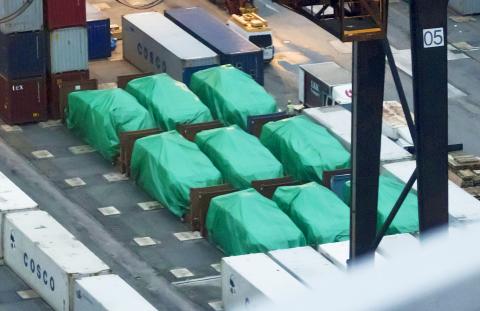
Photo: AP
The shipment of Terrex Infantry Carrier Vehicles (ICVs) and other military equipment is being held in Hong Kong on a request for “routine inspections by the Hong Kong Customs authorities,” the Singarorean ministry said.
“The Terrex ICVs were used by the Singaporean armed forces in routine overseas training and shipped back via commercial means as with previous exercises,” the statement said.
Taiwan and Singapore have a long-standing defense agreement signed in 1974. Under Project Starlight, Singaporean troops are allowed to train in Taiwan alongside Taiwanese troops and the city-state has operated three military training camps in Taiwan since 1975, sending up to 15,000 troops a year to train in Taiwan.
Project Starlight was agreed to by then-Singaporean prime minister Lee Kuan Yew (李光耀) with Taiwan to carry out the project as a means of overcoming the limited land area for training exercises in Singapore.
Under the project, Singapore sends troops to Taiwan annually for training.
A military source said that the two nations had a tacit understanding that the training exercises should be kept secret given the sensitive nature of the arrangement.
The agreement became public when, during routine training exercises in 2007, a Republic of China Air Force F-5F Tiger fighter jet crashed into a military complex in Hsinchu County, killing Singaporean servicemen who were inside at the time.
Army, navy and air force training exercises are all included in Project Starlight, the source said, adding that particular attention is given to special forces paratrooper training.
In 1999 the two nations cooperated on the Wanhsiang Project focusing on the development of underwater eavesdropping technology and the training of marines, the source said.
Air force personnel have also been sent to Singapore to help with the development of the nation’s air force, the source said.
A military official, who declined to be named, said Singaporean servicemen have been conducting armored vehicle training in Hsinchu’s Hukou Township (湖口), artillery regiment training at the Meilin Camp in Yunlin County, and marine corps training in Pingtung County’s Hengchun Township (恆春).
Taiwan and Singapore have also conducted simulation combat exercises against each other in recent years, the official said, adding that there is a solid foundation of cooperative between the two nations.
The number of troop coming to Taiwan for training might have declined in recent years, as Singapore has shifted some of its training to China, sources said.
China has been pursuing closer military ties with Singapore, inviting the military to train on Hainan Island, a source said.
In 2014, Singapore conducted joint training exercises with the Nanjing Military Region of the Chinese People’s Liberation Army, engaging in exercises for mountain-based combat, sources said.
Given the focus of the Nanjing Military is combat readiness for operations against Taiwan, the joint training exercises with Taiwan’s long-term military ally Singapore are seen as a challenge to the nation, sources said, adding that Wednesday’s seizure of military vehicles seems to corroborate these suspicions.

The Centers for Disease Control (CDC) yesterday reported the first case of a new COVID-19 subvariant — BA.3.2 — in a 10-year-old Singaporean girl who had a fever upon arrival in Taiwan and tested positive for the disease. The girl left Taiwan on March 20 and the case did not have a direct impact on the local community, it said. The WHO added the BA.3.2 strain to its list of Variants Under Monitoring in December last year, but this was the first imported case of the COVID-19 variant in Taiwan, CDC Deputy Director-General Lin Ming-cheng (林明誠) said. The girl arrived in Taiwan on

South Korea is planning to revise its controversial electronic arrival card, a step Taiwanese officials said prompted them to hold off on planned retaliatory measures, a South Korean media report said yesterday. A Yonhap News Agency report said that the South Korean Ministry of Foreign Affairs is planning to remove the “previous departure place” and “next destination” fields from its e-arrival card system. The plan, reached after interagency consultations, is under review and aims to simplify entry procedures and align the electronic form with the paper version, a South Korean ministry official said. The fields — which appeared only on the electronic form

The Ministry of Foreign Affairs (MOFA) is suspending retaliation measures against South Korea that were set to take effect tomorrow, after Seoul said it is updating its e-arrival system, MOFA said today. The measures were to be a new round of retaliation after Taiwan on March 1 changed South Korea's designation on government-issued alien resident certificates held by South Korean nationals to "South Korea” from the "Republic of Korea," the country’s official name. The move came after months of protests to Seoul over its listing of Taiwan as "China (Taiwan)" in dropdown menus on its new online immigration entry system. MOFA last week

A bipartisan group of US senators has introduced a bill to enhance cooperation with Taiwan on drone development and to reduce reliance on supply chains linked to China. The proposed Blue Skies for Taiwan Act of 2026 was introduced by Republican US senators Ted Cruz and John Curtis, and Democratic US senators Jeff Merkley and Andy Kim. The legislation seeks to ease constraints on Taiwan-US cooperation in uncrewed aerial systems (UAS), including dependence on China-sourced components, limited access to capital and regulatory barriers under US export controls, a news release issued by Cruz on Wednesday said. The bill would establish a "Blue UAS


 RSS
RSS