


Bricks from a demolished historical estate in Tainan have been used to make pottery glaze for charitable causes and to promote local art and crafts, Shanhua District Administrator Lee Huang-hsing (李皇興) said.
On Dec. 4 last year the estate of historical figure Chen Tzu-yung (陳子鏞) in Shanhua District (善化) was demolished, despite the Tainan City Government designating the ruins as a provisional cultural heritage site.
The city’s Cultural Affairs Bureau made the designation two days prior to the demolition.
Later, local conservationists asked the Shanhua District Office to think of a way to preserve the Chen estate in spirit using the bricks, which they said still possessed cultural value.
Lee said his office has been promoting pottery arts and crafts in the district, and said the bricks could be used.
Following a long period of experimentation, Huang Yi-wen (黃怡文), a professional pottery artist enlisted by the office to help with the project, developed a red glaze from the bricks that could be applied to ceramics, Lee said.
Huang conducted about 100 experiments to create a working formula to produce the glaze and a technique for applying it, Lee said.
The glaze’s red color — which comes from the bricks’ iron content — is a fitting representation of Chen’s “hot blood” in his passionate resistance against Japanese colonialism, Lee said.
Historians say that Chen raised a local force using his own money to defend Tainan against the invading Japanese imperial army in 1895 at the end of the First Sino-Japanese War.
Shanhua District Home for Arts and Crafts, a communal pottery workshop, was established by the office on the site of the former Tianliao Community Activities Center, which had become idle following construction of a new community center in 2013, Lee said.
A charitable sale of pottery at the workshop is to raise money for the Huashang Social Welfare Foundation, Lee said, adding that many pottery associations use the workshop to market their products.
A portion of the proceeds are to be donated to a charitable cause the office works with, he said.
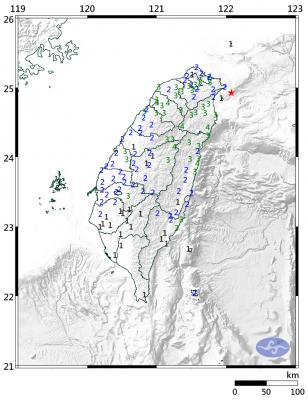
A magnitude 6.1 earthquake struck off the coast of Yilan County at 8:39pm tonight, the Central Weather Administration (CWA) said, with no immediate reports of damage or injuries. The epicenter was 38.7km east-northeast of Yilan County Hall at a focal depth of 98.3km, the CWA’s Seismological Center said. The quake’s maximum intensity, which gauges the actual physical effect of a seismic event, was a level 4 on Taiwan’s 7-tier intensity scale, the center said. That intensity level was recorded in Yilan County’s Nanao Township (南澳), Hsinchu County’s Guansi Township (關西), Nantou County’s Hehuanshan (合歡山) and Hualien County’s Yanliao (鹽寮). An intensity of 3 was
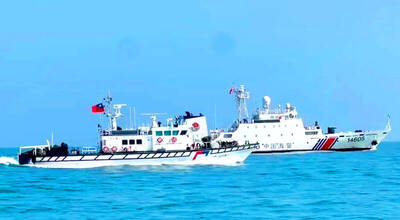
Instead of focusing solely on the threat of a full-scale military invasion, the US and its allies must prepare for a potential Chinese “quarantine” of Taiwan enforced through customs inspections, Stanford University Hoover fellow Eyck Freymann said in a Foreign Affairs article published on Wednesday. China could use various “gray zone” tactics in “reconfiguring the regional and ultimately the global economic order without a war,” said Freymann, who is also a nonresident research fellow at the US Naval War College. China might seize control of Taiwan’s links to the outside world by requiring all flights and ships entering or leaving Taiwan
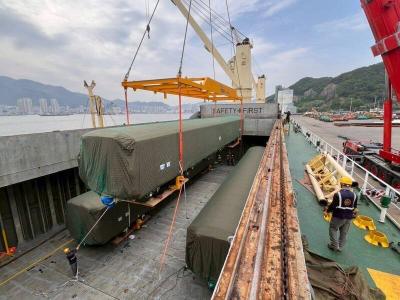
The first of 10 new high-capacity trains purchased from South Korea’s Hyundai Rotem arrived at the Port of Taipei yesterday to meet the demands of an expanding metro network, Taipei Rapid Transit Corp (TRTC) said yesterday. The train completed a three-day, 1,200km voyage from the Port of Masan in South Korea, the company said. Costing NT$590 million (US$18.79 million) each, the new six-carriage trains feature a redesigned interior based on "human-centric" transportation concepts, TRTC said. The design utilizes continuous longitudinal seating to widen the aisles and optimize passenger flow, while also upgrading passenger information displays and driving control systems for a more comfortable
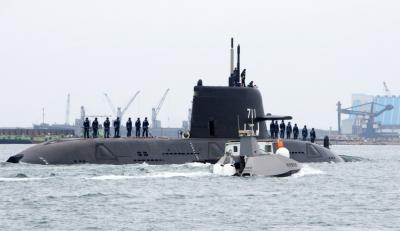
Taiwan's first indigenous defense submarine, the SS-711 Hai Kun (海鯤, or Narwhal), departed for its 13th sea trial at 7am today, marking its seventh submerged test, with delivery to the navy scheduled for July. The outing also marked its first sea deployment since President William Lai (賴清德) boarded the submarine for an inspection on March 19, drawing a crowd of military enthusiasts who gathered to show support. The submarine this morning departed port accompanied by CSBC Corp’s Endeavor Manta (奮進魔鬼魚號) uncrewed surface vessel and a navy M109 assault boat. Amid public interest in key milestones such as torpedo-launching operations and overnight submerged trials,


 RSS
RSS