


The Ministry of Foreign Affairs (MOFA) on Tuesday said that changing the ownership registration of its main office in Tokyo — registered in the name of former representative to Japan Ma Chi-chuang (馬紀壯), who died 18 years ago — is prohibitively expensive, with alterations to each deed estimated to cost at least ¥70 million (US$674,000).
The ministry was responding to comments made by Representative to Japan Frank Hsieh (謝長廷), who criticized the ministry for registering the properties of the Taipei Economic and Cultural Representative Office in Japan in the name of a private individual.
According to ministry data, in addition to the representative office’s properties in Tokyo, its properties in Yokohama, Osaka, Fukuoka and other cities are similarly registered in the names of former representatives, including Ke Chen-hua (柯振華), Shen Kuo-hsiung (沈國雄) and Kuo Ming-shan (郭明山).
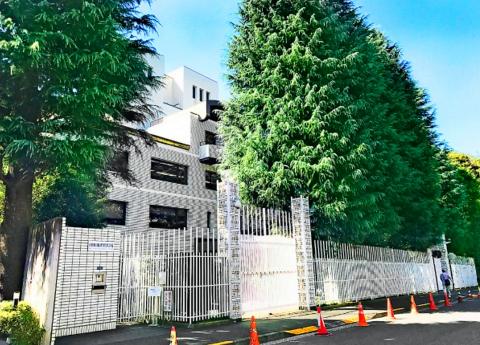
Photo: Chang Mao-sen, Taipei Times
However, the ministry denied that it had procrastinated on changing the registrations of the properties when representatives are transferred or replaced, saying it had considered making the changes, but those plans were abandoned due to the high costs of altering the deeds when there are no legal liabilities associated with registering them in the names of individuals.
In each case, legally binding documents that affirm the government’s ownership of the properties had been signed by the nominal owners, which barred them from bequeathing or transferring the properties to another party, the ministry said.
Under those circumstances, the high costs of altering the deeds are not justified, it said, adding that the ministry is nevertheless committed to finding a better way to secure the legal protection of the government’s overseas properties.
Following Japan severing diplomatic ties with Taiwan in 1972, the properties used by the nation’s embassy in Japan lost the privileges and protections afforded to diplomatic establishments under Japanese law.
Reacting to the situation, the nation’s de facto representative office in Japan registered the many properties it owned in the names of various representatives and officials, the ministry said, adding that the method was at the time viewed as “expedient” and not a long-term solution.
The ministry also expressed misgivings about Hsieh’s suggestion that the properties be registered in the name of a foundation, saying that under Japanese law, local authorities have the power to inspect and regulate properties owned by legal entities and such a situation would do harm to “the status and dignity of the nation’s diplomatic missions.”
Hsieh on Thursday said that while the two nations’ representative offices were established in the wake of the severance of diplomatic ties, which is an extremely special case, he believes that there is plenty of room for negotiation over the costs of changing the registration of the buildings.
Additional reporting by Chang Mao-sen

Considering that most countries issue more than five denominations of banknotes, the central bank has decided to redesign all five denominations, the bank said as it prepares for the first major overhaul of the banknotes in more than 24 years. Central bank Governor Yang Chin-lung (楊金龍) is expected to report to the Legislative Yuan today on the bank’s operations and the redesign’s progress. The bank in a report sent to the legislature ahead of today’s meeting said it had commissioned a survey on the public’s preferences. Survey results showed that NT$100 and NT$1,000 banknotes are the most commonly used, while NT$200 and NT$2,000

The Centers for Disease Control (CDC) yesterday reported the first case of a new COVID-19 subvariant — BA.3.2 — in a 10-year-old Singaporean girl who had a fever upon arrival in Taiwan and tested positive for the disease. The girl left Taiwan on March 20 and the case did not have a direct impact on the local community, it said. The WHO added the BA.3.2 strain to its list of Variants Under Monitoring in December last year, but this was the first imported case of the COVID-19 variant in Taiwan, CDC Deputy Director-General Lin Ming-cheng (林明誠) said. The girl arrived in Taiwan on

South Korea is planning to revise its controversial electronic arrival card, a step Taiwanese officials said prompted them to hold off on planned retaliatory measures, a South Korean media report said yesterday. A Yonhap News Agency report said that the South Korean Ministry of Foreign Affairs is planning to remove the “previous departure place” and “next destination” fields from its e-arrival card system. The plan, reached after interagency consultations, is under review and aims to simplify entry procedures and align the electronic form with the paper version, a South Korean ministry official said. The fields — which appeared only on the electronic form

The Ministry of Foreign Affairs (MOFA) is suspending retaliation measures against South Korea that were set to take effect tomorrow, after Seoul said it is updating its e-arrival system, MOFA said today. The measures were to be a new round of retaliation after Taiwan on March 1 changed South Korea's designation on government-issued alien resident certificates held by South Korean nationals to "South Korea” from the "Republic of Korea," the country’s official name. The move came after months of protests to Seoul over its listing of Taiwan as "China (Taiwan)" in dropdown menus on its new online immigration entry system. MOFA last week


 RSS
RSS