


Japanese actress Masami Nagasawa is to be the spokesperson for the Tourism Bureau’s campaign to promote travel in Taiwan to Japanese, the bureau announced yesterday, adding that it is targeting female tourists aged 20 to 35.
Nagasawa, one of the actresses in John Woo’s (吳宇森) drama The Crossing, arrived in Taiwan on Friday to shoot a new commercial for the bureau.
At a news conference in Taipei yesterday, Nagasawa said she was honored to take on the role, adding that she lived in Taipei for five months while shooting the Taiwanese TV drama Chocolat.

Photo: Lin Cheng-kung, Taipei Times
She was impressed by how friendly people were, as she could barely speak Mandarin at that time, she said.
Nagasawa said she has also traveled to Taichung and Tainan and liked both places.
The main reason Nagasawa was offered the position is because she was a lead actress in a Taiwanese TV drama and had lived in Taiwan for some time, Tourism Bureau Deputy Director-General Wayne Liu (劉喜臨) said.
“We wanted to choose someone who has an understanding of Taiwan,” he said.
From January to August, about 1.2 million Japanese tourists visited Taiwan, Liu said.
“The majority of Japanese tourists have been male, and we want to encourage more women to visit, particularly those aged from 20 to 35. Japanese women in this age group prefer in-depth and localized tour arrangements. They are also very likely to be avid Internet users and often have a say in how a family tour should be planned. In particular, they often want to try things that their idols have done. As Miss Nagasawa is very popular in Japan and has many female followers, we chose her as our tourism spokesperson in Japan,” Liu said.
Regarding the tourism campaign commercial featuring Nagasawa, Liu said its main theme would be “A Colorful Taiwan,” which aims to present the nation’s diversity through images of the nation’s tourist attractions.
The focus of the commercial this year would be very different from the one shot last year, which starred Japanese hearthrob Takuya Kimura, he added.
“When Mr Kimura was invited to shoot the commercial for us last year, Taiwan had experienced negative growth in Japanese tourists from January to August. Therefore, we featured Mr Kimura tasting soup dumplings, mango shaved ice and Taiwanese tea. The purpose of the commercial was to motivate Japanese tourists to come to Taiwan quickly and try the unique food and beverages for themselves,” he said.
Liu said the focus of the commercial this year had changed as the number of Japanese tourists had increased by almost 20 percent year-on-year from January to August.
Bureau statistics showed that Japan has a population of 127 million, but only 24 percent of Japanese have passports.
The bureau has used both Taiwanese and Japanese stars to represent it in Japan, including Taiwanese boy bands F4 and Fahrenheit and Japanese actor and singer Masaharu Fukuyama.
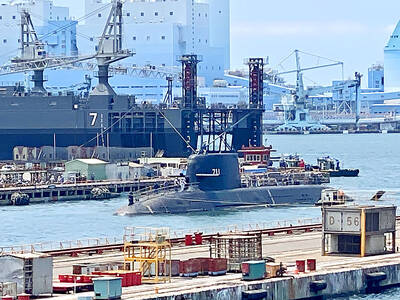
AGING: While Japan has 22 submarines, Taiwan only operates four, two of which were commissioned by the US in 1945 and 1946, and transferred to Taiwan in 1973 Taiwan would need at least 12 submarines to reach modern fleet capabilities, CSBC Corp, Taiwan chairman Chen Cheng-hung (陳政宏) said in an interview broadcast on Friday, citing a US assessment. CSBC is testing the nation’s first indigenous defense submarine, the Hai Kun (海鯤, Narwhal), which is scheduled to be delivered to the navy next month or in July. The Hai Kun has completed torpedo-firing tests and is scheduled to undergo overnight sea trials, Chen said on an SET TV military affairs program. Taiwan would require at least 12 submarines to establish a modern submarine force after assessing the nation’s operational environment and defense

A white king snake that frightened passengers and caused a stir on a Taipei MRT train on Friday evening has been claimed by its owner, who would be fined, Taipei Rapid Transit Corp (TRTC) said yesterday. A person on Threads posted that he thought he was lucky to find an empty row of seats on Friday after boarding a train on the Bannan (Blue) Line, only to spot a white snake with black stripes after sitting down. Startled, he jumped up, he wrote, describing the encounter as “terrifying.” “Taipei’s rat control plan: Release snakes on the metro,” one person wrote in reply, referring
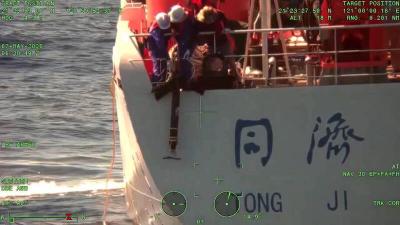
The coast guard today said that it had disrupted "illegal" operations by a Chinese research ship in waters close to the nation and driven it away, part of what Taipei sees a provocative pattern of China's stepped up maritime activities. The coast guard said that it on Thursday last week detected the Chinese ship Tongji (同濟號), which was commissioned only last year, 29 nautical miles (54km) southeast of the southern tip of Taiwan, although just outside restricted waters. The ship was observed lowering ropes into the water, suspected to be the deployment of scientific instruments for "illegal" survey operations, and the coast

Taiwan’s two cases of hantavirus so far this year are on par with previous years’ case numbers, and the government is coordinating rat extermination work, so there should not be any outbreaks, Centers for Disease Control (CDC) Director-General Philip Lo (羅一鈞) said today in an interview with the Liberty Times (the Taipei Times’ sister newspaper). An increase in rat sightings in Taipei and New Taipei City has raised concerns about the spread of hantavirus, as rats can carry the disease. In January, a man in his 70s who lived in Taipei’s Daan District (大安) tested positive posthumously for hantavirus, Taiwan’s


 RSS
RSS