


Once served as no-frills sustenance for train passengers, simple rice lunchboxes are selling in their millions across the nation, a food trend fueled by nostalgia.
Known as railway biandang (boxed meal, 便當), which means “convenience” in Chinese, the meals have changed little over the decades. Traditionally a pragmatic combination of braised or fried meat and pickles piled onto steamed white rice — ingredients designed to endure long train journeys — they are now seen as an enduring symbol of the “good old days” when rail travel trumped planes and cars.
While they used to be the preserve of passengers looking for a low-cost meal, now fans are picking them up as comfort food, whether they are taking a journey or not.
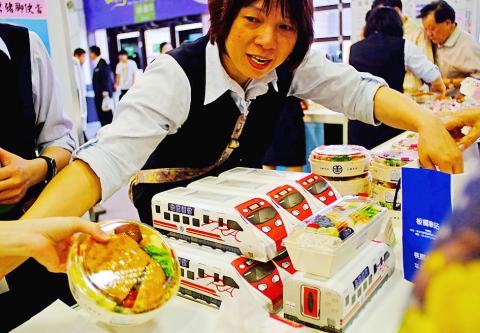
Photo: AFP
“It reminds me of when I was little, when I would take the train to Yilan with my family,” said a 42-year-old woman surnamed Chang (張), buying boxes of classic pork chop rice from a shop at a Taipei station to take home.
Chang estimates she eats a railway-style lunchbox about 10 times a month, making a point to buy one whenever she is passing a station. Although there are now fancier, pricier, lunchboxes containing everything from red quinoa rice to rosemary chicken, Chang still prefers the traditional combination.
“It is just tastier — the rice tastes better,” she said.
The Taiwan Railways Administration (TRA) expects to sell a record 10 million of the popular lunchboxes this year, pulling in roughly NT$700 million (US$22.31 million).
The TRA still sells the biandang on trains and in stations. Private vendors are also cashing in, running their own kiosks in or nearby stations, while convenience store chains now sell “railway-style” lunchboxes too.
Originally presented in round metal tins placed under seats for collection when finished, they now usually come in simple paper or wooden containers.
The TRA’s most popular box is the simple pork chop rice, says Michael Lee, deputy general manager of the TRA’s food and services division.
As well as a nostalgia hit, price is still a major draw — the classic combo costs just NT$60.
“Like our ticket prices, biandang prices have not increased for many years,” Lee said.
The idea of catering meals to-go for train travelers originated in far-flung locations along Taiwan’s east coast, according to food writer Wang Jue-yao (王瑞瑤).
“The more inaccessible a place is, the more there is a need for biandang,” she said.
Some vendors who sold them from station platforms would include a pickled plum to prevent meals from spoiling, a trick picked up from the Japanese, she added.
Japan built much of Taiwan’s railway network during its half-century rule of the nation, which ended with its defeat in World War II.
The name biandang is thought to come from the Japanese bento, used to describe a lunchbox with various ingredients. While more than 230 million people still travel by train in Taiwan each year, increased plane and car travel has hit some lunchbox sellers.
For Tseng A-fa (曾阿發), sales at his store at Fulong Beach (福隆) in New Taipei City’s Gongliao District (貢寮) have fallen since a car tunnel opened in 2006.
“Fewer and fewer trains now stop at Fulong,” he said at a culinary fair in Taipei in August that featured a section dedicated to railway biandang.
However, Tseng, 70, says he still manages to sell 1,000 lunchboxes each day and will continue with his business — which has loyal customers.
He said he has barely changed his recipe in 18 years and still serves up rice piled with pork, tofu, egg and pickles.


UPGRADE: The Kang Ding-class frigate is replacing its Chaparall missiles with Tien Chien II and Hua Yang VLS, which would provide it with long-range, 360° air defense Taiwan plans to produce 1,200 to 1,376 Hai Chien II missiles (海劍二, Sea Sword II) — also known as TC-2N — to serve as the standard air defense system of the navy’s surface combatant fleet, a source said yesterday. Last week, the Hai Chien II, the naval version of the Tien Kung II missile (天劍二, Sky Sword II), completed a live-fire test in waters off the National Chungshan Institute of Science and Technology’s Jiupeng facility (九鵬) in Pingtung County’s Manjhou Township (滿州). The MIM72 Chaparral and other dated air defense missiles that currently arm Taiwanese ships have inadequate range to combat Chinese

REASONS FOR TRAVEL: An assistant professor said that proposed amendments to penalize drivers if they used drugs overseas would not deter people from traveling People who operate a motor vehicle under the influence of marijuana would have their driver’s license revoked, even if they used the substance while overseas, the Ministry of Transportation and Communications said yesterday, citing proposed amendments to the Road Traffic Management and Penalty Act (道路交通管理處罰條例). The amendments would also authorize the government to revoke the licenses of people determined to have used Category 1 or Category 2 narcotics, even if they were not operating a vehicle while under the influence of drugs, as well as ban them from taking the license test for three years, the ministry said. People aged 18 or
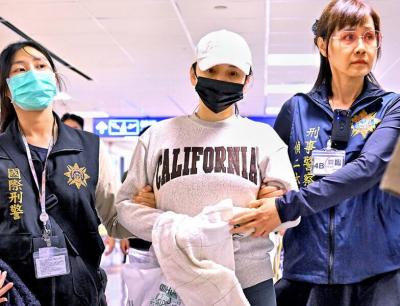
Johanne Liou (劉喬安), a Taiwanese woman who shot to unwanted fame during the Sunflower movement protests in 2014, returned to Taiwan last night after being deported from the US. She is to stand trial in Taiwan for charges involving embezzlement, fraud and drug crimes. The Criminal Investigation Bureau (CIB) said it took her into custody at Taiwan Taoyuan International Airport and would first question her before transferring her to the New Taipei District Prosecutors’ Office. She was arrested upon disembarking a flight from San Francisco that landed shortly before 7pm. Liou absconded to the US in 2019 after jumping bail
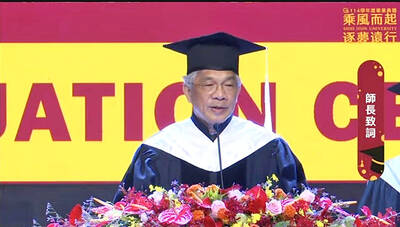
Shih Hsin University President Chen Ching-he (陳清河) yesterday issued a public apology for comments made in his commencement speech last week, stating that he has asked the school to suspend his duties and halt his wages for two months as a show of contrition. At the commencement ceremony on May 30, Chen said, “If you don’t manage your time well, or your own emotions, or your health, then I am telling every one of you — put a quick end to ‘you,’ because the world has no need for ‘you.’” The comments have sparked significant controversy online, and Chen through an open


 RSS
RSS