


A Chiayi County anti-drug campaign has drawn fire for seeking to capitalize on the popularity of Pokemon character Pikachu without permission.
The county government’s Drug Abuse Prevention Center used the image Pikachu in its most recent campaign, which features a standin board featuring the diaper-clad character crying, with a caption bubble that says: “Use ketamine just one time, be in diapers for a lifetime.”
Mighty Media, the Taiwanese agent that holds rights to use the Pokemon image in this nation, said that the county government did not seek approval to use Pikachu and simply “took without asking.”
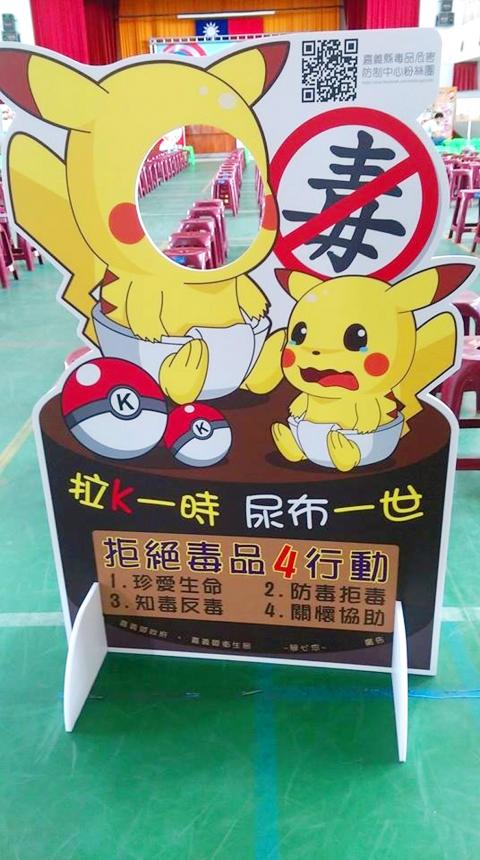
Photo: Screengrab from Facebook
“They once again set a bad example,” the agent said.
Comic artist Chung Meng-shun (鍾孟舜) criticized the county government, adding: “They even portrayed Pikachu as a ketamine user! The Japanese should sue.”
Mighty Media vice general manager Chin Chi-hua (金啟華) said it is an ongoing issue.
“During the election campaign, there were many legislators who used modified cartoon images for their campaigns and thought nothing of it,” he said.
Chin said that even though the image was drawn by a different artist, it was clearly meant to be Pikachu.
“For a socially beneficial campaign like this one they only need to notify the copyright holder,” he said.
“The Japanese company might even have been happy to allow the use of the original image without charge because it is for a campaign against drug use — and the result would look much better,” he said.
“However, if the government insists on embarrassing itself, it will simply end up in a helpless situation,” he said.
“There are more examples of companies infringing on copyright laws to market to Taiwanese Pokemon fans. I just hope is that there will be respect for copyright. I call on others to avoid engaging in copyright violations,” he said.

Considering that most countries issue more than five denominations of banknotes, the central bank has decided to redesign all five denominations, the bank said as it prepares for the first major overhaul of the banknotes in more than 24 years. Central bank Governor Yang Chin-lung (楊金龍) is expected to report to the Legislative Yuan today on the bank’s operations and the redesign’s progress. The bank in a report sent to the legislature ahead of today’s meeting said it had commissioned a survey on the public’s preferences. Survey results showed that NT$100 and NT$1,000 banknotes are the most commonly used, while NT$200 and NT$2,000

The Centers for Disease Control (CDC) yesterday reported the first case of a new COVID-19 subvariant — BA.3.2 — in a 10-year-old Singaporean girl who had a fever upon arrival in Taiwan and tested positive for the disease. The girl left Taiwan on March 20 and the case did not have a direct impact on the local community, it said. The WHO added the BA.3.2 strain to its list of Variants Under Monitoring in December last year, but this was the first imported case of the COVID-19 variant in Taiwan, CDC Deputy Director-General Lin Ming-cheng (林明誠) said. The girl arrived in Taiwan on

South Korea is planning to revise its controversial electronic arrival card, a step Taiwanese officials said prompted them to hold off on planned retaliatory measures, a South Korean media report said yesterday. A Yonhap News Agency report said that the South Korean Ministry of Foreign Affairs is planning to remove the “previous departure place” and “next destination” fields from its e-arrival card system. The plan, reached after interagency consultations, is under review and aims to simplify entry procedures and align the electronic form with the paper version, a South Korean ministry official said. The fields — which appeared only on the electronic form

The Ministry of Foreign Affairs (MOFA) is suspending retaliation measures against South Korea that were set to take effect tomorrow, after Seoul said it is updating its e-arrival system, MOFA said today. The measures were to be a new round of retaliation after Taiwan on March 1 changed South Korea's designation on government-issued alien resident certificates held by South Korean nationals to "South Korea” from the "Republic of Korea," the country’s official name. The move came after months of protests to Seoul over its listing of Taiwan as "China (Taiwan)" in dropdown menus on its new online immigration entry system. MOFA last week


 RSS
RSS