


New Southbound Policy Office Director James Huang (黃志芳) yesterday said that the cultivation of talent is the most important aspect in the policy aimed at expanding ties with ASEAN member states and India.
Speaking at a forum at the National Taipei University of Education, Huang underlined the role of the nation’s higher education institutes in pushing the policy.
The “new southbound policy” is a talent-based policy, he said, adding that only when the nation has the necessary talent will it be able to expand its business ties southbound.
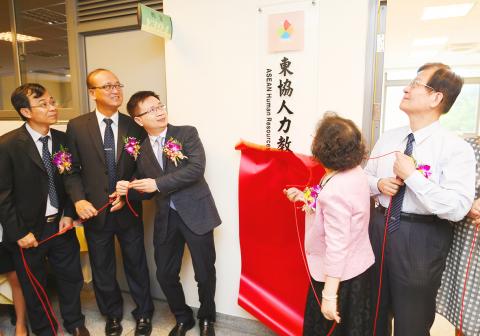
Photo: Chang Chia-ming, Taipei Times
The higher education sector has not yet reached its full capacity, as the nation’s low birth rate has thrown the student-teacher ratio off balance, Huang said, adding that one of the policies’ benefits is that it can help solve this issue by having tertiary institutes implement plans to recruit students and white-collar workers from Southeast Asia and India.
For example, the Indonesian government routinely allocates funding to finance officials attending classes offered by higher education institutes in Taiwan, he said.
The government has initiated talks with the Philippine government to collaborate on higher education, Huang said, adding that he learned from Representative to the Philippines Gary Lin (林松煥) that many Philippine college graduates have expressed an interest in earning an English-teaching diploma in Taiwan.
While the nation’s population is shrinking, populations are on the rise in Southeast Asia and India, with the population of ASEAN member states estimated to reach 790 million and that of India to reach 1.65 billion, surpassing China by 2050, he said.
Huang said that countries around the world have carried out business strategies in ASEAN such as helping its members build railways and bridges in exchange for business opportunities, but the fiercest competition among these countries is in leveraging their higher education capacity in ASEAN.
For instance, Japan has implemented a program to send tenured professors to Indonesia as visiting scholars for three years, after which the professors would recommend their best students in Indonesia to graduate institutes, with all tuition fees covered by the Japanese government, he said.
After these students receive their master’s degrees, they are immediately offered jobs at Japanese corporations to help them profit in Southeast Asia, he said, adding that this type of strategy is the essence of the policy.
Taiwan has an edge over Southeast Asia in terms of higher education, Huang said, adding that its climate, which is very similar to that of Southeast Asian countries, makes it an ideal destination for Southeast Asian students to pursue higher education.
Recruiting Southeast Asian students would help to cultivate “Taiwan-friendly” talent, Huang added.
“Taiwan, as the ‘pivot’ between Northeast and Southeast Asia, must not be absent from this competition,” he said, adding that the new southbound policy is different from past policy in that it is “human-centered,” rather than simply profit-driven.
Responding to audience members’ question about people having limited access to learning materials on Southeast Asian languages, Huang said that this problem can be resolved by asking Southeast Asian workers to bring publications from their hometowns to Taiwan when they return home for vacation.
He added that there is a bookstore opened by new residents in Taoyuan where people can buy language-learning materials on Southeast Asian languages.

NATIONAL SECURITY: Authorities are working to confirm the identities of the military personnel involved and investigating possible illegal conduct and regulatory violations Authorities are probing possible national security implications after Kinmen police and immigration officers on Sunday found a Chinese woman allegedly posing as a tourist while engaging in prostitution involving more than 10 military personnel. The woman, surnamed Chen (陳), has since been deported, authorities said, adding that investigators are still working to confirm the identities of those implicated, as the records only listed code names and aliases. The case stemmed from a report received by the Kinmen District Prosecutors’ Office on Friday last week from the Jinhu Precinct of the Kinmen County Police Bureau. On Sunday, police, along with the National Immigration

GLOBALGIVING: ‘ Caving to external pressure is not acceptable for an organization that has cultivated justice reform and human rights for 30 years,’ one NGO said A slew of non-government organizations (NGOs) have withdrawn from the GlobalGiving fundraising platform after it announced it would use “Chinese Taipei” instead of “Taiwan” from next month. The Taiwan Good Rice Association wrote on Facebook on Friday that it was informed on April 28 via a teleconference call of the change, which was made because the platform wanted to operate in China. Taiwan Good Rice is to terminate all cooperative relationships with GlobalGiving in response to the platform’s “unilateral and non-negotiable” decision to remove references to Taiwan, the NGO said. “Taiwan is in the official name of Taiwan Good Rice Association and the

HEAVY WEATHER: Typhoon Jangmi is due to crash straight into the Ryukyus as airlines look to shift flights to larger aircraft or cancel flights to Okinawa entirely Taiwan’s international air carriers announced flight adjustments over the weekend as Typhoon Jangmi is forecast to hit the Ryukyu Islands today and tomorrow. The Central Weather Administration (CWA) upgraded Jangmi from a tropical storm to a typhoon at 8am yesterday, with the eye located 580km south of Naha city. It was moving north at 19kph. Today, China Airlines’ CI-120, CI-121, CI-122 and CI-123 flights between Taoyuan and Naha, Okinawa, have been canceled as well as CI-132 and CI-133 between Kaohsiung and Naha. EVA Air’s BR-112, BR-113, BR-186 and BR-185 flights between Taoyuan and Naha are also canceled. Low-cost carrier Tigerair Taiwan canceled IT-230,

REASONS FOR TRAVEL: An assistant professor said that proposed amendments to penalize drivers if they used drugs overseas would not deter people from traveling People who operate a motor vehicle under the influence of marijuana would have their driver’s license revoked, even if they used the substance while overseas, the Ministry of Transportation and Communications said yesterday, citing proposed amendments to the Road Traffic Management and Penalty Act (道路交通管理處罰條例). The amendments would also authorize the government to revoke the licenses of people determined to have used Category 1 or Category 2 narcotics, even if they were not operating a vehicle while under the influence of drugs, as well as ban them from taking the license test for three years, the ministry said. People aged 18 or


 RSS
RSS