


Kaohsiung International Airport might already be Taiwan’s second-biggest airport, but it is now hoping for a larger slice of the nation’s aviation pie.
Pitching Kaohsiung’s location, the local government and lawmakers have begun a campaign to turn the airport into a cash cow that can bring more investment and business to the port city.
The campaign’s timing coincides with the accession to power in May of the Democratic Progressive Party (DPP) administration and its “new southbound policy” aimed at building closer ties with Southeast Asian nations.
Of the airport’s more than 700 weekly flights, 500 are to destinations in Southeast Asia and another 162 serve destinations in China, and the city thinks it is well-positioned for more.
DPP Legislator Lai Jui-lung (賴瑞隆), who represents the district where the airport is located, on July 2 asked the central government to come up with measures to encourage airlines to operate more flights out of Kaohsiung.
He also demanded that the Ministry of Transportation and Communications issue a report on the utilization of Kaohsiung airport in a month.
“Our goal is to have Kaohsiung airport share the burden of the international airport in Taoyuan as quickly as possible and create a win-win situation for both sides,” Lai said.
On June 16, Kaohsiung Secretary-General Yang Ming (楊明) suggested during a Cabinet meeting that the ministry assess the possibility of relocating more international flights from Taoyuan to Kaohsiung.
“The recent flight disruptions at Taoyuan airport resulting from floods reflected a long-standing problem. The high concentration of flights at the airport has made it hard to manage so many passengers,” he said at the time.
Taiwan Taoyuan International Airport is by far the nation’s biggest international gateway. It handled 38.47 million passengers last year, up 7.4 percent from 2014 and more than the 32 million it was originally designed for.
It is undertaking projects to dramatically increase its capacity, but, along with Lai, Yang thinks some of the flights should be diverted away to other airports.
“Southern Taiwan needs more flights to help bring in more tourists and create business opportunities,” Yang said, adding that moving flights to Kaohsiung would help strike a balance in development between the north and south.
Although Kaohsiung airport has also seen growth in passenger arrivals and departures in recent years, there is room for it to process more passengers.
Kaohsiung International Airport Deputy Director Fu Yao-nan (傅耀南) said the airport handled 4.86 million passengers flying international routes last year, still some way off its designed capacity of 6.09 million, so Kaohsiung would welcome more flights bound for Southeast Asian nations.
However, while Lai, Yang and Fu are appealing for more traffic and hoping to draw more visitors from Southeast Asian nations to the city, they might be engaging in wishful thinking.
Industry sources questioned whether airlines would be willing to cooperate with a shift of flights from Taoyuan to Kaohsiung because of questions over operating costs and market demand.
Behind the need to expand the airport’s facilities, the core problem facing Kaohsiung airport is a lack of passengers, they said, adding that if there were demand, airlines would take steps on their own to add more flights to and from the city.
Overall demand for international travel in Kaohsiung has been rising, with the growth in passengers on international routes averaging 14.1 percent at the airport from 2012 to last year.
However, the load factors of inbound and outbound international flights in Kaohsiung have been 5 to 6 percent lower over that time than flights at Taoyuan airport.
Would airlines move flights south if they paid a price in more empty seats?
Fu said another problem is that Kaoshiung airport is already too busy during the peak hours of 5:30am to 7:30am and from 1:30pm to 3pm.
Fu said that if flights were diverted from Taoyuan to Kaohsiung, they would have to operate at off-peak times, something analysts said airlines would not accept because of cost concerns and low demand.
The airport’s operations are also constrained by a decades-old curfew that bans aircraft landing and taking off from midnight to 6:30am.
Kaohsiung-based tourism operators have tried hard over the past decades to have the curfew removed, but local residents have resisted.
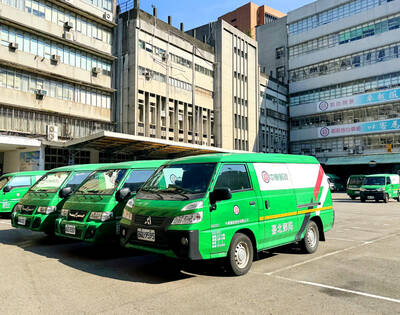
SHIPS, TRAINS AND AUTOMOBILES: The ministry has announced changes to varied transportation industries taking effect soon, with a number of effects for passengers Beginning next month, the post office is canceling signature upon delivery and written inquiry services for international registered small packets in accordance with the new policy of the Universal Postal Union, the Ministry of Transportation and Communications said yesterday. The new policy does not apply to packets that are to be delivered to China, the ministry said. Senders of international registered small packets would receive a NT$10 rebate on postage if the packets are sent from Jan. 1 to March 31, it added. The ministry said that three other policies are also scheduled to take effect next month. International cruise ship operators
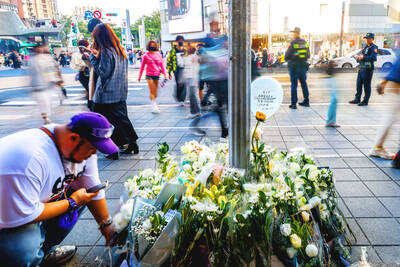
HORROR STORIES: One victim recounted not realizing they had been stabbed and seeing people bleeding, while another recalled breaking down in tears after fleeing A man on Friday died after he tried to fight the knife-wielding suspect who went on a stabbing spree near two of Taipei’s busiest metro stations, Taipei Mayor Chiang Wan-an (蔣萬安) said. The 57-year-old man, identified by his family name, Yu (余), encountered the suspect at Exit M7 of Taipei Main Station and immediately tried to stop him, but was fatally wounded and later died, Chiang said, calling the incident “heartbreaking.” Yu’s family would receive at least NT$5 million (US$158,584) in compensation through the Taipei Rapid Transit Corp’s (TRTC) insurance coverage, he said after convening an emergency security response meeting yesterday morning. National
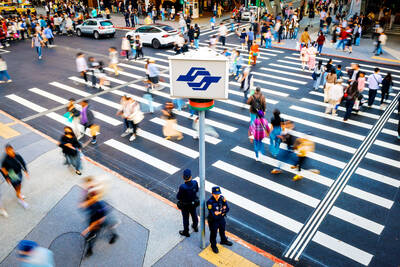
PLANNED: The suspect visited the crime scene before the killings, seeking information on how to access the roof, and had extensively researched a 2014 stabbing incident The suspect in a stabbing attack that killed three people and injured 11 in Taipei on Friday had planned the assault and set fires at other locations earlier in the day, law enforcement officials said yesterday. National Police Agency (NPA) Director-General Chang Jung-hsin (張榮興) said the suspect, a 27-year-old man named Chang Wen (張文), began the attacks at 3:40pm, first setting off smoke bombs on a road, damaging cars and motorbikes. Earlier, Chang Wen set fire to a rental room where he was staying on Gongyuan Road in Zhongzheng District (中正), Chang Jung-hsin said. The suspect later threw smoke grenades near two exits
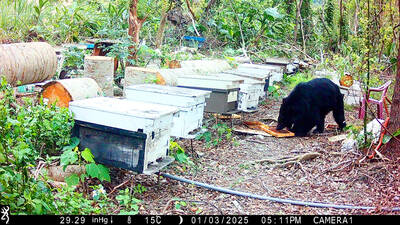
The Forestry and Nature Conservation Agency yesterday launched a gift box to market honey “certified by a Formosan black bear” in appreciation of a beekeeper’s amicable interaction with a honey-thieving bear. Beekeeper Chih Ming-chen (池明鎮) in January inspected his bee farm in Hualien County’s Jhuosi Township (卓溪) and found that more than 20 beehives had been destroyed and many hives were eaten, with bear droppings and paw prints near the destroyed hives, the agency said. Chih returned to the farm to move the remaining beehives away that evening when he encountered a Formosan black bear only 20m away, the agency said. The bear


 RSS
RSS