


Entertainers with pro-Taiwanese independence “thoughts” should be “ashamed” to work in China, actress Lily Tien (田麗) told the Chinese-language Apple Daily yesterday, refusing to back down from social media posts that accused model and actress Lin Chi-ling (林志玲) of being a supporter of Taiwanese independence.
On Monday, Tien shared an article titled “Pro-Independence Lin Chi-ling is the Real Problem” on Chinese social media, following controversy over a purported pro-independence stance by Taiwanese actor Leon Dai (戴立忍).
Tien said Lin should clarify whether she supports Taiwanese independence, adding that the media should “go ask her” for answers.
“It is a matter of fact that [Lin] cannot deny her relatives are supporters of the Democratic Progressive Party... If you really harbor such thoughts, do not come here. You should be ashamed to make money in neidi,” Tien said.
Neidi (內地), which means “the interior” in Mandarin, has been used by Chinese and China-based Taiwanese artists to refer to China.
Tien said she did not feel sympathy for Dai, who early last month was the subject of a public furor in China, despite saying on two occasions that he does not support Taiwanese independence
“You cannot criticize the people of neidi and take jobs here,” Tien said.
Tien said that she is “a Taiwanese entertainer, but not pro-Taiwanese independence” and that she “highly supports” the so-called “declaration of anti-splittism,” a document rumored to be in the works in Beijing that Taiwanese entertainers would be required to sign before working in China, because “Taiwan and neidi should coexist peacefully, and Taiwan should not provoke anything.”
Tien, 49, received the Golden Bell Award for best actress in 2002 and is the ex-wife of People First Party Chairman James Soong’s (宋楚瑜) brother-in-law.
In recent years, Tien’s career has mostly been based in China and she is now married to a Chinese actor.
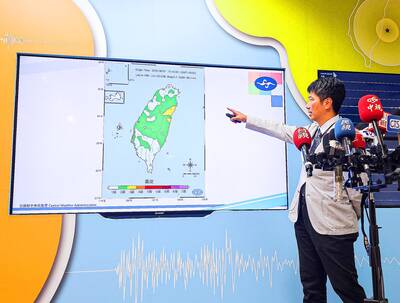
Aftershocks from a magnitude 6.2 earthquake that struck off Yilan County at 3:45pm yesterday could reach a magnitude of 5 to 5.5, the Central Weather Administration (CWA) said. Seismological Center technical officer Chiu Chun-ta (邱俊達) told a news conference that the epicenter of the temblor was more than 100km from Taiwan. Although predicted to measure between magnitude 5 and 5.5, the aftershocks would reach an intensity of 1 on Taiwan’s 7-tier scale, which gauges the actual effect of an earthquake, he said. The earthquake lasted longer in Taipei because the city is in a basin, he said. The quake’s epicenter was about 128.9km east-southeast

GENSLER SURVEY: ‘Economic infrastructure is not enough. A city needs to inspire pride, offer moments of joy and foster a sense of belonging,’ the company said Taipei was named the city with the “highest staying power” in the world by US-based design and architecture firm Gensler. The Taiwanese capital earned the top spot among 65 cities across six continents with 64 percent of Taipei respondents in a survey of 33,000 people saying they wanted to stay in the city. Rounding out the top five were Vietnam’s Ho Chi Minh City (61 percent), Singapore (59 percent), Sydney (58 percent) and Berlin (51 percent). Sixth to 10th place went to Monterrey, Mexico; Munich, Germany; Sao Paulo, Brazil; Vancouver; and Seoul. Cities in the US were ranked separately, with Minneapolis first at
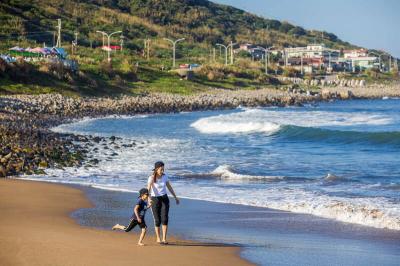
The New Taipei City Government today warned about the often-overlooked dangers of playing in water, and recommended safe swimming destinations to cool off from the summer heat. The following locations in the city as safe and fun for those looking to enjoy the water: Chienshuiwan (淺水灣), Baishawan (白沙灣), Jhongjiao Bay (中角灣), Fulong Beach Resort (福隆海水浴場) and Sansia District’s (三峽) Dabao River (大豹溪), New Taipei City Tourism and Travel Department Director-General Yang Tsung-min (楊宗珉) said. Outdoor bodies of water have variables outside of human control, such as changing currents, differing elevations and environmental hazards, all of which can lead to accidents, Yang said. Sudden
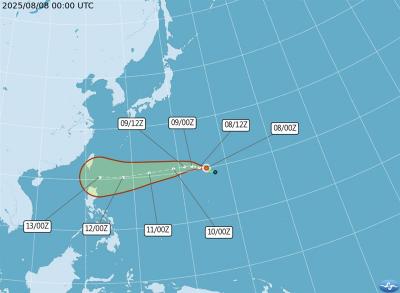
Tropical Storm Podul has formed over waters north-northeast of Guam and is expected to approach the seas southeast of Taiwan next week, the Central Weather Administration (CWA) said today. The 11th Pacific storm of the year developed at 2am over waters about 2,660km east of Oluanpi (歐鑾鼻), Pingtung County — Taiwan's southernmost tip. It is projected to move westward and could have its most significant impact on Taiwan on Wednesday and Thursday next week, the CWA said. The agency did not rule out the possibility of issuing a sea warning at that time. According to the CWA's latest update, Podul is drifting west-northwest


 RSS
RSS