


For Tama Talum of the Bunun community, hunting is a way of life, integral to his tribal customs — but after his arrest for illegally killing a deer and goat on land near his village, he fears those traditions will soon die out.
It is just one of many cases reflecting the wrangling between the government and Aborigines, with critics saying laws discriminate against Aboriginal cultures and that society as a whole has little understanding of them.
President Tsai Ing-wen (蔡英文) — the first Taiwanese leader with Aboriginal blood — will attempt to ease those tensions when she delivers the first ever apology to the nation’s Aborigines on Monday for injustices they have suffered over the centuries.
“An apology isn’t going to solve all the problems, but symbolically it shows Tsai is willing to face this issue,” said Democratic Progressive Party (DPP) Legislator Kolas Yotaka, who is from the Amis people.
“It gives us hope,” she added.
However, for Tama Talum, the damage is done.
The 57-year-old is a free man while he awaits the result of an appeal to the Supreme Court after an uproar in the Aboriginal community over his three-and-a-half-year sentence for possessing an illegal weapon and hunting a protected species.
Aboriginal hunters are legally allowed to use only homemade firearms — which they say can be dangerous and have led to injuries — and to hunt on festival days, restrictions to which many object.
Tama Talum’s arrest has already stopped younger members of his community from wanting to hunt, he said.
“Some of them are scared after seeing me being dragged away. They don’t want to learn. I was an optimistic man, but it is hard to be upbeat,” he said.
Anthropologists say Taiwan’s Aborigines have linguistic and genetic ties with Austronesians in Malaysia and Indonesia. They make up about 2 percent of the nation’s population.
Their sense of injustice revolves mainly around the loss of ancestral land rights, which first came under threat when immigrants from China arrived 400 years ago.
Much of that land is now designated as national parks, leading to clashes over hunting, fishing and foraging in areas where permits are needed.
“There are so many restrictions, telling us what we cannot do,” Tama Talum said at his home, nestled among mountains in Taitung County.
Corn and rice fields surround the village of Tastas — “waterfall” in the Bunun language — where about 250 people live in simple corrugated-metal roofed houses.
“We are not stealing or robbing anyone, and it is not that we are hunting everyday,” he said.
Tama Talum moved to a city in search of work, but eventually returned to take care of his mother.
Aboriginal unemployment is higher than the rest of the workforce and their wages average about 40 percent less than the national average, according to the Council of Indigenous Peoples.
A lack of autonomy to manage and live off their land also exacerbates social issues, such as alcohol abuse, according to Scott Simon, a professor at the University of Ottawa, who researches Taiwanese indigenous rights.
“The alcohol problem is a major public health issue that is not being adequately addressed. These issues are related,” he said.
Despite the challenges, some young Aborigines are trying to reconnect with their roots.
“What we want is simple: Give us back what was originally ours,” said Kelun Katadrepan, who works for an Aboriginal TV station.
The 30-year-old from the Puyuma community has started a campaign to gather young professionals to advocate Aboriginal involvement in politics.
In addition to restoring dispossessed land, Kelun Katadrepan wants an overhaul of the education system to prevent further loss of tribal languages — five have been designated as “severely endangered” by UNESCO.
His parents did not want to teach him their language while growing up, believing he needed to master Chinese to secure a better future.
“We are not Chinese, but we are forced to learn Chinese since we are little. That is not our culture,” Kelun Katadrepan said.
However, there have been gradual efforts to change that.
While teaching is usually in Chinese, some schools offer options to take Aboriginal language classes. There are also community colleges where traditional customs and skills are taught.
With the DPP in power, Kolas Yotaka hopes government regulations will be brought in line with the Aboriginal Basic Act (原住民族基本法), adopted in 2005 to protect Aboriginal rights.
That would correct current contradictions, including hunting being illegal apart from during major festivals — even though the act protects Aboriginal rights to kill wild animals for self-consumption.
Tama Talum said he has not risked hunting since his conviction, except for a sanctioned foray during a spring festival, where young Bunun men demonstrate their hunting skills and pray for a good millet harvest.
He still clings onto hope that his son, who was raised in the city and is now in his 30s, will eventually learn the old ways.
“After a while, when the time comes, he will think of going to the mountains with his father,” he said.

UPGRADE: The Kang Ding-class frigate is replacing its Chaparall missiles with Tien Chien II and Hua Yang VLS, which would provide it with long-range, 360° air defense Taiwan plans to produce 1,200 to 1,376 Hai Chien II missiles (海劍二, Sea Sword II) — also known as TC-2N — to serve as the standard air defense system of the navy’s surface combatant fleet, a source said yesterday. Last week, the Hai Chien II, the naval version of the Tien Kung II missile (天劍二, Sky Sword II), completed a live-fire test in waters off the National Chungshan Institute of Science and Technology’s Jiupeng facility (九鵬) in Pingtung County’s Manjhou Township (滿州). The MIM72 Chaparral and other dated air defense missiles that currently arm Taiwanese ships have inadequate range to combat Chinese

REASONS FOR TRAVEL: An assistant professor said that proposed amendments to penalize drivers if they used drugs overseas would not deter people from traveling People who operate a motor vehicle under the influence of marijuana would have their driver’s license revoked, even if they used the substance while overseas, the Ministry of Transportation and Communications said yesterday, citing proposed amendments to the Road Traffic Management and Penalty Act (道路交通管理處罰條例). The amendments would also authorize the government to revoke the licenses of people determined to have used Category 1 or Category 2 narcotics, even if they were not operating a vehicle while under the influence of drugs, as well as ban them from taking the license test for three years, the ministry said. People aged 18 or

HEAVY WEATHER: Typhoon Jangmi is due to crash straight into the Ryukyus as airlines look to shift flights to larger aircraft or cancel flights to Okinawa entirely Taiwan’s international air carriers announced flight adjustments over the weekend as Typhoon Jangmi is forecast to hit the Ryukyu Islands today and tomorrow. The Central Weather Administration (CWA) upgraded Jangmi from a tropical storm to a typhoon at 8am yesterday, with the eye located 580km south of Naha city. It was moving north at 19kph. Today, China Airlines’ CI-120, CI-121, CI-122 and CI-123 flights between Taoyuan and Naha, Okinawa, have been canceled as well as CI-132 and CI-133 between Kaohsiung and Naha. EVA Air’s BR-112, BR-113, BR-186 and BR-185 flights between Taoyuan and Naha are also canceled. Low-cost carrier Tigerair Taiwan canceled IT-230,
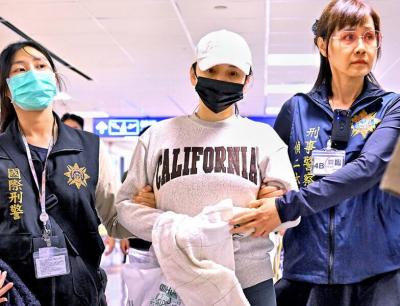
Johanne Liou (劉喬安), a Taiwanese woman who shot to unwanted fame during the Sunflower movement protests in 2014, returned to Taiwan last night after being deported from the US. She is to stand trial in Taiwan for charges involving embezzlement, fraud and drug crimes. The Criminal Investigation Bureau (CIB) said it took her into custody at Taiwan Taoyuan International Airport and would first question her before transferring her to the New Taipei District Prosecutors’ Office. She was arrested upon disembarking a flight from San Francisco that landed shortly before 7pm. Liou absconded to the US in 2019 after jumping bail


 RSS
RSS