


The security partnership between Taiwan and the US would be increasingly tested by the continuing modernization of China’s armed forces, the Brookings Institution said in a working paper.
“What Taiwan does to ensure its security is also a critical variable,” said the paper, which was written by former American Institute in Taiwan chairman Richard Bush, who is director of the think tank’s Center for East Asia Policy Studies.
It is part of a series on Washington’s commitments in the Asia-Pacific region released as the US “election season heats up and campaign rhetoric questioning the value of US alliances overseas has kicked off a furor of debate in foreign policy circles.”
The US Republican Party held its national convention last week, while the Democratic Party held its convention this week.
“The ability of the People’s Liberation Army [PLA] to project power across the Taiwan Strait and in the East China Sea will only grow,” Bush wrote in the paper. “Despite the ambiguity of public American rhetoric, the capabilities that the PRC [People’s Republic of China] has acquired to complicate any US intervention suggest that it assumes the US will in fact act to defend Taiwan.”
Even if the US did come to Taiwan’s aid in the case of a Chinese attack, the “tyranny of distance” across the Pacific Ocean would require Taiwan to survive on its own for an estimated several weeks, he wrote.
“That raises the question of whether Taiwan’s defense strategy would buy it enough time,” he wrote.
China’s array of ballistic and cruise missiles has created the possibility that the PLA could immobilize Taiwan’s air force by repeated missile strikes on airfields, Bush said.
“The Chinese military cannot yet conduct a successful amphibious campaign against Taiwan or execute a tight naval blockade of the island’s ports, but its capabilities are improving systematically and in the process are negating the ROC’s [Republic of China] long-standing defense strategy,” Bush said.
“Washington policymakers should probably pull out the dual-deterrence playbook and consider the appropriate mix of warnings and reassurances to Beijing and Taipei in the knowledge that China’s military power will only grow in the years ahead,” he wrote.
The paper came as another US expert warned President Tsai Ing-wen (蔡英文) that she might need to restrict her supporters who want to promote an “ideological agenda.”
Former US Department of State policy planning official Alan Romberg said in an analysis that the most hopeful interpretation of the present situation between Taiwan and China is that a process has begun that could eventually lead to a stable relationship.
“For that process to succeed, Tsai will need to rein in enthusiasts in both the executive and legislative branches who may be inclined to see the January election results as giving Tsai and the DPP [Democratic Progressive Party] a mandate to press an ideological agenda,” Romberg said.
“And Beijing will have to pull back from its most rigid requirements, allowing interpretation of Tsai’s words and actions to fill the gap,” he said.
The analysis, published by California-based think tank the Hoover Institution, said that a general consensus seems to exist both in Taiwan and China that any process to stabilize relations — or decide that is not possible — would take about six months.
“While the view in Taipei seems to be hopeful that all will be well by the end of that period, one senses a rather more downbeat expectation on the Mainland [China],” said Romberg, who is now director of the East Asia Program at Hoover’s Stimson Center.
“Some people believe that if Tsai does not openly embrace some form of ‘one China’ not just in actions, but also in words, cross-strait relations will take a decided turn for the worse,” he said. “One hopes the more optimistic view prevails, but we will have to wait and see.”
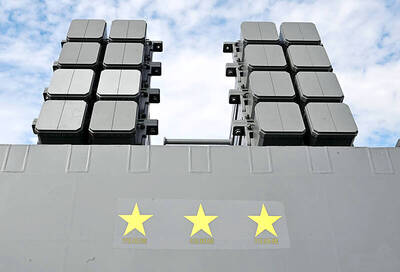
UPGRADE: The Kang Ding-class frigate is replacing its Chaparall missiles with Tien Chien II and Hua Yang VLS, which would provide it with long-range, 360° air defense Taiwan plans to produce 1,200 to 1,376 Hai Chien II missiles (海劍二, Sea Sword II) — also known as TC-2N — to serve as the standard air defense system of the navy’s surface combatant fleet, a source said yesterday. Last week, the Hai Chien II, the naval version of the Tien Kung II missile (天劍二, Sky Sword II), completed a live-fire test in waters off the National Chungshan Institute of Science and Technology’s Jiupeng facility (九鵬) in Pingtung County’s Manjhou Township (滿州). The MIM72 Chaparral and other dated air defense missiles that currently arm Taiwanese ships have inadequate range to combat Chinese

REASONS FOR TRAVEL: An assistant professor said that proposed amendments to penalize drivers if they used drugs overseas would not deter people from traveling People who operate a motor vehicle under the influence of marijuana would have their driver’s license revoked, even if they used the substance while overseas, the Ministry of Transportation and Communications said yesterday, citing proposed amendments to the Road Traffic Management and Penalty Act (道路交通管理處罰條例). The amendments would also authorize the government to revoke the licenses of people determined to have used Category 1 or Category 2 narcotics, even if they were not operating a vehicle while under the influence of drugs, as well as ban them from taking the license test for three years, the ministry said. People aged 18 or

HEAVY WEATHER: Typhoon Jangmi is due to crash straight into the Ryukyus as airlines look to shift flights to larger aircraft or cancel flights to Okinawa entirely Taiwan’s international air carriers announced flight adjustments over the weekend as Typhoon Jangmi is forecast to hit the Ryukyu Islands today and tomorrow. The Central Weather Administration (CWA) upgraded Jangmi from a tropical storm to a typhoon at 8am yesterday, with the eye located 580km south of Naha city. It was moving north at 19kph. Today, China Airlines’ CI-120, CI-121, CI-122 and CI-123 flights between Taoyuan and Naha, Okinawa, have been canceled as well as CI-132 and CI-133 between Kaohsiung and Naha. EVA Air’s BR-112, BR-113, BR-186 and BR-185 flights between Taoyuan and Naha are also canceled. Low-cost carrier Tigerair Taiwan canceled IT-230,
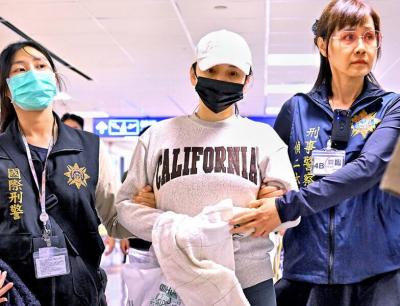
Johanne Liou (劉喬安), a Taiwanese woman who shot to unwanted fame during the Sunflower movement protests in 2014, returned to Taiwan last night after being deported from the US. She is to stand trial in Taiwan for charges involving embezzlement, fraud and drug crimes. The Criminal Investigation Bureau (CIB) said it took her into custody at Taiwan Taoyuan International Airport and would first question her before transferring her to the New Taipei District Prosecutors’ Office. She was arrested upon disembarking a flight from San Francisco that landed shortly before 7pm. Liou absconded to the US in 2019 after jumping bail


 RSS
RSS