


An invasive species, the spot-legged tree frog, has reportedly disrupted the local ecosystem, prompting conservationists to track down and remove the animals from wetlands.
Members of the Wild Bird Society of Yunlin and the Taiwan Sustainable Union on Saturday launched an operation to remove the frogs from local forests, saying they were concerned that the frogs, which breed rapidly and feed on the eggs and tadpoles of local frog species, are a threat to the survival of the indigenous population.
Taiwan Sustainable Union secretary-general Chan Tsung-ta (詹宗達) said the spot-legged frog is indigenous to southern China, Indochina and South Asia and was first seen in Taiwan in Taichung in 2006.
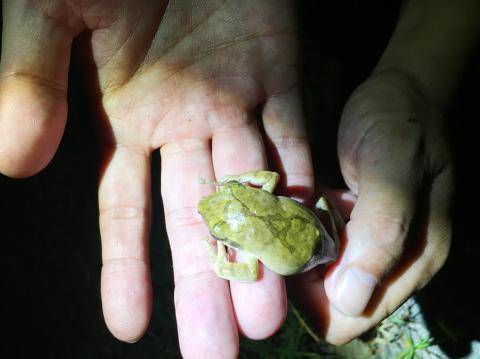
Photo: Huang Shu-li, Taipei Times
Given their rapid breeding habits, after just 10 years evidence of the species can be found in the farmlands of most low-elevation areas, wetlands and ponds across Yunlin County.
Chan said that research has turned up traces of the spot-legged frog in the townships of Cihtong (莿桐), Siluo (西螺), Erlun (二崙), Lunbei (崙背) and Baojhong (褒忠).
On Saturday, members of environmentalist groups braved rainy weather to hunt for the frogs along the riverbanks under Siluo Bridge and other low-elevation areas in Siluo Township.
The team said they discovered tadpoles in ponds at vegetable farms and in gardens, as well as finding adult frogs in bushes and papaya trees.
They handed the captured frogs and tadpoles over to biologists for research.
“As a tree-dweller, the spot-legged frog has no natural competitors for food in lower-elevation areas. Insects are a staple of the frog’s diet, but researchers have discovered that they also feed on the eggs and tadpoles of other frog species,” said Chang Heng-chia (張恆嘉), a teacher and council member of the Wild Bird Society of Yunlin.
“Any time a rapidly reproducing foreign species is introduced into a new environment like this it jeopardizes the survival of local species,” Chang said.
He said that inexperienced people might misidentify the native brown tree frog (Brauer’s tree frog) as the spot-legged frog, citing similarities in size and appearance between the two.
“It is not recommended that you catch the frogs yourself. If you find what appears to be a spot-legged tree frog, please call the bird society or the county government and someone will be sent to investigate it for you,” Chang said.

Considering that most countries issue more than five denominations of banknotes, the central bank has decided to redesign all five denominations, the bank said as it prepares for the first major overhaul of the banknotes in more than 24 years. Central bank Governor Yang Chin-lung (楊金龍) is expected to report to the Legislative Yuan today on the bank’s operations and the redesign’s progress. The bank in a report sent to the legislature ahead of today’s meeting said it had commissioned a survey on the public’s preferences. Survey results showed that NT$100 and NT$1,000 banknotes are the most commonly used, while NT$200 and NT$2,000

The Centers for Disease Control (CDC) yesterday reported the first case of a new COVID-19 subvariant — BA.3.2 — in a 10-year-old Singaporean girl who had a fever upon arrival in Taiwan and tested positive for the disease. The girl left Taiwan on March 20 and the case did not have a direct impact on the local community, it said. The WHO added the BA.3.2 strain to its list of Variants Under Monitoring in December last year, but this was the first imported case of the COVID-19 variant in Taiwan, CDC Deputy Director-General Lin Ming-cheng (林明誠) said. The girl arrived in Taiwan on

South Korea is planning to revise its controversial electronic arrival card, a step Taiwanese officials said prompted them to hold off on planned retaliatory measures, a South Korean media report said yesterday. A Yonhap News Agency report said that the South Korean Ministry of Foreign Affairs is planning to remove the “previous departure place” and “next destination” fields from its e-arrival card system. The plan, reached after interagency consultations, is under review and aims to simplify entry procedures and align the electronic form with the paper version, a South Korean ministry official said. The fields — which appeared only on the electronic form

The Ministry of Foreign Affairs (MOFA) is suspending retaliation measures against South Korea that were set to take effect tomorrow, after Seoul said it is updating its e-arrival system, MOFA said today. The measures were to be a new round of retaliation after Taiwan on March 1 changed South Korea's designation on government-issued alien resident certificates held by South Korean nationals to "South Korea” from the "Republic of Korea," the country’s official name. The move came after months of protests to Seoul over its listing of Taiwan as "China (Taiwan)" in dropdown menus on its new online immigration entry system. MOFA last week


 RSS
RSS