


Aboriginal divisions over giving recognition to members of Pingpu Aboriginal communities were yesterday on full display at a Legislative Yuan forum, with Aboriginal legislators sparring over how such recognition should be accomplished, while many legislators declined to attend.
“The Status Act for Indigenous Peoples (原住民身分法) has us by the throat, making it impossible for us to do anything,” Democratic Progressive Party (DPP) Legislator Kolas Yotaka, who is Amis, said at a Legislative Yuan forum on restoring Pingpu status and rights hosted by the Pingpu Aboriginal Status and Rights Restoration Working Group and the Tainan Siraya Village Development Promotion Association.
“Pingpu” is a general term used for Aboriginal communities that inhabited lowland regions of western Taiwan, with strong assimilation pressure from Chinese immigrants over centuries causing them to largely lose their ancestral languages and lifestyles.
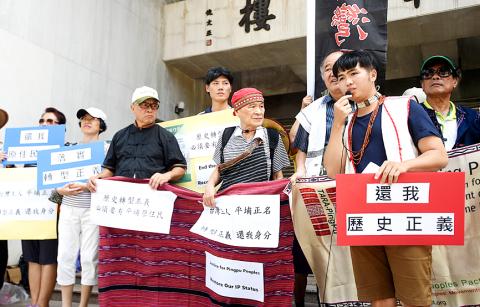
Photo: Fang Pin-chao, Taipei Times
While members of Pingpu communities have fought for official recognition for decades, only members of the Kavalan people have succeeded, winning recognition from the Executive Yuan in 2002.
Kolas called for the passage of a constitutional amendment to remove the distinction between officially recognized “plains” and “mountain” Aborigines, along with amendments to the Status Act for Indigenous Peoples and the passage of a new Pingpu status act to grant official recognition to members of Pingpu communities.
“After 30 years, there is finally a beam of sunlight — although I would not say there is a lot of sunlight,” she said, referring to campaign promises by President Tsai Ing-wen (蔡英文) of the DPP to push for official recognition of Pingpu communities and to issue an official apology to all Aborigines on Aug. 1.
“There has always been light, it was just blocked by clouds,” said New Power Party (NPP) Legislator Kawlo Iyun Pacidal, who is also Amis, adding that there was no need to pass new legislation, because the Status Act for Indigenous Peoples does not define the legal period within which “plains” Aboriginals can register their status.
“As we are already on the last lap, I do not think we should add more distance by taking on the passage of amendments or new Pingpu status legislation,” she said, adding that Pingpu communities could be recognized immediately if the Executive Yuan changes its interpretation of the legislation’s registration provisions.
Both legislators gained seats through their respective parties’ legislator-at-large tickets and are likely to be rivals in the next election cycle for seats in the nation’s multimember “plains” Aboriginal district, to which Pingpu Aborigines would likely be assigned if granted official recognition.
Non-partisan Solidarity Union Legislator May Chin (高金素梅), who is half-Atayal and represents “mountain Aborigines” in the Legislative Yuan, was also at the forum, while the DPP’s “plains” Aboriginal Legislator Chen Ying (陳瑩) declined to attend, as did several Chinese Nationalist Party (KMT) legislators who hold most multimember district seats.
“Aboriginal legislators should not worry about being able to hold onto their seats if Pingpu communities are recognized,” said National Dong Hua University professor Shih Cheng-feng (施正鋒), who claims to have partial Pingpu ancestry, adding that he estimated “at most” 200,000 Pingpu Aborigines would register if granted official recognition.
The nation currently boasts almost 500,000 Aborigines from officially recognized tribes, with the more than 200,000 members of the Amis people comprising the vast majority of eligible “plains” aboriginal voters.
“If Tsai just apologizes next month without doing anything substantial, she will just be putting on a deceptive show, because an apology should include promises to immediately address specific issues,” Shih said, calling for Tsai to immediately recognize members of Pingpu communities.
He added that Pingpu Aborigines should be entitled to special subsidies and other privileges enjoyed by members of officially recognized communities.
“Your identity is what should determine your rights — whether you live in a village or city, or have already become ‘overly sinicized’ has nothing to do with it,” he said, adding that using “sinicization” to deny Pingpu rights would imply other Aborigines could lose their rights if they become more assimilated.

UPGRADE: The Kang Ding-class frigate is replacing its Chaparall missiles with Tien Chien II and Hua Yang VLS, which would provide it with long-range, 360° air defense Taiwan plans to produce 1,200 to 1,376 Hai Chien II missiles (海劍二, Sea Sword II) — also known as TC-2N — to serve as the standard air defense system of the navy’s surface combatant fleet, a source said yesterday. Last week, the Hai Chien II, the naval version of the Tien Kung II missile (天劍二, Sky Sword II), completed a live-fire test in waters off the National Chungshan Institute of Science and Technology’s Jiupeng facility (九鵬) in Pingtung County’s Manjhou Township (滿州). The MIM72 Chaparral and other dated air defense missiles that currently arm Taiwanese ships have inadequate range to combat Chinese

REASONS FOR TRAVEL: An assistant professor said that proposed amendments to penalize drivers if they used drugs overseas would not deter people from traveling People who operate a motor vehicle under the influence of marijuana would have their driver’s license revoked, even if they used the substance while overseas, the Ministry of Transportation and Communications said yesterday, citing proposed amendments to the Road Traffic Management and Penalty Act (道路交通管理處罰條例). The amendments would also authorize the government to revoke the licenses of people determined to have used Category 1 or Category 2 narcotics, even if they were not operating a vehicle while under the influence of drugs, as well as ban them from taking the license test for three years, the ministry said. People aged 18 or

HEAVY WEATHER: Typhoon Jangmi is due to crash straight into the Ryukyus as airlines look to shift flights to larger aircraft or cancel flights to Okinawa entirely Taiwan’s international air carriers announced flight adjustments over the weekend as Typhoon Jangmi is forecast to hit the Ryukyu Islands today and tomorrow. The Central Weather Administration (CWA) upgraded Jangmi from a tropical storm to a typhoon at 8am yesterday, with the eye located 580km south of Naha city. It was moving north at 19kph. Today, China Airlines’ CI-120, CI-121, CI-122 and CI-123 flights between Taoyuan and Naha, Okinawa, have been canceled as well as CI-132 and CI-133 between Kaohsiung and Naha. EVA Air’s BR-112, BR-113, BR-186 and BR-185 flights between Taoyuan and Naha are also canceled. Low-cost carrier Tigerair Taiwan canceled IT-230,
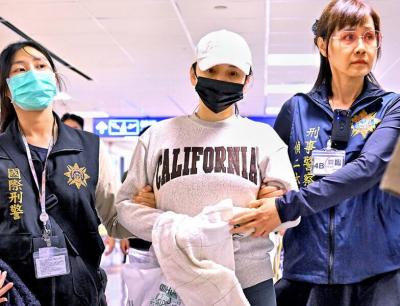
Johanne Liou (劉喬安), a Taiwanese woman who shot to unwanted fame during the Sunflower movement protests in 2014, returned to Taiwan last night after being deported from the US. She is to stand trial in Taiwan for charges involving embezzlement, fraud and drug crimes. The Criminal Investigation Bureau (CIB) said it took her into custody at Taiwan Taoyuan International Airport and would first question her before transferring her to the New Taipei District Prosecutors’ Office. She was arrested upon disembarking a flight from San Francisco that landed shortly before 7pm. Liou absconded to the US in 2019 after jumping bail


 RSS
RSS