


Sports fans yesterday expressed support for tennis pro Hsieh Su-wei (謝淑薇) and accused tennis officials of a funding bias following an angry outburst by the Taiwanese star earlier this week in which she threatened to quit the Olympic team.
With Hsieh already qualified for both the women’s singles and doubles events at next month’s Olympic Games in Rio de Janeiro, the developments might affect the nation’s medal hopes, with the partnership of Hsieh and Chuang Chia-jung (莊佳容) in doubt.
Hsieh accused the Chinese Taipei Tennis Association (CTTA) of unfair treatment, saying that officials have favored sisters Chan Yung-jan (詹詠然) and Chan Hao-ching (詹皓晴) with funding and coaching support to represent the nation at international tournaments.
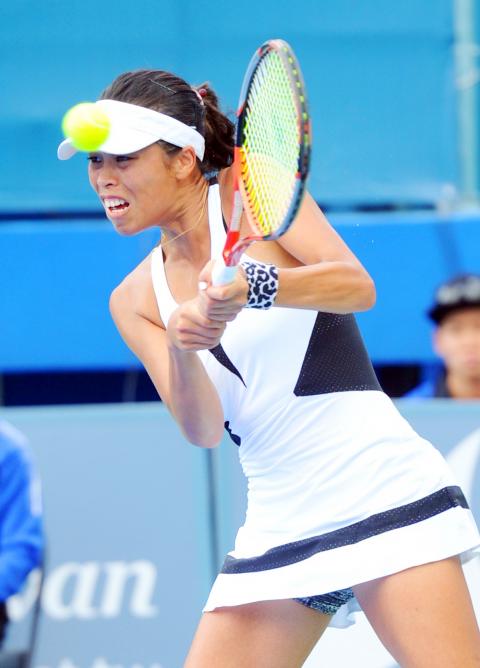
Photo: Huang Chih-yuan, Taipei Times
Hsieh, the nation’s top-ranked female singles player and the only Taiwanese to claim the world No. 1 spot — in the Women’s Tennis Association (WTA) Tour doubles ranking in May 2014 — has won two Grand Slams alongside China’s Peng Shuai (彭帥), Wimbledon in 2013 and the French Open in 2014.
However, she has fallen to 51st in the WTA Tour doubles ranking, while Chan Yung-jan is fifth and Chan Hao-ching in sixth.
Hsieh, Chuang and the Chan sisters are dubbed the nation’s “four reigning tennis queens.”
There have been reports of a long-running rivalry between Hsieh and the Chan sisters, although they have expressed respect for each other in public.
They are among Taiwan’s most prominent sports stars, with Chan Yung-jan the winner of 16 WTA Tour doubles titles.
Hsieh expressed anger toward the CTTA, accusing it of denying funding for her coach to go to Rio, while Chan Yuan-liang (詹元良), the Chan sisters’ father, received money to travel as their coach.
Hsieh said on Facebook that “without my coach, it will seriously affect my performance.”
“Not having a coach at the Games is like playing without a racket,” she said. “Do they [CTTA officials] think I’m going to Rio for a vacation?”
She accused tennis officials of manipulating the system, ruining the selection and funding processes.
“I feel like I have been bullied [by CTTA officials],” she wrote. “Can I apply for compensation from the government for this bullying, which has been going on for a long time?”
Hsieh’s father, Hsieh Tzu-lung (謝子龍), expressed similar sentiments on Facebook.
“If Su-wei’s situation does not change, then she should quit the Rio Olympics, but it is our country that quit on us,” he wrote. “If [she withdraws], we should go our own way, which would be easier for us. That way we would not have to get all dirty in the mud amid manipulation of the decisionmaking process by the Chan family to get funding.”
Fans and netizens have expressed support for Hsieh Su-wei, accusing the CTTA of bias over the years, while some said that tennis officials seem to be colluding with the Chan family to force Hsieh out.
One netizen made a chart comparing wins and achievements by each player at major competitions, with Hsieh ranked top for wins.
CTTA secretary-general Liu Chung-hsing (劉中興) said that regulations limit the Taiwan Olympic tennis team to two coaches, one for the men’s team and one for the women’s team.
Liu said that the coaching decisions were made following proper procedures using the players’ rankings, with Chan Yuan-liang getting the nod as an official coach this time.
The association would apply for “daily passes” to allow additional coaches to be courtside in Rio on a daily basis, Liu said.
Sports Administration Director-General Ho Jow-fei (何卓飛) said that rules governing the selection of coaches were set by the CTTA, although his agency approved them.
He said that Chan Yuan-liang was tapped because Chan Yung-jan and Chan Hao-ching outrank Hsieh Su-wei in the WTA Tour doubles rankings.
According to the rules, the highest-ranked player, whether in doubles or singles, has the right to choose the coach, he said.
He dismissed accusations that the Sports Administration favored Chan Yung-jan, saying that officials do not know the Chan family very well.

Considering that most countries issue more than five denominations of banknotes, the central bank has decided to redesign all five denominations, the bank said as it prepares for the first major overhaul of the banknotes in more than 24 years. Central bank Governor Yang Chin-lung (楊金龍) is expected to report to the Legislative Yuan today on the bank’s operations and the redesign’s progress. The bank in a report sent to the legislature ahead of today’s meeting said it had commissioned a survey on the public’s preferences. Survey results showed that NT$100 and NT$1,000 banknotes are the most commonly used, while NT$200 and NT$2,000

The Centers for Disease Control (CDC) yesterday reported the first case of a new COVID-19 subvariant — BA.3.2 — in a 10-year-old Singaporean girl who had a fever upon arrival in Taiwan and tested positive for the disease. The girl left Taiwan on March 20 and the case did not have a direct impact on the local community, it said. The WHO added the BA.3.2 strain to its list of Variants Under Monitoring in December last year, but this was the first imported case of the COVID-19 variant in Taiwan, CDC Deputy Director-General Lin Ming-cheng (林明誠) said. The girl arrived in Taiwan on

South Korea is planning to revise its controversial electronic arrival card, a step Taiwanese officials said prompted them to hold off on planned retaliatory measures, a South Korean media report said yesterday. A Yonhap News Agency report said that the South Korean Ministry of Foreign Affairs is planning to remove the “previous departure place” and “next destination” fields from its e-arrival card system. The plan, reached after interagency consultations, is under review and aims to simplify entry procedures and align the electronic form with the paper version, a South Korean ministry official said. The fields — which appeared only on the electronic form

The Ministry of Foreign Affairs (MOFA) is suspending retaliation measures against South Korea that were set to take effect tomorrow, after Seoul said it is updating its e-arrival system, MOFA said today. The measures were to be a new round of retaliation after Taiwan on March 1 changed South Korea's designation on government-issued alien resident certificates held by South Korean nationals to "South Korea” from the "Republic of Korea," the country’s official name. The move came after months of protests to Seoul over its listing of Taiwan as "China (Taiwan)" in dropdown menus on its new online immigration entry system. MOFA last week


 RSS
RSS