


A building in Taipei’s Xinyi District’s (信義) Yongchun Community (永春) that was part of a 16-year-old private urban renewal project was torn down yesterday.
The demolition came one day after Wang Tong-kai (王東凱), the last holdout property owner, voiced objections to the project at a meeting of the city’s urban renewal and dispute arbitration committee.
Taiwan Alliance for Victims of Urban Renewal director Peng Lung-san (彭龍三) accused the Taipei Department of Urban Development of having illegally demolished the building.
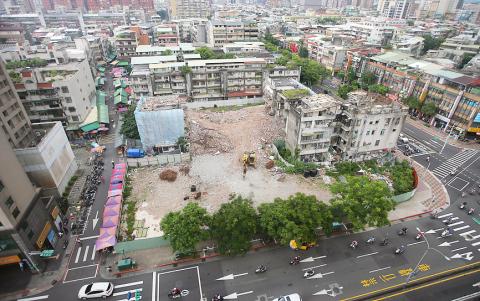
Photo: CNA
Peng said that an agreement reached between property owners in favor of the project and Sen Yeh Construction, which had been contracted to carry out the project, should have been voided after the Taipei High Administrative Court last month ruled against the Taipei City Government in a lawsuit filed by Wang and other stakeholders who opposed the project.
Peng said Wang had been “ambushed,” as Sen Yeh did not notify him before tearing down his house.
He said that he would sue Sen Yeh and department Commissioner Lin Jou-min (林洲民) over the demolition.
Minutes taken at the meeting show that Wang, whose house is on the ground floor, said that the land he can reclaim after the project’s completion should be larger than that determined by Sen Yeh, as his house would be turned into public space shared by all homeowners.
A resolution by the committee on Friday said that Wang asked to reclaim properties worth NT$1.29 billion (US$40.04 million), while the construction firm said that he can acquire properties worth NT$42.1 million.
Wang’s demand was “unreasonable,” as it is in breach of a system governing the conversion of property rights in urban renewal projects, the committee said..
Wang denied having made the claim.
When asked to comment about Peng’s pledge to sue him, Lin said: “Let him be.”
Lin said the department in January last year issued a construction license and a demolition permit for the project, adding that Sen Yeh demolished the building in accordance with the permit.
Separately, Taipei Mayor Ko Wen-je (柯文哲), responding to media queries about the demolition, said that urban renewal projects in Taipei should move forward with time.
“If an urban renewal project is untended to for more than 10 years, it means that the government is negligent,” he said.
He asked people to contemplate what would have happened if the earthquake in February that killed 116 people had hit Taipei instead of Tainan.
Environmental Protection Administration Deputy Minister Thomas Chan (詹順貴), who has spoken out on the project before, criticized the municipal government for siding with the construction firm, saying that the area delimited by the demolition permit did not include Wang’s house.
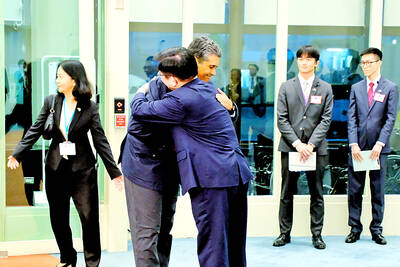
Palauan President Surangel Whipps Jr arrived in Taiwan last night to kick off his first visit to the country since beginning his second term earlier this year. After arriving at Taoyuan International Airport at around 6:30 pm, Whipps and his delegation were welcomed by Minister of Foreign Affairs Lin Chia-lung (林佳龍). Speaking to gathered media, the Palauan leader said he was excited and honored to be back in Taiwan on his first state visit to Taiwan since he was sworn in this January. Among those traveling with Whipps is Minister of State Gustav N. Aitaro, Public Infrastructure
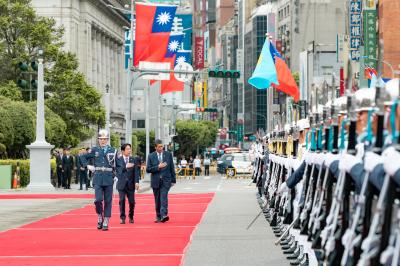
President William Lai (賴清德) yesterday thanked Palau for its continued support of Taiwan's international participation, as Taipei was once again excluded from the World Health Assembly (WHA) currently taking place in Switzerland. "Palau has never stopped voicing support for Taiwan" in the UN General Assembly, the WHO and other UN-affiliated agencies, Lai said during a bilateral meeting with visiting Palau President Surangel Whipps Jr. "We have been profoundly touched by these endorsements," Lai said, praising the Pacific island nation's firm support as "courageous." Lai's remarks came as Taiwan was excluded for the ninth consecutive year from the WHA, which is being held in
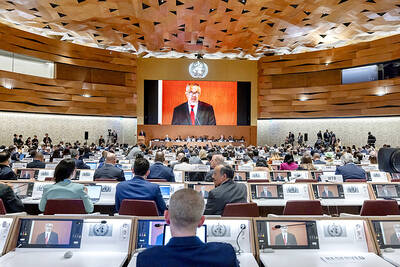
RESOLUTIONS DEBATE: Taiwan’s allies said that UN and WHA resolutions cited by China and other nations ‘do not determine Taiwan’s participation in WHO activities’ A proposal to invite Taiwan to this year’s World Health Assembly (WHA) was rejected on Monday, resulting in Taipei’s absence from the annual meeting for a ninth consecutive year, although partners spoke up for Taiwan’s participation at the first day of the meeting. The first agenda item after the opening was a “two-on-two debate” on a proposal to invite Taiwan to participate at the WHA as an observer. Similar to previous years, two countries made statements in favor of the proposal, while two others expressed their opposition. Philippine Secretary of Health Teodoro Herbosa, president of the 78th WHA, accepted the WHA General Committee’s
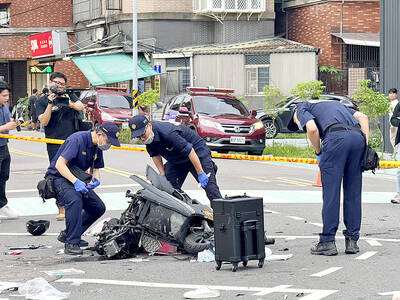
At least three people died and more than a dozen were injured yesterday afternoon when a vehicle struck a group of pedestrians in New Taipei City’s Sansia District (三峽). The incident happened at about 4pm when a car rammed into pedestrians at an intersection near Bei Da Elementary School. Witnesses said the sedan, being driven at a high speed, ran a red light, knocking scooters out of the way and hitting students crossing the road before careening into a median near the intersection of Guocheng and Guoguang streets. The incident resulted in three deaths and 13 injuries, including the driver, a 78-year-old man


 RSS
RSS