


The Democratic Progressive Party (DPP) legislative caucus is planning to call two extraordinary legislative sessions after the current session ends on July 15 to clear some major bills, such as those dealing with ill-gotten party assets and promoting transitional justice.
The Chinese Nationalist Party (KMT) caucus protested the passage late last month of the Local Government Act (地方制度法) amendments requiring speakers and deputy speakers of local councils to be elected by open ballots by pronouncing that they would stop partaking in cross-caucus negotiations.
Legislative Speaker Su Jia-chyuan (蘇嘉全) has since attempted to convene a cross-caucus negotiation several times, but to no avail.
After DPP lawmakers conducted a committee review of the bill dealing with ill-gotten party assets on Wednesday last week, in the face of criticism by KMT lawmakers, who later staged a walk-out, the KMT caucus said that it would propose more than1,000 motions to obstruct the passage of the budget bills on state-run enterprises.
DPP caucus director-general Wu Ping-jui (吳秉叡) on Friday quoted the caucus meeting resolution as saying that the DPP would call two extraordinary sessions, if needed, in response to the KMT caucus’ possible obstruction, which might take up to 90 hours to process.
The caucus could call an extraordinary session, following the legislature’s scheduled recess starting on July 15, that would take place from July 18 to July 29, Wu said, adding that another extraordinary session could be called in August after Su returns from a trip to Japan from Aug. 1 to Aug. 4.
Wu said that the draft act dealing with ill-gotten party assets, transitional justice promotion and regulation of distant fisheries are all legislation that the caucus considers crucial and expects to pass in this legislative session.
KMT caucus secretary-general Lin Te-fu (林德福) said the KMT would not be able to stop the DPP, which has a majority in the legislature and is free to call extraordinary sessions as many times as it wishes.
Howeve, he said that the KMT would not agree to participate in cross-caucus negotiations as the DPP now relies entirely on “majoritarian violence.”
New Power Party caucus convener Hsu Yung-ming (徐永明) said the NPP would hope that during the planned extraordinary sessions, in addition to the said bills, proposed amendments to the Civil Servants Election and Recall Act (公職人員選舉罷免法) concerning the campaigning and the threshold for initiating recalls and the amendment bill to the Referendum Act (公民投票法) concerning the lowering of the threshold to hold a referendum could also be cleared.
People First Party (PFP) caucus director-general Chen Yi-chieh (陳怡潔) said that bills to be processed in the extraordinary sessions should not be limited to those proposed by the DPP to whip up political feuds.
Draft acts calling for equality among ethnic groups and for Aboriginal transitional justice proposed by the PFP caucus should also be dealt with, she said.


UPGRADE: The Kang Ding-class frigate is replacing its Chaparall missiles with Tien Chien II and Hua Yang VLS, which would provide it with long-range, 360° air defense Taiwan plans to produce 1,200 to 1,376 Hai Chien II missiles (海劍二, Sea Sword II) — also known as TC-2N — to serve as the standard air defense system of the navy’s surface combatant fleet, a source said yesterday. Last week, the Hai Chien II, the naval version of the Tien Kung II missile (天劍二, Sky Sword II), completed a live-fire test in waters off the National Chungshan Institute of Science and Technology’s Jiupeng facility (九鵬) in Pingtung County’s Manjhou Township (滿州). The MIM72 Chaparral and other dated air defense missiles that currently arm Taiwanese ships have inadequate range to combat Chinese

REASONS FOR TRAVEL: An assistant professor said that proposed amendments to penalize drivers if they used drugs overseas would not deter people from traveling People who operate a motor vehicle under the influence of marijuana would have their driver’s license revoked, even if they used the substance while overseas, the Ministry of Transportation and Communications said yesterday, citing proposed amendments to the Road Traffic Management and Penalty Act (道路交通管理處罰條例). The amendments would also authorize the government to revoke the licenses of people determined to have used Category 1 or Category 2 narcotics, even if they were not operating a vehicle while under the influence of drugs, as well as ban them from taking the license test for three years, the ministry said. People aged 18 or
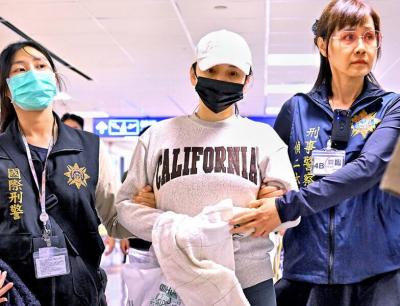
Johanne Liou (劉喬安), a Taiwanese woman who shot to unwanted fame during the Sunflower movement protests in 2014, returned to Taiwan last night after being deported from the US. She is to stand trial in Taiwan for charges involving embezzlement, fraud and drug crimes. The Criminal Investigation Bureau (CIB) said it took her into custody at Taiwan Taoyuan International Airport and would first question her before transferring her to the New Taipei District Prosecutors’ Office. She was arrested upon disembarking a flight from San Francisco that landed shortly before 7pm. Liou absconded to the US in 2019 after jumping bail
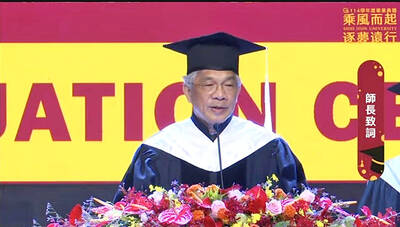
Shih Hsin University President Chen Ching-he (陳清河) yesterday issued a public apology for comments made in his commencement speech last week, stating that he has asked the school to suspend his duties and halt his wages for two months as a show of contrition. At the commencement ceremony on May 30, Chen said, “If you don’t manage your time well, or your own emotions, or your health, then I am telling every one of you — put a quick end to ‘you,’ because the world has no need for ‘you.’” The comments have sparked significant controversy online, and Chen through an open


 RSS
RSS