


The People First Party (PFP) legislative caucus yesterday criticized the Democratic Progressive Party (DPP) caucus for not addressing the issue of transitional justice for Aborigines, saying that failing to do so would see the government’s drive to come to terms with the legacy of past abuses become little more than a political vendetta.
The PFP caucus told a news conference that the goal of transitional justice is to heal the wounds of the past by holding perpetrators of injustice accountable, so that the nation is steered toward fairness and justice.
“Transitional justice must not become a tool in a political vendetta. Efforts to achieve transitional justice that do not examine unfair treatment and land dispossession suffered by Aboriginal communities during the Japanese colonial era cannot achieve justice,” the PFP caucus said.
It urged DPP Legislator Tuan Yi-kang (段宜康) to schedule all the proposed transitional justice-related draft bills for discussion.
The PFP caucus made the remarks after Tuan, the convener of the legislature’s Judiciary and Organic Laws and Statutes Committee, put the DPP’s draft transitional justice promotion bill on the agenda for a legislative committee review yesterday.
Tuan said the rationale for his decision was that draft bills addressing injustices perpetrated during the then-Chinese Nationalist Party (KMT) regime’s authoritarian rule should be separated from those aiming to tackle land justice and rights recovery for Aborigines, an issue that could date back 400 years, and which Tuan said has been used by the KMT caucus to block the DPP’s draft transitional justice promotion act.
The PFP caucus said a ruling party that is truly determined to push for transitional justice would not carve history into periods, focus only on seeking vengeance, neglect the hardship and suffering of Aborigines, and forgot about the injustices committed before 1947.
“Tuan’s decision to only include the DPP’s draft transitional justice promotion act for committee review and exclude other draft transitional justice bills that cover Aboriginal issues, is tantamount to turning the injustices of a violent authoritarian regime into procedural injustice, caused by the DPP’s tyranny of the majority in the legislature,” the PFP caucus said.
DPP lawmakers said that its drive toward transitional justice should be separated from the efforts aimed at transitional justice for Aborigines, as they are different issues.
“The bill for transitional justice that the DPP proposed goes beyond ethnic boundaries,” said Kolas Yotaka, a DPP legislator of the Amis Aboriginal community. “The DPP proposal very clearly targets the 228 Incident and the White Terror period, it is not excluding the nation’s Aborigines, because the victims of political persecution during the era included people of all ethnicities.”
Kolas said that, as an Amis, she certainly agrees that the government should do something to make up for its past violation of Aboriginal rights, such as forced seizure of Aboriginal lands, the failure to protect Aboriginal hunting rights, and the loss of Aboriginal languages and cultures, “but it is a bigger and more complicated issue to deal with, and should be taken care of separately.”
Kolas added that Premier Lin Chuan (林全) promised her during a legislative meeting that President Tsai Ing-wen (蔡英文) would create a truth and reconciliation committee under the purview of the Presidential Office to come up with policies to deal with the Aboriginal rights issue, and the conclusions of the committee would become government policy directions.
“For me, this was a very acceptable answer and I look forward to it,” she said.
DPP Caucus Director-General Wu Ping-jui (吳秉叡) said: “We’re not ignoring the Aboriginal issue, we certainly will deal with it, but the two things should be handled separately.”

UPGRADE: The Kang Ding-class frigate is replacing its Chaparall missiles with Tien Chien II and Hua Yang VLS, which would provide it with long-range, 360° air defense Taiwan plans to produce 1,200 to 1,376 Hai Chien II missiles (海劍二, Sea Sword II) — also known as TC-2N — to serve as the standard air defense system of the navy’s surface combatant fleet, a source said yesterday. Last week, the Hai Chien II, the naval version of the Tien Kung II missile (天劍二, Sky Sword II), completed a live-fire test in waters off the National Chungshan Institute of Science and Technology’s Jiupeng facility (九鵬) in Pingtung County’s Manjhou Township (滿州). The MIM72 Chaparral and other dated air defense missiles that currently arm Taiwanese ships have inadequate range to combat Chinese

REASONS FOR TRAVEL: An assistant professor said that proposed amendments to penalize drivers if they used drugs overseas would not deter people from traveling People who operate a motor vehicle under the influence of marijuana would have their driver’s license revoked, even if they used the substance while overseas, the Ministry of Transportation and Communications said yesterday, citing proposed amendments to the Road Traffic Management and Penalty Act (道路交通管理處罰條例). The amendments would also authorize the government to revoke the licenses of people determined to have used Category 1 or Category 2 narcotics, even if they were not operating a vehicle while under the influence of drugs, as well as ban them from taking the license test for three years, the ministry said. People aged 18 or

HEAVY WEATHER: Typhoon Jangmi is due to crash straight into the Ryukyus as airlines look to shift flights to larger aircraft or cancel flights to Okinawa entirely Taiwan’s international air carriers announced flight adjustments over the weekend as Typhoon Jangmi is forecast to hit the Ryukyu Islands today and tomorrow. The Central Weather Administration (CWA) upgraded Jangmi from a tropical storm to a typhoon at 8am yesterday, with the eye located 580km south of Naha city. It was moving north at 19kph. Today, China Airlines’ CI-120, CI-121, CI-122 and CI-123 flights between Taoyuan and Naha, Okinawa, have been canceled as well as CI-132 and CI-133 between Kaohsiung and Naha. EVA Air’s BR-112, BR-113, BR-186 and BR-185 flights between Taoyuan and Naha are also canceled. Low-cost carrier Tigerair Taiwan canceled IT-230,
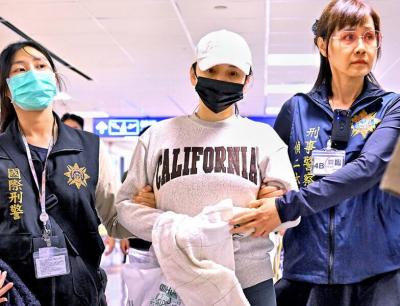
Johanne Liou (劉喬安), a Taiwanese woman who shot to unwanted fame during the Sunflower movement protests in 2014, returned to Taiwan last night after being deported from the US. She is to stand trial in Taiwan for charges involving embezzlement, fraud and drug crimes. The Criminal Investigation Bureau (CIB) said it took her into custody at Taiwan Taoyuan International Airport and would first question her before transferring her to the New Taipei District Prosecutors’ Office. She was arrested upon disembarking a flight from San Francisco that landed shortly before 7pm. Liou absconded to the US in 2019 after jumping bail


 RSS
RSS