


Candidates nominated by the Executive Yuan to serve on the National Communications Commission (NCC) expressed mixed views concerning the five draft acts designed to handle issues in the era of digital convergence, with some of them indicating that the legal framework of the acts could be subject to change after they take office.
The six nominees for NCC commissioner faced lawmakers at a meeting of the legislature’s Transportation Committee and Education and Culture Committee.
They were asked by the lawmakers to comment on the draft acts proposed by the commission, which last month secured the approval of the Executive Yuan.
Nicole Chan (詹婷怡), vice president of the science and technology law department at the Institute of Information Industry, was nominated for the role of NCC chairwoman.
She said that she had read the draft acts and agreed with the general direction of the legislation.
However, she questioned if it is absolutely necessary to propose five acts at one time, adding that she has yet to understand how the different acts complement one another.
“Some of the special terms in the draft acts are very difficult to understand. I would have to discuss with the NCC staff and other NCC commissioners, and hear thoughts from industry representatives first,” she said, adding that the commission might have to change the legal frame of the draft acts.
National Taiwan University professor Hung Chen-ling (洪貞玲), who was nominated for NCC commissioner, said that the draft acts intend to relax regulations for media outlets. However, she said she still has doubts about the acts, particularly regarding the emphasizing of competition of the free market.
Another nominee, National Taipei University professor Chen Yaw-shyang (陳耀祥), said that it has yet to reach the point where the commission has to draft the new acts. However, he said that the public needs to reach a consensus on the acts before they can be enforced.
NCC Chairman Howard Shyr (石世豪) suggested that these nominees read the articles in the draft acts first.
Prior to qualification review yesterday, Shyr had said that, if legislators think they can master the five different acts in one day, the commission might as well throw out the draft acts because it would prove that they are worthless.
Apart from the draft acts, the nominees faced other questions from the legislators on issues regarding media monopolization, the service rates of fourth-generation telecoms services and over-the-top content providers from China and the US.
Chinese Nationalist Party (KMT) Legislator John Wu (吳志揚) asked whether Chan would like the job of NCC chairwoman. He said that the role is less interesting than some of her previous roles, such as being a movie producer.
Chan said that her various job experiences in the past enabled her to understand the “status quo” of the media industry and realize that some problems need to be solved to enhance the nation’s competitiveness in this regard.
“These are reasons that I decided to accept the nomination,” she said.
The nominee list was submitted because some of the NCC’s members’ terms are set to end on July 31. According to the Organic Act for the National Communications Commission (國家通訊傳播委員會組織法), the nomination process must be finalized three months prior to the end of their terms.
Commission members to end their term at the end of July include Shyr, NCC Vice Chairman Yu Hsiao-cheng (虞孝成), as well as members Chiang Yu-fen (江幽芬) and Peng Shin-yi (彭心儀).
In addition to Chan, Hung and Chen, the other two nominees are NCC Secretary-General Jason Ho (何吉森) and Guo Wen-chung (郭文忠), an associate professor at National Taipei University’s department of economics.
Incumbent commission member Wong Po-tsung (翁柏宗) was recommended by the Cabinet to serve as the vice chairman of the commission.
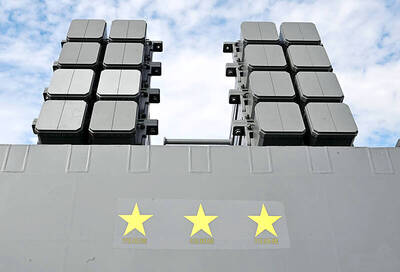
UPGRADE: The Kang Ding-class frigate is replacing its Chaparall missiles with Tien Chien II and Hua Yang VLS, which would provide it with long-range, 360° air defense Taiwan plans to produce 1,200 to 1,376 Hai Chien II missiles (海劍二, Sea Sword II) — also known as TC-2N — to serve as the standard air defense system of the navy’s surface combatant fleet, a source said yesterday. Last week, the Hai Chien II, the naval version of the Tien Kung II missile (天劍二, Sky Sword II), completed a live-fire test in waters off the National Chungshan Institute of Science and Technology’s Jiupeng facility (九鵬) in Pingtung County’s Manjhou Township (滿州). The MIM72 Chaparral and other dated air defense missiles that currently arm Taiwanese ships have inadequate range to combat Chinese

REASONS FOR TRAVEL: An assistant professor said that proposed amendments to penalize drivers if they used drugs overseas would not deter people from traveling People who operate a motor vehicle under the influence of marijuana would have their driver’s license revoked, even if they used the substance while overseas, the Ministry of Transportation and Communications said yesterday, citing proposed amendments to the Road Traffic Management and Penalty Act (道路交通管理處罰條例). The amendments would also authorize the government to revoke the licenses of people determined to have used Category 1 or Category 2 narcotics, even if they were not operating a vehicle while under the influence of drugs, as well as ban them from taking the license test for three years, the ministry said. People aged 18 or

HEAVY WEATHER: Typhoon Jangmi is due to crash straight into the Ryukyus as airlines look to shift flights to larger aircraft or cancel flights to Okinawa entirely Taiwan’s international air carriers announced flight adjustments over the weekend as Typhoon Jangmi is forecast to hit the Ryukyu Islands today and tomorrow. The Central Weather Administration (CWA) upgraded Jangmi from a tropical storm to a typhoon at 8am yesterday, with the eye located 580km south of Naha city. It was moving north at 19kph. Today, China Airlines’ CI-120, CI-121, CI-122 and CI-123 flights between Taoyuan and Naha, Okinawa, have been canceled as well as CI-132 and CI-133 between Kaohsiung and Naha. EVA Air’s BR-112, BR-113, BR-186 and BR-185 flights between Taoyuan and Naha are also canceled. Low-cost carrier Tigerair Taiwan canceled IT-230,
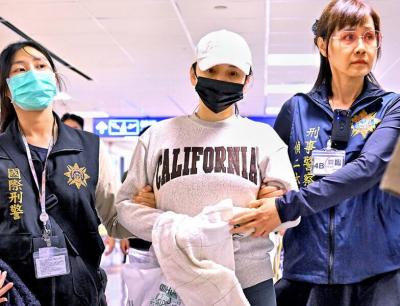
Johanne Liou (劉喬安), a Taiwanese woman who shot to unwanted fame during the Sunflower movement protests in 2014, returned to Taiwan last night after being deported from the US. She is to stand trial in Taiwan for charges involving embezzlement, fraud and drug crimes. The Criminal Investigation Bureau (CIB) said it took her into custody at Taiwan Taoyuan International Airport and would first question her before transferring her to the New Taipei District Prosecutors’ Office. She was arrested upon disembarking a flight from San Francisco that landed shortly before 7pm. Liou absconded to the US in 2019 after jumping bail


 RSS
RSS