


Hundreds of China Airlines (CAL) flight attendants and maintenance engineers yesterday staged a protest in Taipei against a change in their working conditions.
Flight attendants said they refused to sign the written agreement mandated by Article 84-1 of the Labor Standards Act (勞動基準法), because CAL was using it as a reason not to grant the rights of flight attendants working on regional flights the same benefits as their peers on international flights.
The company said the act allows them to increase the working hours of flight attendants to 220 hours per month, even though the Act states that the working hours should be set at 174 hours per month, they said.
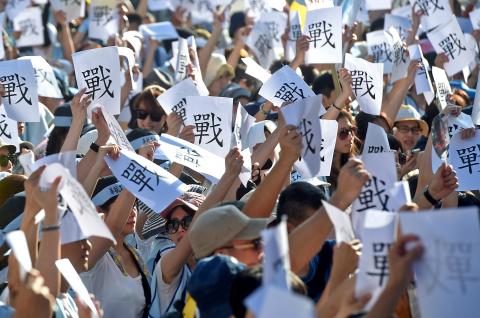
Photo: Chien Jung-fong, Taipei Times
Despite the protest, the new policy is to take effect today as planned, the company said.
Yesterday’s protest began at 4am when three CAL flight attendants arrived in front of the airline’s branch office on Nanjing E Road. They remained in place for 12 hours.
Members of the CAL’s flight attendants union, as well as the China Airlines Maintenance and Engineering Labor Union (CAMELU), also staged a rally in front of the Ministry of Transportation and Communications yesterday afternoon, saying that none of Minister of Transportation and Communications Hochen Tan’s (賀陳旦) stated aims addresses the working conditions of the airline’s basic-level employees, despite the fact that the ministry is one of the airline’s main shareholders.
Union members said the airline’s new labor policy does not take into account commuting times.
They said the company now calculates the work hours of the flight attendants from 90 minutes before flight departure to 30 minutes after flights land, down from the previous policy of counting the work hours from 140 minutes before flights depart to 60 minutes after flights land.
Working hours appear to have been shortened by 80 minutes, but the work they have to do remains unchanged, they said, including carrying out security inspections and verifying sales and payments of duty-free items.
“By adopting the new policy, the company would legitimize not paying the flight attendants for working overtime,” they said.
“The rest time that would have been enjoyed by the flight attendants would be reduced too, which enables the company to further abuse the flight attendants when they arrange the rotation,” the union said in a statement.
The airline held a news conference before the afternoon protest to rebut the union’s claims.
CAL president Chang Yu-hern (張有恆) said the company has held five information sessions since February about the new policies.
Chang said the new polices would not affect the rest periods enjoyed by flight attendants and signing the document as per the requirements of Article 84-1 of the Act is mandated by law.
“The act states that an employee should work eight hours per day, and employees cannot work more than 12 hours if they work overtime. However, the job of a flight attendant cannot meet the standard because flights to the US or Europe take more than 10 hours. Article 84-1 functions as a protection clause for flight attendants, which requires both the labor and the employer to sign an agreement and give it to the labor rights authority for reference,” he said.
Chang said the company would not overwork the flight attendants and would even offer work hours shorter than the requirements stated in the Civil Aviation Act (民用航空法) and the Labor Standards Act.
The firm would not change the accommodation available to flight attendants, whether they work on long-distance or regional flights, he said.
The company plans to continue seeking to resolve the dispute through a just third party, the airline said in a statement.
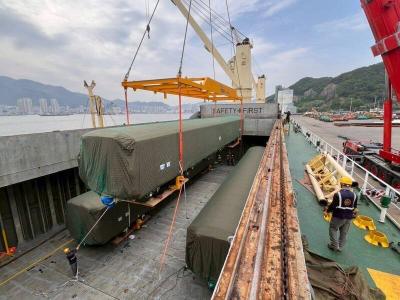
The first of 10 new high-capacity trains purchased from South Korea’s Hyundai Rotem arrived at the Port of Taipei yesterday to meet the demands of an expanding metro network, Taipei Rapid Transit Corp (TRTC) said yesterday. The train completed a three-day, 1,200km voyage from the Port of Masan in South Korea, the company said. Costing NT$590 million (US$18.79 million) each, the new six-carriage trains feature a redesigned interior based on "human-centric" transportation concepts, TRTC said. The design utilizes continuous longitudinal seating to widen the aisles and optimize passenger flow, while also upgrading passenger information displays and driving control systems for a more comfortable
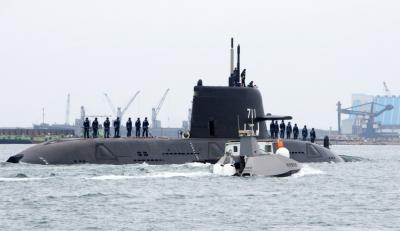
Taiwan's first indigenous defense submarine, the SS-711 Hai Kun (海鯤, or Narwhal), departed for its 13th sea trial at 7am today, marking its seventh submerged test, with delivery to the navy scheduled for July. The outing also marked its first sea deployment since President William Lai (賴清德) boarded the submarine for an inspection on March 19, drawing a crowd of military enthusiasts who gathered to show support. The submarine this morning departed port accompanied by CSBC Corp’s Endeavor Manta (奮進魔鬼魚號) uncrewed surface vessel and a navy M109 assault boat. Amid public interest in key milestones such as torpedo-launching operations and overnight submerged trials,
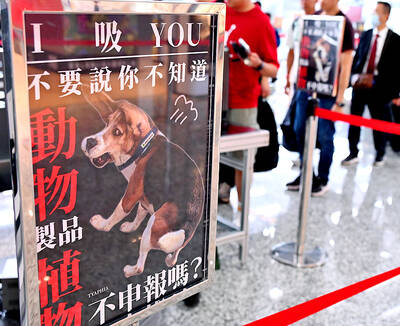
Quarantine awareness posters at Taiwan Taoyuan International Airport have gone viral for their use of wordplay. Issued by the airport branch of the Animal and Plant Health Inspection Agency, the posters feature sniffer dogs making a range of facial expressions, paired with advisory messages built around homophones. “We update the messages for holidays and campaign needs, periodically refreshing materials to attract people’s attention,” quarantine officials said. “The aim is to use the dogs’ appeal to draw focus to quarantine regulations.” A Japanese traveler visiting Taiwan has posted a photo on X of a poster showing a quarantine dog with a

Taiwan’s coffee community has launched a “one-person-one-e-mail” campaign, calling for people to send a protest-e-mail to the World Coffee Championships (WCC) urging it to redesignate Taiwanese competitors as from “Taiwan,” rather than “Chinese Taipei.” The call followed sudden action last week after the WCC changed all references to Taiwanese competitors from “Taiwan” to “Chinese Taipei,” including recent World Latte Art champion Bala (林紹興), who won the World Latte Art Championship in San Diego earlier this month. When Bala received the trophy, he was referred to as representing Taiwan, as well as in the announcement on the WCC’s Web site, until it


 RSS
RSS