


Animal rights advocates yesterday called for the elimination of live pig auctions and the sale of unrefrigerated pork at traditional markets, claiming that the measures would reduce animal cruelty and food contamination.
Environment and Animal Society Taiwan members showed a video of the bidding process, in which pigs, purportedly following a period of starvation to avoid motion sickness during transportation, were confined in dirty, overcrowded cages in the bidding venue, while workers prodded them with sticks and electric-shock devices to move them to a weighing area and sales area.
According to a study by Animal Technology Institute researcher Liao Chen-yuan (廖震元), there is a problem with a herding process if more than 20 percent of pigs have to be prodded into moving, but almost all pigs are given electric shocks in the auction process, group director Chen Yu-min (陳玉敏) said.
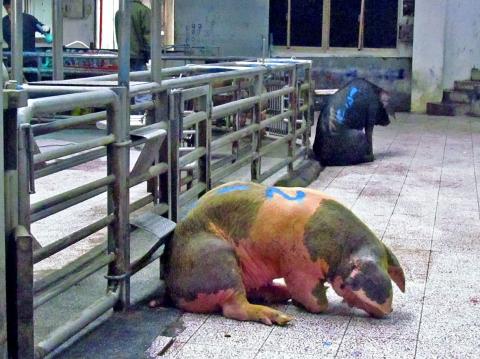
Photo courtesy of the Environment and Animal Society of Taiwan
Pigs are often injured at auction and could be frightened to death or become lame, Chen said, adding that 6,600 to 21,000 pigs are estimated to die during the transportation and auction process each year.
After the animals are slaughtered, the carcasses are transported in trucks without refrigeration systems or in enclosed containers, exposing pork to traffic pollution, while the meat is cut and sold at unsanitary meat shops at traditional markets, the video said.
“Pork is not refrigerated throughout the process, as warm pork is believed to be fresher and more delicious than frozen pork, which is a myth that institutionalizes the practice of animal cruelty and prevents the pork industry from being modernized,” Homemakers Union Consumers Co-op director Hwang Shu-te (黃淑德) said.
“However, unrefrigerated pork is not fresh or clean at all. Unpackaged and unrefrigerated pork sold at traditional markets is exposed to heat for as long as 12 hours, making it a hotbed for germs,” Hwang said.
About 7 million pigs are sold at auctions every year, which accounts for 85 percent of the nation’s pork supply, but auctions cannot guarantee meat quality, because bidders can only judge pigs by appearances, compared with the carcass image analysis system used in modernized slaughterhouses, Hwang said.
The groups said live pig auctions should be replaced with a modernized trading and grading system of livestock, which they said would do away with long-distance transportation and animal cruelty in the auction process, while preserving meat in sanitary conditions.
“I feel saddened by the video, because the [Council of Agriculture] has been promoting humane animal transportation and herding for more than 10 years with training sessions,” Animal Husbandry Division deputy director Wang Chung-shu (王忠恕) said. “However, the reality is that animals are not being properly treated, but we will try to improve animal welfare.”
The council has been trying to phase out live pig auctions and introduce a modernized carcass trading system for more than 30 years with little success because the idea is not well received by retailers and consumers and because it involves the interests of pig farmers and pork suppliers, Wang said, adding that the council would maintain its push to transition the industry by modernizing an auction venue in Kaohsiung.

Considering that most countries issue more than five denominations of banknotes, the central bank has decided to redesign all five denominations, the bank said as it prepares for the first major overhaul of the banknotes in more than 24 years. Central bank Governor Yang Chin-lung (楊金龍) is expected to report to the Legislative Yuan today on the bank’s operations and the redesign’s progress. The bank in a report sent to the legislature ahead of today’s meeting said it had commissioned a survey on the public’s preferences. Survey results showed that NT$100 and NT$1,000 banknotes are the most commonly used, while NT$200 and NT$2,000

The Centers for Disease Control (CDC) yesterday reported the first case of a new COVID-19 subvariant — BA.3.2 — in a 10-year-old Singaporean girl who had a fever upon arrival in Taiwan and tested positive for the disease. The girl left Taiwan on March 20 and the case did not have a direct impact on the local community, it said. The WHO added the BA.3.2 strain to its list of Variants Under Monitoring in December last year, but this was the first imported case of the COVID-19 variant in Taiwan, CDC Deputy Director-General Lin Ming-cheng (林明誠) said. The girl arrived in Taiwan on

South Korea is planning to revise its controversial electronic arrival card, a step Taiwanese officials said prompted them to hold off on planned retaliatory measures, a South Korean media report said yesterday. A Yonhap News Agency report said that the South Korean Ministry of Foreign Affairs is planning to remove the “previous departure place” and “next destination” fields from its e-arrival card system. The plan, reached after interagency consultations, is under review and aims to simplify entry procedures and align the electronic form with the paper version, a South Korean ministry official said. The fields — which appeared only on the electronic form

The Ministry of Foreign Affairs (MOFA) is suspending retaliation measures against South Korea that were set to take effect tomorrow, after Seoul said it is updating its e-arrival system, MOFA said today. The measures were to be a new round of retaliation after Taiwan on March 1 changed South Korea's designation on government-issued alien resident certificates held by South Korean nationals to "South Korea” from the "Republic of Korea," the country’s official name. The move came after months of protests to Seoul over its listing of Taiwan as "China (Taiwan)" in dropdown menus on its new online immigration entry system. MOFA last week


 RSS
RSS