


The Nanzih Presbyterian Church should not proceed with a plan to demolish an historic building, arguably the oldest Christian church in Kaohsiung, local historian Lin Sheng-tung (林勝童) said, calling the decision “deeply regrettable.”
Although most residents believe that the Holy Rosary Cathedral is the oldest Christian church in Kaohsiung, conventional wisdom erroneously confuses the date of the church’s construction with the actual age of the architecture, Lin said.
The Nanzih Presbyterian Church was originally built in Kaohsiung’s Chiaotu District (橋頭) in 1929 and was later reconstructed using the original materials on Nanzih Street, its current address, making it two years older than the Holy Rosary Cathedral, he said.
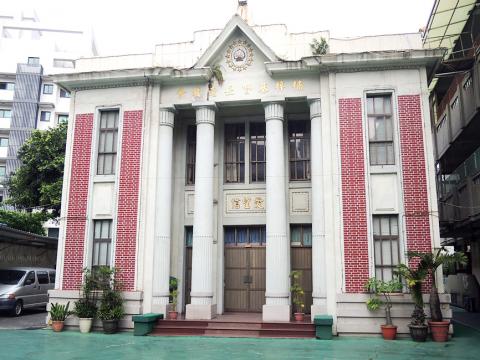
Photo: Tsai Ching-hua, Taipei Times
In the past, Kaohsiung Christians were ostracized and slandered because their doctrines and practices — such as refusing to participate in ancestral worship — contradicted traditional Taiwanese social mores and rituals, and local residents sometimes hurled feces at the church, he said.
However, Kaohisung’s Presbyterians thrived in spite of their hardship and in 1929 they built the largest Christian church in the city.
“The Nanzih Presbyterian Church’s architecture is baroque in style, with both modern and classical elements as well as some Egyptian-inspired details, with an overall effect that is austere, solemn and of aesthetic value to Kaohsiung,” National Cheng Kung University architecture professor Fu Chao-ching (傅朝卿) said.
Lin said that the church’s most distinctive architectural feature is its burning bush emblem, which in Presbyterian symbolism should have a circle of 12 stars, symbolizing the 12 tribes of Israel, but instead it has 16 stars, which he speculated to have been a stone mason’s error or an intentional design whose symbolism has been lost to history.
If the demolition of the church proceeds as planned, the burning bush emblem would be the only part of the original structure that would be preserved.
The undulating gable of the priests’ dormitory, which is shaped like a crown, is also a unique detail that is not found in any other Christian church in Taiwan, Lin said.
When asked for comment, the Nanzih Presbyterian Church said that the decision to demolish building was not one that its congregation made lightly, but that the decision was taken due to the building’s aged facilities and because elderly worshipers had trouble climbing its steep staircases.
The Kaohsiung Bureau of Cultural Affairs said that the church is listed as a site with “potential cultural value” and it had sent officials to consult with the congregation to communicate the bureau’s wish that architects and historians be appointed to help select and preserve portions of the original structure.

Considering that most countries issue more than five denominations of banknotes, the central bank has decided to redesign all five denominations, the bank said as it prepares for the first major overhaul of the banknotes in more than 24 years. Central bank Governor Yang Chin-lung (楊金龍) is expected to report to the Legislative Yuan today on the bank’s operations and the redesign’s progress. The bank in a report sent to the legislature ahead of today’s meeting said it had commissioned a survey on the public’s preferences. Survey results showed that NT$100 and NT$1,000 banknotes are the most commonly used, while NT$200 and NT$2,000

The Centers for Disease Control (CDC) yesterday reported the first case of a new COVID-19 subvariant — BA.3.2 — in a 10-year-old Singaporean girl who had a fever upon arrival in Taiwan and tested positive for the disease. The girl left Taiwan on March 20 and the case did not have a direct impact on the local community, it said. The WHO added the BA.3.2 strain to its list of Variants Under Monitoring in December last year, but this was the first imported case of the COVID-19 variant in Taiwan, CDC Deputy Director-General Lin Ming-cheng (林明誠) said. The girl arrived in Taiwan on

South Korea is planning to revise its controversial electronic arrival card, a step Taiwanese officials said prompted them to hold off on planned retaliatory measures, a South Korean media report said yesterday. A Yonhap News Agency report said that the South Korean Ministry of Foreign Affairs is planning to remove the “previous departure place” and “next destination” fields from its e-arrival card system. The plan, reached after interagency consultations, is under review and aims to simplify entry procedures and align the electronic form with the paper version, a South Korean ministry official said. The fields — which appeared only on the electronic form

The Ministry of Foreign Affairs (MOFA) is suspending retaliation measures against South Korea that were set to take effect tomorrow, after Seoul said it is updating its e-arrival system, MOFA said today. The measures were to be a new round of retaliation after Taiwan on March 1 changed South Korea's designation on government-issued alien resident certificates held by South Korean nationals to "South Korea” from the "Republic of Korea," the country’s official name. The move came after months of protests to Seoul over its listing of Taiwan as "China (Taiwan)" in dropdown menus on its new online immigration entry system. MOFA last week


 RSS
RSS