


Traffic along the western terminus of Zhongxiao W Road is scheduled to resume tomorrow morning thanks to the unexpectedly quick demolition of the overpass to Zhongxiao Bridge (忠孝橋), Taipei City Government officials said yesterday.
The 750m overpass was located near Taipei’s North Gate (北門) and stretched from Zhongxiao W Road near Taipei Railway Station to Zhongxiao Bridge, connecting downtown Taipei to New Taipei City’s Sanchong District (三重).
Taipei Deputy Mayor Charles Lin (林欽榮) was joined by several city department commissioners for a ceremony to mark the removal of the protective barrier which had been built around the North Gate to protect it during the demolition process, which began on Sunday to take advantage of the city’s lower commuter traffic during the Lunar New Year holiday.
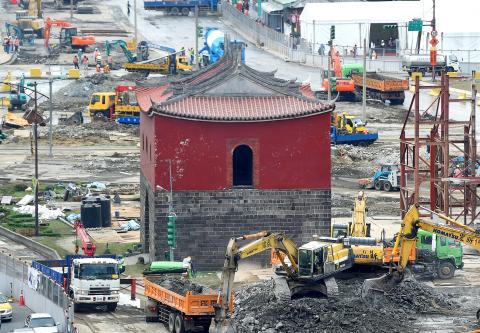
Photo: Chien Jung-fong, Taipei Times
Lin said the demolition project was 90 percent completed and was well ahead of schedule, adding that traffic would fully resume by 8am tomorrow.
Following the demolition of the overpass, cars that used to cross the bridge are to pass through three traffic lights on Zhongxiao W Road, adding three to five minutes to their commute, Lin said, adding that construction work to expand sidewalks and build a plaza around the North Gate is to continue until the end of November.
The construction project would help the area to once again serve as a gateway to the city, particularly after the nearby terminus station of the Taoyuan Airport MRT line opens later this year, he said.
The gate, designated as a national historic building, was built in 1882 and is the only one of the city’s five gates that has retained its original look.
Taipei Department of Transportation Commissioner Chung Hui-yu (鍾慧諭) said that people returning to work next week would likely take a few days to get used to the overpass’ demolition, urging commuters to switch to public transportation.
Although there would now be one less lane along Zhongxiao W Road’s western terminus, the road itself would not be closed and monitoring equipment on Zhongxiao, Taipei and Zhongxing (中興橋) bridges would be used to help police officers direct traffic, she said, adding that the frequency of city buses to MRT stations would be increased to help more residents ride the MRT lines connecting Taipei and New Taipei City.
“Traffic can be controlled as long as 20 percent of people change their commute habits,” she said.

LOUD AND PROUD Taiwan might have taken a drubbing against Australia and Japan, but you might not know it from the enthusiasm and numbers of the fans Taiwan might not be expected to win the World Baseball Classic (WBC) but their fans are making their presence felt in Tokyo, with tens of thousands decked out in the team’s blue, blowing horns and singing songs. Taiwanese fans have packed out the Tokyo Dome for all three of their games so far and even threatened to drown out home team supporters when their team played Japan on Friday. They blew trumpets, chanted for their favorite players and had their own cheerleading squad who dance on a stage during the game. The team struggled to match that exuberance on the field, with
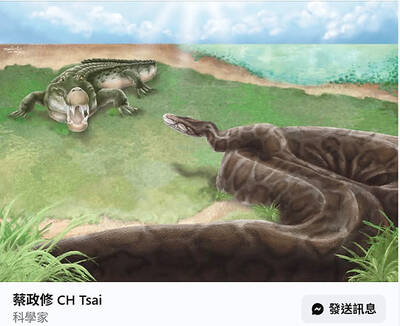
Taiwanese paleontologists have discovered fossil evidence that pythons up to 4m long inhabited Taiwan during the Pleistocene epoch, reporting their findings in the international scientific journal Historical Biology. National Taiwan University (NTU) Institute of Ecology and Evolutionary Biology associate professor Tsai Cheng-hsiu (蔡政修) led the team that discovered the largest snake fossil ever found in Taiwan. The single trunk vertebra was discovered in Tainan at the Chiting Formation, dated to between 400,000 and 800,000 years ago in the Middle Pleistocene, the paper said. The area also produced Taiwan’s first avian fossil, as well as crocodile, mammoth, saber-toothed cat and rhinoceros fossils, it said. Discoveries

Taiwanese paleontologists have discovered fossil evidence that pythons up to 4m long inhabited Taiwan during the Pleistocene epoch, reporting their findings in the international scientific journal Historical Biology. National Taiwan University (NTU) Institute of Ecology and Evolutionary Biology associate professor Tsai Cheng-hsiu (蔡政修) led the team that discovered the largest snake fossil ever found in Taiwan. A single trunk vertebra was discovered in Tainan at the Chiting Formation, dated to between 800,000 to 400,000 years ago in the Middle Pleistocene, the paper said. The area also produced Taiwan’s first avian fossil, as well as crocodile, mammoth, sabre-toothed cat and rhinoceros fossils, it said. Discoveries

Whether Japan would help defend Taiwan in case of a cross-strait conflict would depend on the US and the extent to which Japan would be allowed to act under the US-Japan Security Treaty, former Japanese minister of defense Satoshi Morimoto said. As China has not given up on the idea of invading Taiwan by force, to what extent Japan could support US military action would hinge on Washington’s intention and its negotiation with Tokyo, Morimoto said in an interview with the Liberty Times (sister paper of the Taipei Times) yesterday. There has to be sufficient mutual recognition of how Japan could provide


 RSS
RSS